 SUNSET:

 0
0What does “true color” mean in a deep-space photograph? How would a galaxy or nebula actually look to the naked eye from close up?
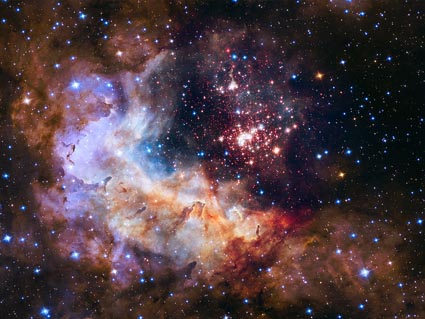
NASA / ESA / Hubble Heritage Team / A. Nota / Westerlund 2 Science Team
“True color” is how an object would look if you were nearby or were viewing it in a telescope under a dark sky, and if its surface brightness (the amount of light per unit area) were boosted enough for your normal color vision to work. To see color, the human eye requires a scene with fairly high surface brightness — and most deep-sky objects don’t qualify. This has nothing to do with how closely you could view them. An object’s surface brightness doesn’t change with viewing distance; all that changes is its apparent size.
For instance, to see how a typical spiral galaxy would look close up, gaze at the Milky Way on a dark night. To the eye, the Milky Way looks pale gray. A true-color photo shows that the Milky Way’s spiral arms, which form most of the parts we see, are pale blue-white, and that the galaxy’s central bulge in the Sagittarius region is pale yellowish. This is what you would see if your color vision worked in dim light.
— Alan MacRobert
About Alan MacRobert
Alan M. MacRobert became an avid Sky & Telescope subscriber in 1966 at age 14, joined the editorial staff in 1982, and is now a senior contributing editor, semi-retired. He played a role in practically every part of the magazine and the company's other products for more than a generation, both on the amateur-observing side and the science-reporting side. In 1994 a book collection of his observing how-tos and telescopic sky tours was published as Star Hopping for Backyard Astronomers. He has produced This Week's Sky at a Glance online every week since 1989.




Comments
You must be logged in to post a comment.