 SUNSET:

Sky at a Glance | February 1st, 2008
Orion and Sirius shine their highest in the south during evening. High above them Mars still glares brightly, but it's retreating into the interplanetary distance. Low in the dawn, bright Venus and Jupiter remain strikingly close together.

Sky at a Glance | January 25th, 2008
The evening sky turns dark and moonless again, so check in on Comet Holmes high overhead after dark. The comet is spreading out wider every week. And try some deep-sky hunting with binoculars while you're at it. Low in the dawn, watch Venus and Jupiter closing in on each other every day.

Sky at a Glance | January 4th, 2008
Mars is getting higher in the east these evenings even as it shrinks into the distance. Mercury is just emerging from the glow of sunset, and Venus shines at dawn.

Sky at a Glance | January 18th, 2008
Mercury is putting on a fine evening appearance, Mars is still close enough to show detail in a telescope, and Comet Holmes is crossing Algol in the moonlight. Meanwhile, early risers can watch Jupiter closing in on Venus at dawn.
Sky at a Glance | January 11th, 2008
Mercury emerges from the glow of sunset, Jupiter emerges from the glow of sunrise, Venus blazes, Mars fades, and Algol dips.
January's Splash of Meteors
The annual Quadrantid meteor shower is one of the year's best — but to catch them you'll need to brave the cold on the night of January 3–4.

Sky at a Glance | December 28th, 2007
Mars outshines everything else high in the east these evenings, stealing the limelight from the bright winter constellations around it. Meanwhile, Comet Holmes just keeps growing — and Comet Tuttle is nearest and brightest this week.
A Gamma-Ray Burst Out of Nowhere
Astronomers are mystified by a gamma-ray burst without a host galaxy.

Sky at a Glance | December 14th, 2007
This week Mars is at its closest to Earth; get out the telescope! And Comet Holmes just keeps growing, though it's dimmed by the increasing moonlight.
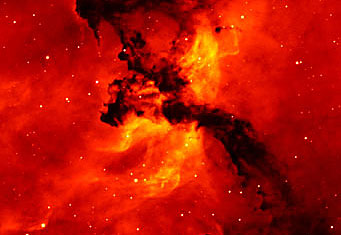
200 Million Objects Shining in Hydrogen
A new sky survey is seeing the universe in a new way.
Dust in a Hot Jupiter's Atmosphere
Precise measures by Hubble indicate that a roasting "hot Jupiter" close to its star has an atmosphere thick with dust.
Observe Mars Tonight!
Mars now appears bigger through a telescope than it will again until 2016.
Sky at a Glance | November 30th, 2007
Comet Holmes, dimming but growing ever larger, is one again easy to spot in a moonless evening sky. The Moon itself has gone off to consort with Regulus, Saturn, Venus, and Spica in the dawn.
A Revival of Comet Holmes
It's still there! With the Moon now gone from the early-eyening sky, Comet Holmes is the easiest-to-spot "deep sky object" after the Pleiades.
Sky at a Glance | November 21st, 2007
Comet Holmes, fading as it enlarges, is moving away from the star Mirfak this week. And the bright Moon passes among bright stars and a planet.
Sky at a Glance | November 16th, 2007
Comet Holmes is passing very close by Mirfak this week — and fading as it enlarges. Mars and Orion rise together, Vega and Capella balance out, and Venus guides the way to Mercury at dawn.
Sky at a Glance | November 9th, 2007
Comet Holmes remains big, bright, and puffy high in the evening sky — but moonlight will soon be back. Before dawn, dazzling Venus marks the route to other sky sights in the east.
Sky at a Glance | November 2nd, 2007
Comet Holmes has turned big and puffy — and the Moon is now gone from the evening, leaving a dark sky behind. Early risers will find that the Moon is off pairing up with Regulus, Saturn, Venus, and Mercury in the dawn.
Comet Holmes Beckons Skygazers Worldwide
As of January 4th the comet, ever-enlarging and thinning, is still in naked-eye view — but only if you have a fairly dark-sky site. Use binoculars to follow its next moves.
Sky at a Glance | October 26th, 2007
Glance up at Perseus during evening, and they's all you may need to do to spot Comet Holmes in outburst, tiny but bright enough to change the constellation's familiar pattern. Late in the evening, Mars rises to blaze in the east.
