 SUNSET:

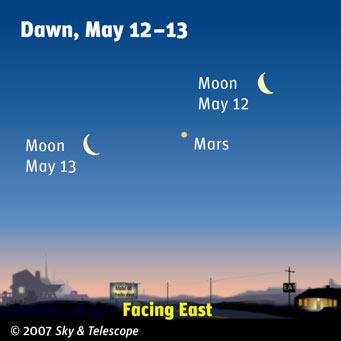
Red Planet Rising
Now that mornings are getting warmer, it's far less daunting to get out of your warm bed and do some early-morning stargazing. But if you need some added motivation to set that alarm, look no further than Mars.
In Caroline Herschel's Footsteps
This is the only known portrait of Caroline Herschel as a young woman.Museum of the History of Science, OxfordCaroline Herschel (1750–1848) was the first famous female astronomer. Though celebrated in her day for discovering eight comets, she started as a deep-sky observer. In fact, it was Caroline's initial deep-sky discoveries…
Sky at a Glance | May 4th, 2007
Watch Venus pass a star cluster in the feet of Gemini. Check in on Saturn even higher after dark. And if it's May, do you know where the Big Dipper is?
Your Audio Sky Tour: May 2007
Why is the Big Dipper, now seen high overhead after sunset, considered the "Swiss army knife" of the sky? You'll find out when you listen to this month's audio tour of the evening sky. Host: S&T's Kelly Beatty. (6MB MP3 download: running time: 6m22s)
Your Audio Sky Tour: April 2007
Some celestial carnivores are on the prowl in the eastern sky after sunset. Learn how to find them — and about a worldwide celebration called Astronomy Day — in this month's audio tour of the evening sky. Host: S&T's Kelly Beatty. (5MB MP3 download: running time: 5m40s)
Tour March 2007's Evening Sky
Winter's majectic constellations make a last stand before giving way to spring. Hear all about them — and about the lunar eclipse on March 3rd — in this month's audio tour of the evening sky. Host: S&T's Kelly Beatty. (5MB MP3 download: running time: 5m25s)
Tour February 2007's Evening Sky
After being absent from evening view for awhile, three planets can now be seen soon after sunset. Download this MP3 file to your iPod or other handheld device to learn how to find them and other celestial delights in the midwinter sky. Hosted by Kelly Beatty, editor of Night Sky…
Tour January 2007's Evening Sky
Ring in the New Year with a little stargazing! Download this MP3 file to your iPod or other handheld device to learn how to view the stars of Orion, the Hyades and Pleiades star clusters, and more! (5.6 MB file; hosted by Kelly Beatty, editor of Night Sky magazine.)
Sky at a Glance | April 27th, 2007
Watch Venus pass a not-quite-first-magnitude star in the western evening sky this week. Meanwhile, Saturn shines in fine view much higher during evening, and Jupiter is well placed before dawn.

Vanishing Acts
One of the most dramatic sights in the nighttime sky occurs when the Moon briefly hides a planet or star — an event called an occultation. On April 25th and 26th, many observers in northwestern North America will be treated to an unusual occultation double-header as the Moon conceals Saturn on one morning and Regulus the next. Both events should be visible without optical aid if the sky conditions are good.
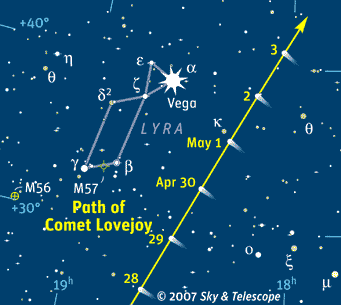
Spring's Comet Lovejoy
During the next few weeks, early risers in the Northern Hemisphere can follow recently-discovered Comet Lovejoy as it makes its way northward past some familiar telescopic sights.
The 2007 Lyrid Meteor Shower
This year North American observers can catch the rising and falling phases of the Lyrid meteor shower in the predawn hours of April 22nd and 23rd.
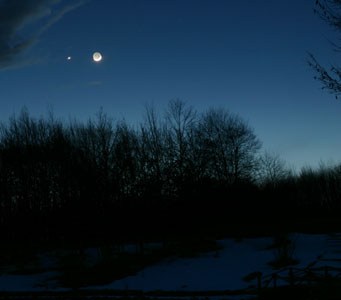
Moon Meets Venus
On the evening of April 19th, the thin crescent Moon passes near Venus, the Evening Star.

Astronomy and Stargazing Projects
How to Make a Star Wheel the Simple Way
Would you like to be able to navigate your way around the night sky with confidence? Using this simple, easy-to-make Star Wheel, you can "dial the sky" for any time or date.

Astronomy and Stargazing Projects
Make a Star Clock!
A quick download, some scissors, and a paper fastener are all it takes to use the stars to tell time.

Astronomy and Stargazing Projects
How to Make a Sundial the Simple Way
Sundials are amazingly simple yet effective devices. They range from sticks planted in the ground to precision-machined marvels costing thousands of dollars. The design shown here can be constructed in minutes from materials lying around your house, but it's surprisingly accurate.
Seven Sisters Host Evening Star
Venus, the brightest planet, and the Pleiades, the sky's brightest star cluster, form a spectacular grouping in the evening sky from April 10-12.
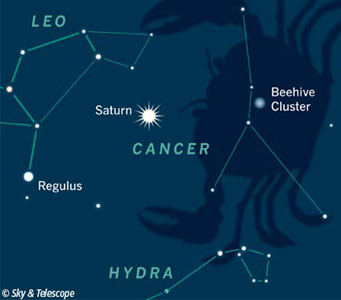
Listen to What the April Sky Offers
With April upon us, the evenings are finally getting warm enough for most of us to comfortably observe the heavens without fear of frostbite. And when you do go out, be sure to download our monthly podcast before you venture outdoors.

A Big Chunk of Rock Passes Near Earth
A mile-wide chunk of rock is now whizzing past Earth. At its closest approach, around 11 p.m. Pacific Daylight Time on March 30th, it will be 10th magnitude and just 2 million miles over the heads of observers in Southern California.

The Moon Meets the Pleiades
The Moon will be closing in on Messier 45 tonight; observers along the West Coast may see the Moon pass in front of some of the star cluster.
