 SUNSET:

The Ringed Planet Returns
After several months with no bright planet well placed in the evening sky, Saturn returns to easy visibility in January, making a striking formation together with the Sickle of Leo. And on Saturday, North Americans can witness a close conjunction of the Moon and Regulus, Leo's brightest star.
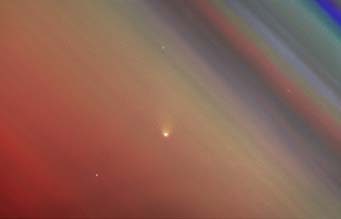
January's Surprise Comet
A major comet, known as Comet McNaught or C/2006 P1, is right now making its way through the inner solar system. It’s already as bright as the brightest stars, but it is also sticking close to the glare of the Sun.
Tour January's Sky by Ear
January nights may be cold, but they boast a spectacular array of constellations. Our podcast will guide you through this month's sky with no need to fuss with paper or red flashlights.

Sky Highlights of 2007
As in any year, the starry heavens unroll with the seasons, and our solar system provides ever-changing sights much closer to home. Here's a taste of special events to watch for in 2007.
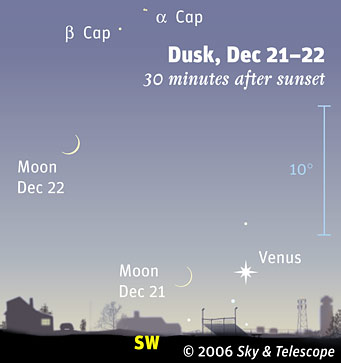
Celestial Omens
Go out at dusk to see Venus and the crescent Moon pair up. It is always a sight to behold when the brightest objects in the evening sky get together.
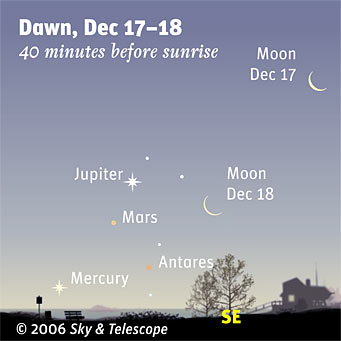
A Reason to Rise
Most of us consider weekends a time for sleeping in, but skywatchers who get up before the Sun are presently in for a treat. A trio of planets will dance with the bright star Antares, and on the mornings of the 17th and 18th there will be a guest appearance by the waning crescent Moon. The performance is free, but clear skies and an unobstructed southeastern horizon are required.
Aurora Watch!
Talk about a red-letter night for astronomy. Not only are Geminid meteors still raining down from the skies, there is a major aurora alert in effect for Thursday and Friday. No telescope needed. Just get outside and look up.
Best Meteor Shower of 2006
With only minor interference from the Moon, the Geminids should put on a great display late Wednesday night and Thursday morning. What's more, a major solar flare just erupted, providing a strong chance for a tremendous northern lights show on Thursday or Friday.
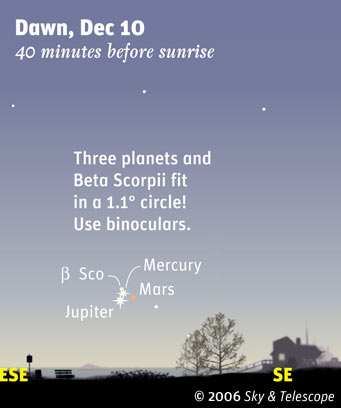
Triple Conjunction
Don't miss the conjunction of three bright planets, Mercury, Mars, and Jupiter in the morning twilight. Early risers will be treated to a planetary triangle at dawn, the best observable triple-conjunction of the bright planets until 2029.
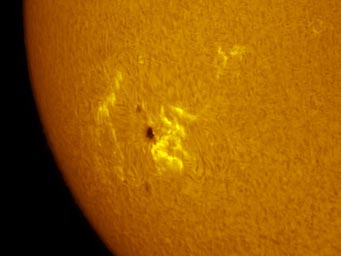
Sunspot Watch!
Grab your solar telescopes and Mylar filters — a major sunspot group has just come around the limb of the Sun and into view. What's more, on December 5th this spot produced a major solar flare. If it erupts again soon, we could be in for dazzling auroral light shows.
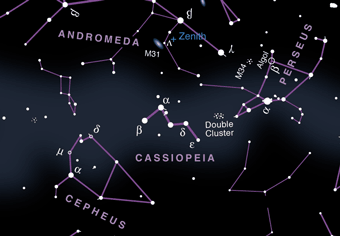
Take a Sky Tour This Month
If you're willing to brave the cold, December is a great month for stargazing. Short days also mean long nights, and some great, albeit frigid, observing conditions.
Tour October's Evening Skies in 2006
Why is this month's full Moon called the "Harvest Moon"? And what two star patterns form a sandwich with Polaris, the North Star? Find out when you download this MP3 file to your iPod or other handheld device. (5.1MB file; hosted by Kelly Beatty, editor of Night Sky magazine.)
Tour September's Evening Sky in 2006
This is a great time of year to do a little stargazing. Just download this MP3 file to your iPod or other handheld device, and you'll get a guided tour of the evening sky. (4.9MB file; hosted by Kelly Beatty, editor of Night Sky magazine.)
Tour August's Evening Sky in 2006
Download this MP3 file to your iPod or other handheld device, and you'll be guided to Jupiter, the constellation Scorpius, the Milky Way, and more! You'll also get tips on when and how to watch the Perseid meteor shower. (5.5MB file; hosted by Kelly Beatty, editor of Night Sky magazine.)
Tour July's Evening Sky In 2006
Track down dazzling Jupiter and the trio of bright stars that comprise the Summer Triangle. (4MB MP3 file; hosted by Kelly Beatty, editor of Night Sky magazine.)
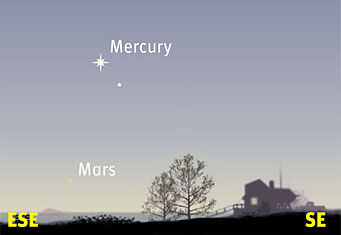
Mercury and Mars at Dawn
Rise and shine! Fleeting Mercury will be highest above the southeastern horizon Sunday morning — your best chance to see it until February. It joins Mars in a predawn appearance.
Modest Leonids
Although there wasn't a storm, the Leonid meteor shower of 2006 did produce a worthwhile display for some.
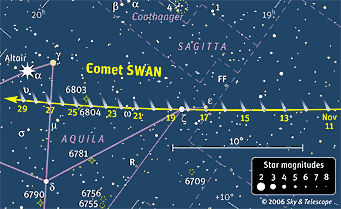
Comet SWAN Still Glows After Dusk
Comet SWAN remains a nice but fading target for telescopes in early evening. Follow it using our chart.

A Leonid Meteor Shower Outburst?
Late Saturday night, November 18, 2006, the Leonid meteor shower could produce a spectacular sky show over New York, New England, and eastern Canada.

Mercury's Day in the Sun
Usually you expect to see planets at night. But in broad daylight on Wednesday, November 8th, the planet Mercury will cross the face of the Sun.
