 SUNSET:


The Hunter's Shooting-Star Show
This past weekend marked the peak of the annual Orionid meteor shower. While this shower doesn't have the famed reputation of the Perseids, Geminids, or Leonids, the reports coming into Sky suggest that the meteors didn't disappoint.

Crescent Moon in Good Company
A 2½-day-old Moon lines up with two bright planets and a first-magnitude star — with an occultation thrown in for some well-situated observers.

The Moon Crosses the Pleiades Tonight
Late Monday evening, small-telescope owners throughout North America can see the bright Moon pass directly in front of the Pleiades star cluster.

A Crescent Moon and Friends
The crescent Moon all by itself is a gorgeous sight when it hangs low above the horizon amid twilight. The scene improves when it's paired with a second bright object. During the next several evenings the Moon will move southward and upward as it waxes toward first-quarter phase on September 30th.

Mercury-Moon Meeting
Shortly after sunset on Sunday the 24th, you may be able to catch the ever-elusive Mercury in an unusual lineup with Spica and a thin crescent Moon. This one will be a challenge.
An Atlantic Solar Eclipse
On Friday, September 22nd, the Sun will rise as a shining ring of light for lucky skywatchers in South America and Africa.

An Early-Morning Close Encounter
Here's a fun challenge for those who wish to get up with the Sun. About 40 minutes or so before sunrise, head outside and look to the east. As dawn's light grows bright, the hairline crescent Moon has a close conjunction with Venus just above the eastern horizon.

Your Lunar Eclipse Pictures
On the night of September 7 – 8, a partial lunar eclipse graced the skies above Europe, Africa, Asia, and Australia. Although the Moon barely entered Earth's umbra (full shadow), plenty of astrophotographers captured the tiny nibble taken out of the edge of Luna.

Chi Cygni's Record-Breaking Maximum
The red, Mira-type variable star Chi Cygni has had a very unusual maximum. It's one of the brightest such variables to begin with (typically peaking at about magnitude 5.2), but in late July and early August 2006, it peaked at about magnitude 3.8.
Earth Bites Moon
On the night of September 7-8, a partial lunar eclipse will be visible in Europe, Africa, Asia, and Australia. On the same night, observers on the west coast of the Americas will see a double shadow transit on Jupiter. Head outdoors and see it for yourself.
Squeezing Out the Last Drops of Summer
The first-quarter Moon shines near Antares in Scorpius tonight. And as the weekend progresses, you can see the growing Moon slide over to the Teapot pattern of Sagittarius. Be sure to capture these constellations before they are gone for the year.

Find the "Dwarf Planets"
The smoke has cleared. Pluto, Ceres, and 2003 UB313 are officially "dwarf planets." And they are all visible to amateurs tonight — if you have the right equipment. Grab your gear and try some "planet" hunting tonight!

Catch a Naked-eye Sunspot
There's a nice big naked-eye spot on the Sun today, even though we're near the minimum of the 11-year sunspot activity cycle. Of course, when we're talking about the Sun, "naked-eye" means looking through a safe solar filter.
The Moon Near the Pleiades
The Moon will be closing in on Messier 45 tomorrow morning; observers in Hawaii will see the Moon pass in front of the star cluster.
Perseids Perform
The reports are in! Despite a waning gibbous Moon on the evening of August 12th, the Perseid meteor shower did not disappoint. Between twilight and moonrise, observers from dark country skies reported up to 20 “shooting stars” an hour — a meteor every three minutes — some fast and blip-like, some slow and spectacular.

How to Catch an Iridium Flare
These communications satellites can briefly outshine Venus as they spray the ground with reflected sunlight.
Chi Cygni: A Wide-Ranging Variable
This red long-period variable is sometimes visible to the unaided eye — and sometimes invisible even in a 4-inch telescope.

Astronomy and Stargazing Projects
111 Deep Sky Wonders for Light-Polluted Skies
Bright skies aren't empty skies. See for yourself how many treasures lie hidden in the glow of a city sky.

How to Safely See a Partial Solar Eclipse
Looking at the Sun is harmful to your eyes at any time, partial solar eclipse or no. Fortunately, there are many easy ways to watch the show safely.
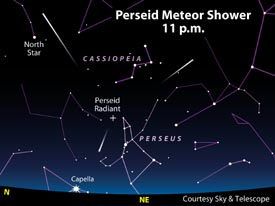
Moonlight Perseids
Although the peak has past, the Perseid meteor shower, an annual celestial event beloved by millions of skywatchers around the world, still has a few stragglers left to see. Try looking for some tonight.
