 SUNSET:


Watch a Bright Star Wink Off and On
It's extremely unusual for a star that's visible to the unaided eye to be momentarily blotted out by a chunk of rock flying through outer space. But that's what's going to happen early on the morning of Thursday, April 17th, over the most densely populated section of the United States.
Pleiades Occultation Observed
The occultation of the Pleiades by the crescent Moon on April 8th was plagued by haze in Boston, but magnificent nonetheless.

Tour April's Sky — By Ear and Eye!
What better way to enjoy April's evening sky sights than to let Sky & Telescope take you on a guided tour?
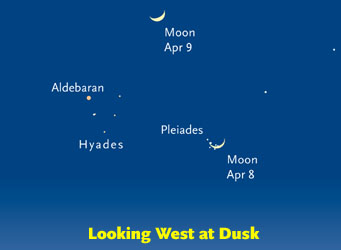
A Perfect Pairing
If your evening sky is clear on Tuesday, April 8th, head out soon after sunset to catch a beautiful celestial scene.
Help Us Help You
Did you know that Venus is still visible in the morning sky in April 2008?

Uranus and Neptune in 2008
Uranus and Neptune are easy to find with the aid of the charts in this article.
Uranus and Neptune in 2009
Uranus and Neptune are easy to find with the aid of the charts in this article.
Fun in the Sun Continues
Don't miss the evolving sunspots now crossing the solar disk.
Go See the Sun
If you have a solar filter or another way to safely view the Sun, be sure to check out the latest group of sunspots marching across its disk.
"First Light" for Twin-Eyed Telescope
The Large Binocular Telescope (LBT) in Arizona achieved a milestone when both of the telescope's 8.4-meter mirrors pointed toward the spiral galaxy NGC 2770. Last week the LBT folks released the images.
A Cloudy Comet and a Wispy Nebula
Comet Holmes is greatly dimmed from its glory days last fall, but this week it's passing the photogenic California Nebula.
Your March Audio Guide to the Heavens
Download this podcast to your MP3 player, and you'll be able to navigate the March evening sky like a seasoned stargazer. Find Mars, Saturn, Orion, the Twins of Gemini, and more! Host: S&T's Kelly Beatty. (6MB MP3 download: running time: 6m10s)
Moon Covers Venus on Wednesday
A special event occurs on March 5th — in broad daylight. If you're in the central or western US, you can use a wide-field scope to try to see Venus disappearing behind the thin waning Moon.
February's Lunar Eclipse: Ideal Indeed!
Your images from Wednesday night's total eclipse of the Moon are pouring in.
See the Doomed Spy Satellite!
Until it reenters the atmosphere — whole or in pieces — in the days ahead, you can see the decaying satellite USA 193 with your own eyes. Here's how to find it.

Extreme Eclipse-Chasing
To enjoy the annular eclipse of the Sun on February 7, 2008, you either had to be an Antarctic penguin or a very dedicated and well-prepared traveler.
February's Audio Guide to the Heavens
After downloading this easy-to-follow sky tour, you'll have a front-row seat for Venus and Jupiter dancing in the dawn, Mars riding high among winter's evening stars, and a total lunar eclipse on February 20th.
A Speedy Asteroid — Captured!
It was faint, and it zipped across the sky at 3° per hour— but 2007 TU24 could be spotted with a good scope if you knew where and when to look.
Jupiter Stalks Venus in the Morning Sky
The sky's two brightest objects (aside from the Sun and Moon) are rapidly approaching each other in the pre-dawn sky.
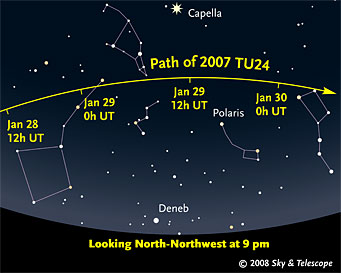
Here Comes Asteroid 2007 TU24
An 800-foot-wide chunk of rock will pass less than a half million miles from Earth on the night of January 28th.
