 SUNSET:


Let's Find Pluto!
At opposition this week and as bright as it will be for the next 190 years, it's time to find your way to Pluto, a frigid enigma at the edge of night.

Exploring the Minispiral at the Milky Way’s Center
The region around Sgr A*, the 4-million-solar-mass black hole at the heart of our galaxy, is a complex and dynamic place. New Atacama Large Millimeter/submillimeter Array (ALMA) observations of the Milky Way’s center now reveal more about this harsh, inhospitable environment.

Third Try at a National Space Council
What is the National Space Council and what will it do? A look back through history provides some possible answers.
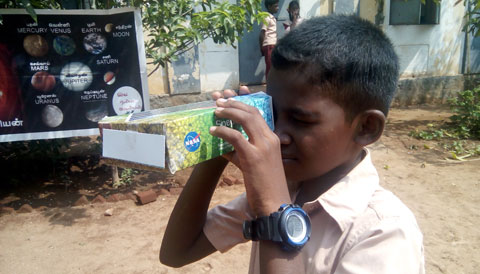
How to Build on the Solar Eclipse Experience
Eclipse-related outreach activities will abound this August, but how do we best capitalize on this rare celestial event after it happens? Astronomers Without Borders has developed a Sun-focused curriculum and is looking for volunteers to help teachers implement it.

Supermassive Black Holes Observed in Close Dance
Astronomers monitoring a tight pair of supermassive black holes have observed their orbital motion.

"Gecko Gripper" Tech to Clean Up Space Junk
Researchers are figuring out how to use a nature-inspired "gecko gripper" technology to solve the mounting problem of space debris.
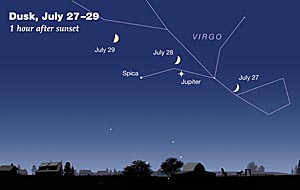
Tour July's Sky: Find Jupiter, Saturn & More
Jupiter and Saturn are easy to spot in the evening sky, as you'll discover in July's fun and informative astronomy podcast.

NASA Eyes "Ice Giant" Missions in the 2030s
A recent NASA study outlines possible dedicated missions to the "ice giant" planets Uranus and Neptune that might leave Earth as early as 2030.

Product Videos & Demonstrations
NEAF 2017 Astronomy Equipment Videos
Dennis di Cicco interviews several vendors about their newest products — watch and find out full details on new lines of astronomy equipment.

NASA Closes Out Its Asteroid Redirect Mission
Following the release of the 2018 budget, the space agency has ordered an “orderly closeout” for the Asteroid Redirect program.

A Partly Cloudy Exoplanet
Direct imaging of exoplanets was once only possible for the brightest of planets orbiting the dimmest of stars — but new observations of the Jupiter-like exoplanet 51 Eridani b provide tantalizing clues about its atmosphere.

New Wrinkles in the Search for “Planet X”
Are astronomers being misled about a possible ninth planet by the quirky alignment of orbits that they’re finding in the distant Kuiper Belt?

Eclipse 2017: T–2 Months and Counting
With two months to go until the total solar eclipse on August 21, it's time to get planning — if you haven't already!

Citizens Spot Cold World 100 Light-years Away
Citizen scientists have discovered a brown dwarf 100 light-years from the Sun, and more finds are sure to come from the Backyard Worlds citizen-science project.

Does the Milky Way Live in a Void?
A sparse galactic neighborhood could clear up certain problems with our understanding of the universe.

Kepler Team Releases Final Exoplanet Catalog
The most comprehensive and detailed exoplanet catalog released yet marks the end of an era for Kepler, the planet-hunting telescope.

China Launches Its First X-ray Observatory
China's Hard X-ray Modulation Telescope (HXMT) headed to orbit this past weekend.

Brown Dwarfs vs. Stars: What Makes a Star a Star?
At what point does a clump of gas ignite, turning into a star? Astronomers now have an answer to what makes a star — and what makes a brown dwarf.

Hello, Saturn! We're Glad You're Back
Saturn, considered by many the most beautiful sight in the sky, comes to opposition this week with its rings in full tilt. You won't want to miss it.

Ring Found Around a Galaxy’s “Hidden” Black Hole
A team of astronomers has taken a close look at a nearby galaxy — and discovered an unusual structure that sheds light on supermassive black holes’ relationships with their host galaxies.
