 SUNSET:


Brown Dwarfs Mimic Their Big Stellar Siblings
Two recent studies suggest that brown dwarfs, or so-called “failed stars,” are nevertheless more like stars than planets.
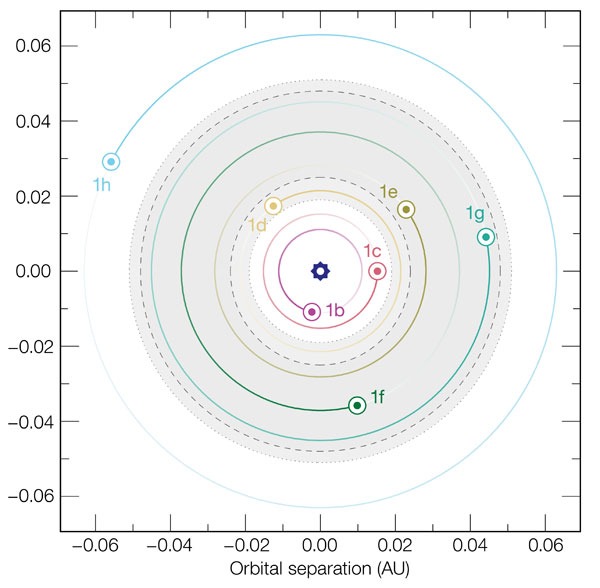
Seventh TRAPPIST-1 Planet Confirmed
Astronomers have confirmed the existence of the seventh planet around the ultracool dwarf star TRAPPIST-1.

How Hard Did It Rain on Ancient Mars?
Mars was once far wetter than it is now — but just how much rain fell, and when?

Finally! The Galaxy’s Most Mysterious Star Is Dimming
Tabby's star, otherwise known as the most mysterious star in the galaxy, is dipping drastically in brightness, giving astronomers an opportunity to figure out what has been causing this star's weird behavior.

Water Flow Gives Insights on Mars and Titan
A team of researchers led by Benjamin Black (City College of New York) used global drainage patterns of Titan, Earth, and Mars' surfaces to determine the likelihood of recent tectonic activity.

Astronomers Discover Magnetic Bridge Between Magellanic Clouds
A magnetic field appears to span the space between the Large and Small Magellanic Clouds, the two dwarf galaxies being consumed by our Milky Way Galaxy.

Meet Valkyrie, NASA’s Space Robot
In just a month, teams will guide this 300-pound, 6-foot-tall humanoid robot in a series of simulated trials as part of NASA’s Space Robotics Challenge.

Bright Supernova Discovered in "Fireworks Galaxy" NGC 6946
A brand new supernova in NGC 6946 is bright enough to see in modest-sized telescopes. Here's how to find it.
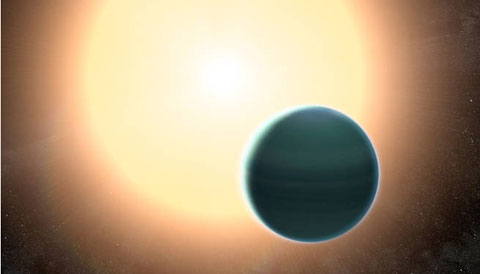
Watery Skies of "Warm Neptune" Hint at Planet's Formation
Astronomers have detected water in the cloud-free skies of "warm Neptune" HAT-P-26b, a clue in the larger mystery of how these planets formed.

Amazing New Views of Near-Earth Asteroid
Large asteroid 2014 JO25 cruised past Earth on April 19, and Goldstone and Arecibo radars were at the ready to capture what turned out to be yet another twin-lobed asteroid.

Watch Comet Johnson Sprint Through Boötes
Another binocular comet? You better believe it. Comet Johnson takes center stage at nightfall this month and next.

Call for Nominations: Chambliss Amateur Achievement Award
The Chambliss Amateur Achievement Award recognizes excellence in astronomical research by American amateur astronomers. Nominations are now open!

Gravitational Lensing Reveals "Iceball Earth" 13,000 Light-Years Away
Astronomers have discovered an "iceball Earth" orbiting a star 13,000 light-years away. Multiple eyes on the sky have revealed some of this world's secrets.

Cassini Traverses "Big Empty" on First Grand Finale Pass
The Grand Finale is underway, as NASA's Cassini spacecraft sails through a clear gap between Saturn and its rings.

Starry Success: Protecting the Night Sky Above La Palma
Ten years ago, La Palma was declared a "Starlight Reserve" and measures were implemented to protect its skies from light pollution. How did they work?

Debate on Universe’s Cold Spot Heats Up
A new galaxy survey suggests that a supervoid isn’t responsible for the Cold Spot seen in the cosmic microwave background — the oddity may have a far more ancient origin.

Tour May's Sky: Big Dipper Leads the Way
Listen to May's astronomy podcast to learn why stargazers think of the Big Dipper as the "Swiss Army Knife" of the late-spring northern sky.

Cassini Survives First "Grand Finale" Dive
Cassini's Grand Finale has begun, as the spacecraft threaded the needle between Saturn and its rings, following several fantastic moon passes and a final glance back at Earth.

Spring Astronomy Day 2017!
Amateur astronomy clubs, planetariums, science museums, and parks celebrate Astronomy Day twice a year, when the public is invited to come learn about the sky and view through telescopes.

U.S. Forever Stamp to Feature Amateur Astrophotos
The U.S. Postal Service's new Total Eclipse Forever stamp will feature photos by the well-know eclipse expert Fred Espenak, who is also a master of many different kinds of astrophotography.
