 SUNSET:

 10
10FRIDAY, AUGUST 1
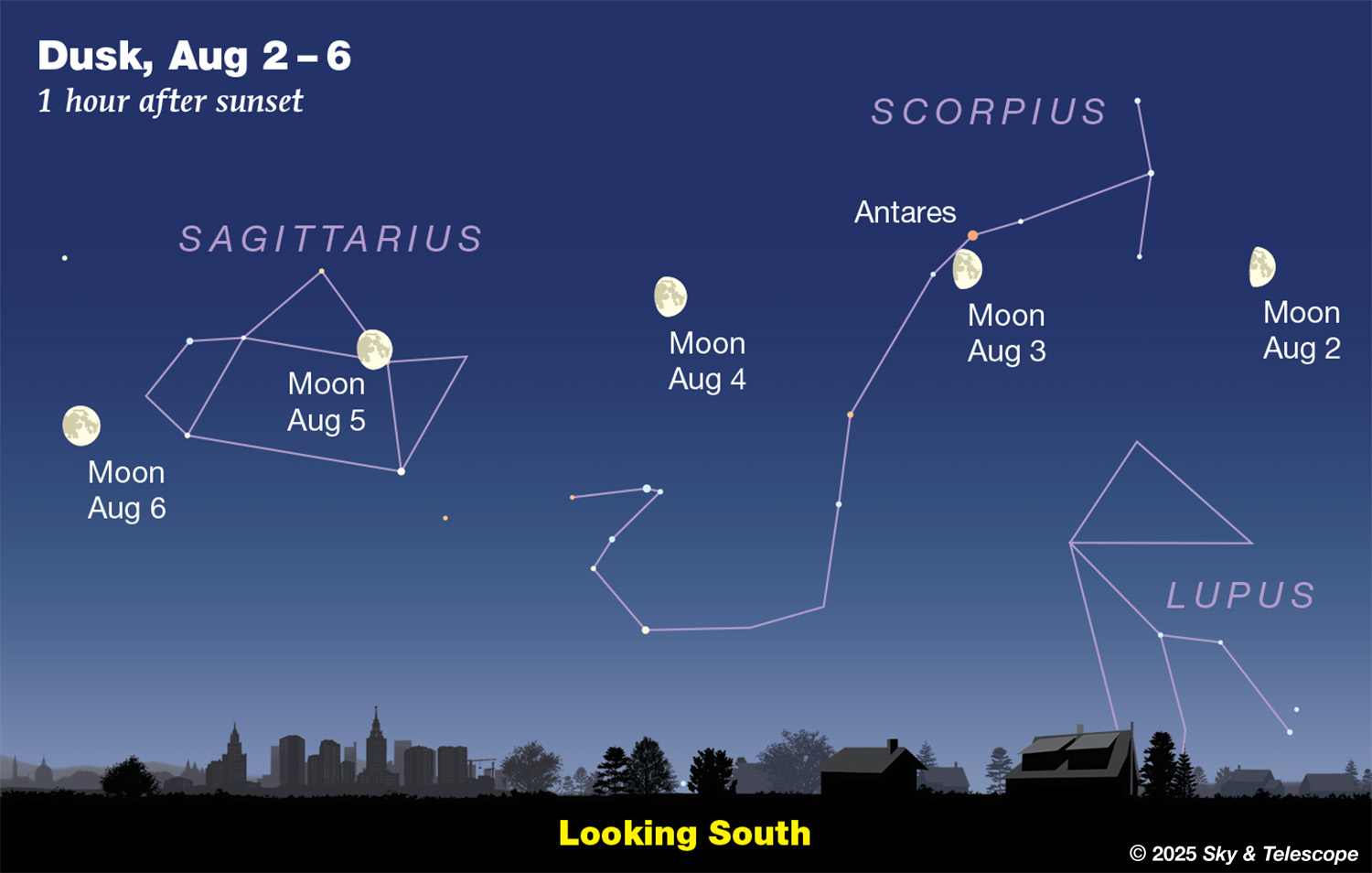
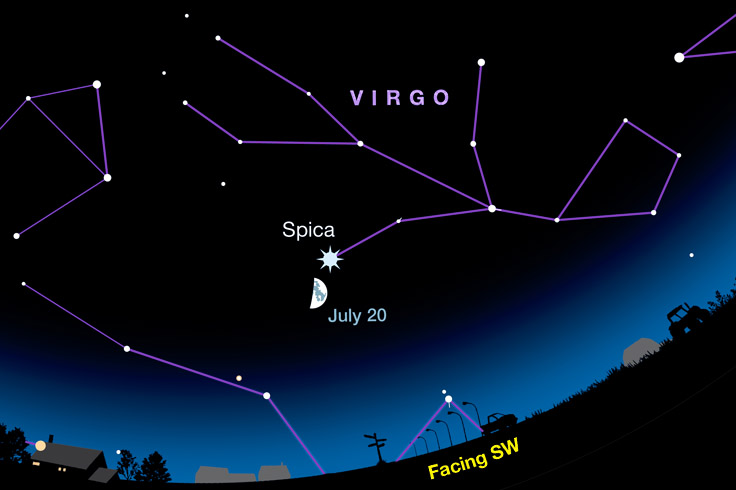
■ First-quarter Moon; exactly so at 8:41 a.m. EDT. The Moon, in Libra, hangs halfway between Antares two fists to its upper left and Spica sinking down two fists to its lower right.
SATURDAY, AUGUST 2
■ The long, drawn-out Delta Aquariid meteor shower continues, weakly. Its nominal peak was July 30th more or less, but the shower runs until mid-August, overlapping the Perseids — which this year will be washed by moonlight. See Bob King's Thumbs Up for the Delta Aquariid Meteor Shower.
■ Titan casts its shadow on Saturn tonight. Every 15 years Titan, Saturn's largest moon, repeatedly crosses Saturn's face from Earth's viewpoint — and, more visibly, casts its very tiny black shadow onto Saturn' face. A new series of these events is under way. They will continue every 16 days until October.
Tonight Titan's shadow crosses Saturn from 6:25 to 11:04 UT August 3rd (UT date). That's from 2:25 to 7:04 a.m. August 3rd Eastern Daylight Time; or 11:25 p.m. Aug. 2nd to 4:04 a.m. Aug. 3rd PDT. Wherever you are, Saturn rises by 11 p.m. local daylight-saving time and is high in good seeing before dawn. So all of North America gets a chance at this shadow transit. See Bob King's Titan Shadow Transit Season Underway.
But if you're used to seeing shadows of Jupiter's moons on Jupiter, be warned: Saturn is twice as far away, and although Titan is large, it's not twice as large as any of Jupiter's moons.
SUNDAY, AUGUST 3
■ This evening the waxing gibbous Moon hangs hardly more than 1° below orange Antares, the 1st-magnitude heart of Scorpius. "The neutral gray of the lunar surface always seems to enhance the color of whatever star or planet the Moon is near," writes Gary Seronik in the August Sky & Telescope. Do you agree?
MONDAY AUGUST 4
■ Now the thickening, brightening gibbous Moon shines midway between Antares to its right and the spout of the Sagittarius Teapot to its left.
TUESDAY, AUGUST 5
■ This evening for North America, the Moon sits where the Teapot's spout joins its body. To bring out the Teapot's 2nd- and 3rd-magnitude stars, cover the Moon with a fingertip to hide its bright glare. Or better, use two fingertips, one for each eye. Close one eye and position a fingertip onto the Moon, then do the same for the other eye with another fingertip. Then without moving, open both eyes.
WEDNESDAY, AUGUST 6
■ Now the Moon is just left of the Teapot's handle.
THURSDAY, AUGUST 7
■ Vega passes its closest to overhead around 10 or 11 p.m. now, depending on how far east or west you are in your time zone.
How closely Vega misses your zenith depends on how far north or south you are. It passes right through your zenith if you're at latitude 39° north (Washington DC, Cincinnati, Kansas City, Lake Tahoe). How closely can you judge its verticality? It helps to lie on your back.
Deneb crosses closest to the zenith almost exactly two hours after Vega. But to see Deneb straight up you need to be farther north, close to latitude 45°: Portland, Minneapolis, Montreal, central Maine, southern France, northern Italy, Odesa, Kherson.
FRIDAY, AUGUST 8
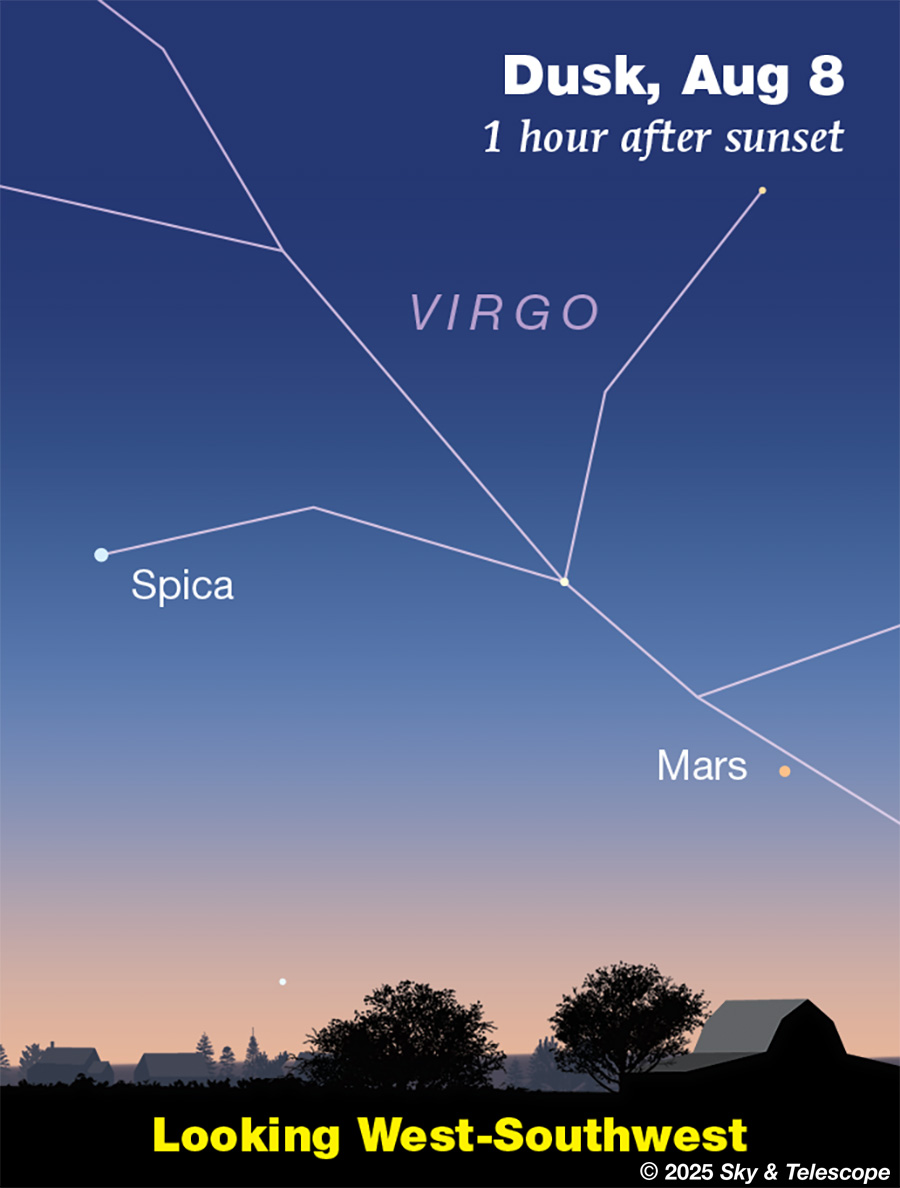
■ Week after week now, distant little Mars stays practically on station at the same height low in the west-northwest in twilight. Its long apparition drags on and on: Mars will continue to set around the end of twilight into early fall (for observers at mid-northern latitudes), and it won't reach conjunction with the Sun until the beginning of 2026.
SATURDAY, AUGUST 9
■ The two brightest stars of summer are Vega, overhead shortly after nightfall, and Arcturus, shining in the west. Draw a line down from Vega to Arcturus. A third of the way down, the line crosses the dim Keystone of Hercules. Two thirds of the way down it crosses the dim semicircle of Corona Borealis with its one modestly bright star, Alphecca or Gemma. If you've been watching for the supposed next explosion of T Coronae Borealis, it has now gone half of another summer unexploded.
■ Vega and the Keystone's star closest to it form an equilateral triangle with 2nd-magnitude Eltanin to their north, the nose of Draco the Dragon. Eltanin is the brightest star of Draco's quadrilateral head; he's eyeing Vega.
SUNDAY, AUGUST 10
■ This is the time of year when the Big Dipper scoops down in the northwest during evening, as if to pick up the water that it will dump from high overhead in the evenings of next spring.
■ Are you seeing any early Perseid meteors yet? Despite the moonlight? The Perseids are active at noticeable levels for many days before and several days after their peak, which this year is predicted for the night of August 12-13.
This Week's Planet Roundup
Mercury is hiding deep in the sunrise.
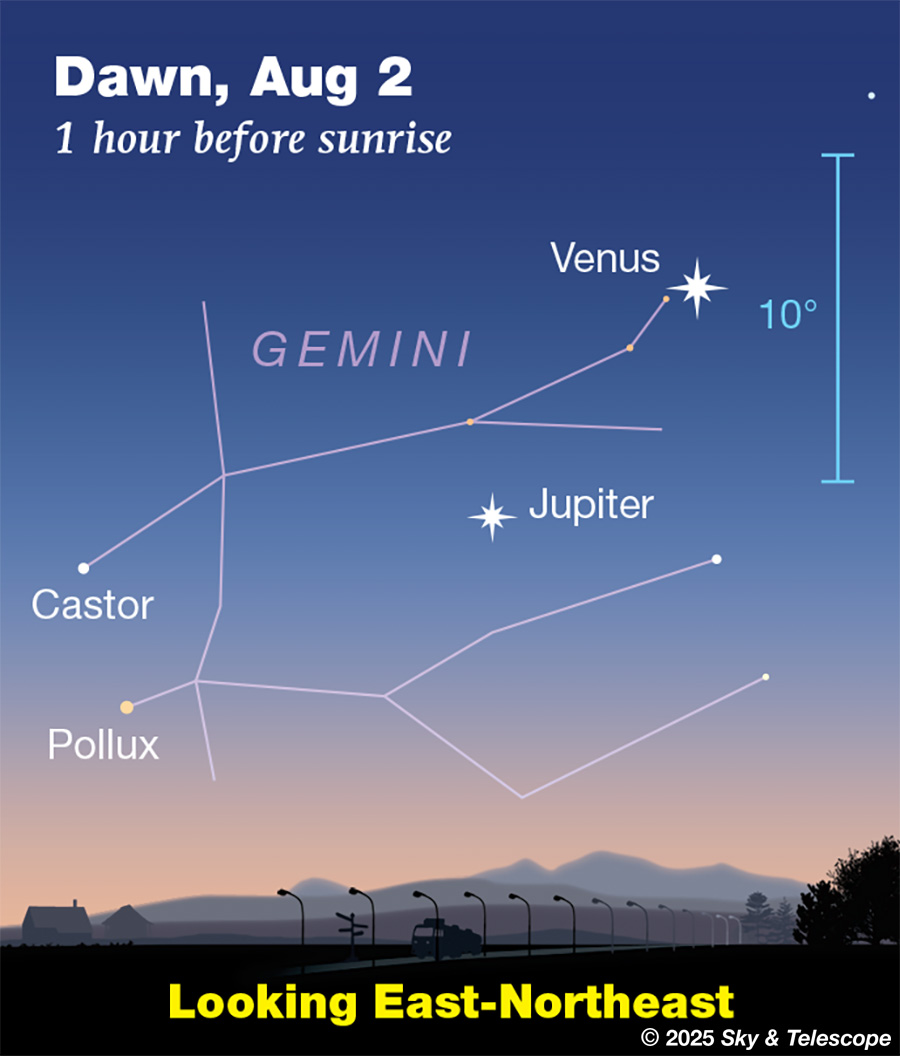
Venus, brilliant at magnitude –4.0, rises above the east-northeast horizon about an hour before the first sign of dawn, followed by Jupiter, the second brightest planet at magnitude –1.9. On Saturday morning August 2nd they rise about 40 minutes apart, but a week later on the 9th Jupiter follows 0nly about 10 minutes behind Venus. During this time their separation shrinks from 9° to 3°.
They'll come to a spectacular close conjunction on the morning of August 12th, 0.9° apart, with Jupiter then to Venus's upper left (north).
Mars, a weak magnitude 1.6 at the border of Leo and Virgo, still glimmers very low due west in twilight. Binoculars will help. Mars sets at twilight's end.
Saturn (magnitude +0.8, in Pisces) rises around 10 p.m. daylight-saving time. But the best time to try a telescope on Saturn is in the hours before dawn, when it's highest in the south. We see Saturn's rings almost edge-on this year, and the Sun shines on them from nearly our direction too. So the rings and their shadow form a super-thin black line along Saturn's equator.
Uranus (magnitude 5.8, in Taurus near the Pleiades) rises around midnight or 1 a.m. and is well placed in the east before the beginning of dawn. In a telescope it's a tiny but definitely non-stellar blob 3.6 arcseconds wide.
Neptune, a telescopic "star" at magnitude 7.9, lurks 1° from Saturn in the early morning hours. Use the finder chart for Neptune with respect to Saturn in the June Sky & Telescope, page 51. With a pencil, put a dot on the path of each of the two planets for your date. Get everything planned and ready the evening before, so that dawn doesn't overtake you before you find it!
All descriptions that relate to your horizon — including the words up, down, right, and left — are written for the world's mid-northern latitudes. Descriptions and graphics that also depend on longitude (mainly Moon positions) are for North America. Eastern Daylight Time (EDT) is Universal Time minus 4 hours. UT is also known as UTC, GMT, or Z time.
Want to become a better astronomer? Learn your way around the constellations. They're the key to locating everything fainter and deeper to hunt with binoculars or a telescope.
This is an outdoor nature hobby. For a more detailed constellation guide covering the whole evening sky, use the big monthly map in the center of each issue of Sky & Telescope, the essential magazine of astronomy.
For the attitude every amateur astronomer needs, read Jennifer Willis's Modest Expectations Give Rise to Delight.
Once you get a telescope, to put it to good use you'll need a much more detailed, large-scale sky atlas (set of charts). The basic standard is the Pocket Sky Atlas, in either the original or Jumbo Edition. Both show all 30,000 stars to magnitude 7.6, and 1,500 deep-sky targets — star clusters, nebulae, and galaxies — to search out among them.
Next up is the larger and deeper Sky Atlas 2000.0, plotting stars to magnitude 8.5; nearly three times as many, as well as many more deep-sky objects. It's currently out of print, but maybe you can find one used.
The next up, once you know your way around well, are the even larger Interstellarum atlas (with 201,000+ stars to magnitude 9.5 and 14,000 deep-sky objects selected to be detectable by eye in large amateur telescopes), and Uranometria 2000.0 (332,000 stars to mag 9.75, and 10,300 deep-sky objects). And read How to Use a Star Chart with a Telescope. It applies just as much to charts on your phone or tablet (which many observers find more versatile) as to charts on paper.
You'll also want a good deep-sky guidebook. A beloved old classic is the three-volume Burnham's Celestial Handbook. An impressive more modern one is the big Night Sky Observer's Guide set (2+ volumes) by Kepple and Sanner. The pinnacle for total astro-geeks is the new Annals of the Deep Sky series, currently at 11 volumes as it works its way forward through the constellations alphabetically. So far it's up to H.
Can computerized telescopes replace charts? Not for beginners I don't think, and not for scopes on mounts and tripods that are less than top-quality mechanically. Unless, that is, you prefer spending your time getting finicky technology to work rather than learning how to explore the sky. As Terence Dickinson and Alan Dyer say in their Backyard Astronomer's Guide, "A full appreciation of the universe cannot come without developing the skills to find things in the sky and understanding how the sky works. This knowledge comes only by spending time under the stars with star maps in hand and a curious mind." Without these, "the sky never becomes a friendly place."
If you do get a computerized scope, make sure that its drives can be disengaged so you can swing it around and point it readily by hand when you want to, rather than only slowly by the electric motors (which eat batteries).
However, finding faint telescopic objects the old-fashioned way with charts isn't simple either. Do learn the essential tricks at How to Use a Star Chart with a Telescope.
 Audio sky tour. Out under the evening sky with your
earbuds in place, listen to Kelly Beatty's monthly
podcast tour of the naked-eye heavens above. It's free.
"The dangers of not thinking clearly are much greater now than ever before. It's not that there's something new in our way of thinking, it's that credulous and confused thinking can be much more lethal in ways it was never before."
— Carl Sagan, 1996
"Facts are stubborn things; and whatever may be our wishes, our inclinations, or the dictates of our passion, they cannot alter the state of facts and evidence."
— John Adams, 1770
About Alan MacRobert
Alan M. MacRobert became an avid Sky & Telescope subscriber in 1966 at age 14, joined the editorial staff in 1982, and is now a senior contributing editor, semi-retired. He played a role in practically every part of the magazine and the company's other products for more than a generation, both on the amateur-observing side and the science-reporting side. In 1994 a book collection of his observing how-tos and telescopic sky tours was published as Star Hopping for Backyard Astronomers. He has produced This Week's Sky at a Glance online every week since 1989.



Comments
mary beth
August 1, 2025 at 5:48 pm
Misha17, and any others interested in Shakespeare’s writings concerning celestial objects and events during the Early Modern Period, here’s a beautiful resource:
https://www.jstor.org/stable/pdf/7273.pdf
You must be logged in to post a comment.
Rod
August 2, 2025 at 6:58 pm
mary beth, good to see your updates 🙂 I am planning to view Saturn in early morning sky soon but hauling 60 lbs. or more of equipment out near 0400 is tough, I may go with my trusty 90-mm refractor 🙂 While I have not been viewing the stars at night recently, other outdoor activities I enjoyed this summer 🙂 https://www.youtube.com/post/UgkxXKCCpPRL9oasRLSf9VoOCiDsklwn2Elz
You must be logged in to post a comment.
mary beth
August 2, 2025 at 7:44 pm
I so hope you have clear skies in the morning so can see the shadow! You'll have to update tomorrow!
Glad y'all are having such a wonderful summer. I read up on that beach and it sounds like such a classic! It sounds like you easily keep up with all the kids, and I bet you can chop more wood than them as well lol! Once school starts, you can get back into stargazing, but you're doing the most important thing right now, making memories with your family!
Over Labor Day weekend, we will be getting together with my husband's big family at their beach house in Galveston in the revitalized East Beach area. Looks like we'll have a waxing moon, i'm going to get a preview of the southeastern sky off Stellarium!
You must be logged in to post a comment.
Rod
August 3, 2025 at 10:04 pm
I did enjoy some views of the Moon and Antares tonight. Observed 2030-2130 EDT. First Quarter Moon 01-Aug-2025 1241 UT. I enjoyed about 1 hour observation time using my 90-mm refractor telescope with TeleVue 40-mm plossl eyepiece. This combination provided 25x with true field of view about 108 arcminutes across. Tonight, the waxing gibbous Moon and Antares in Scorpius 85 arcminute angular separation in the sky using Stellarium 25.2. At 25x I could see Antares and upper northern section of the Moon. Terminator line with crater likes Grignard, Plato, Mare Ibrium and Archimedes crater. The Moon tonight was about 398625 km distance compared to Antares, about 555 light years distance. In the telescope view with both visible, that is some interstellar distance gap I could see 🙂 Temperature 18C, winds 180/2 knots with humidity near 94%. Cirrus clouds passing by interfered with viewing. I will wait and see how clear the sky is tomorrow morning and try seeing Saturn near 0400 EDT. Cirrus clouds obscured my views tonight at different times.
You must be logged in to post a comment.
Rod
August 4, 2025 at 6:01 am
mary beth et al. Great early morning sky today! I observed 0400-0515 EDT. Sunrise near 0610 EDT. I did some Saturn viewing this morning using TeleVue Nagler 9-mm for 111x observations and my 90-mm refractor telescope. Saturn rings thin and crossed the face of the planet. Titan and Rhea moons visible, also some faint stars near 10th-11th magnitude in the field of view. Near 0500 EDT, Venus and Jupiter in Gemini, a stunning pair to see! Using my telescope, I could see Venus with bright gibbous shape about 76% illuminated. To enjoy telescope views of Venus, use a filter, very bright. Clear skies and temperature 14C with light NW winds. I took advantage of a clear, cool morning in August. A howl was hooting in the woods, I hooted back. We communicated with each other for a bit 🙂 As sunrise approached near 0610 EDT, I could see the sky glow appear in the east. Morning twilight near 0542 EDT today according to Stellarium 25.2. Some great viewing this morning, lovely time outdoors. A great way to enjoy the natural world 🙂
You must be logged in to post a comment.
mary beth
August 4, 2025 at 10:39 am
Fantastic! Thanks for describing the moon and Antares so well. Here, unfortunately, it was too cloudy for us to see it and I was very disappointed but so glad to see your post!
Do you know the brightest you have ever seen Venus? 76% is pretty bright so good thing you have lots of filters! How about Saturn? Do you know what the magnitude was?
Super fun about the owl I guess they seem to get a little more active this late summer time of year. Maybe the babies are out of the nest and the adults are able to get out more. Or it might even be that we're seeing them because we are outside so much this time of year. Also add the fact gets dark a little sooner so they fly a little earlier in the evening than they did in June.
You must be logged in to post a comment.
Rod
August 4, 2025 at 1:22 pm
mary beth, Stellarium 25.2 showed Saturn magnitude as 0.78 this morning. Very close to the report at this site, 0.8. Venus this morning was -3.98 according to Stellarium 25.2, this site -4.0. I do not know how bright Venus in the past when I viewed. I would need to search my MS ACCESS DB. MS Bing did show this when I asked 🙂 "-4.7 Venus is the brightest planet in the night sky, outshining all other objects except the Sun and Moon. It reaches its greatest brilliancy on April 27, 2025, at a magnitude of -4.7, making it nearly impossible to miss in the morning sky. After this peak, Venus will not appear this bright until November 2026."
You must be logged in to post a comment.
mary beth
August 4, 2025 at 4:21 pm
A decent brightness for telescope viewing of Saturn!
I was enjoying watching Saturn this Spring and I even told strangers taking walks by my house about its specialness lol. I knew from this great site that it was the brightest it was going to be quite a while. I savored every night I could see it. Was the filter you used this morning sufficient for its maximum brightness? Or will you have to get a stronger one for November 2026?
Over half of one magnitude is quite a bit of difference! I’m going to see if I can find the percentage of illumination for November 2026.
You must be logged in to post a comment.
Rod
August 5, 2025 at 1:09 pm
mary beth, you asked, "Was the filter you used this morning sufficient for its maximum brightness?"
No filters were used. I could use a blue filter or another color on Venus to help. The Moon I do use a filter when viewing waxing gibbous, waning gibbous phases. My 10-inch with 2-inch eyepiece and no lunar filter, it pokes thee in the eye 🙂
You must be logged in to post a comment.
Rod
August 4, 2025 at 8:09 am
"A howl was hooting in the woods", Lol, my bad. It was an owl, sounded like a great horn owl, I had some fun with the bird 🙂 The owls here seem to like my hooting and calls, or they are upset with me during those hours of the night and morning 🙂
You must be logged in to post a comment.
You must be logged in to post a comment.