 SUNSET:

 0
0There are red stars, orange stars, yellow stars, and blue stars. Why no green stars?
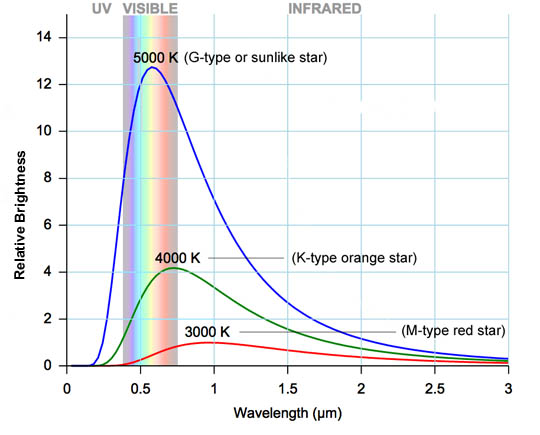
A star (or other hot object) emits light across the entire visible spectrum, but the wavelength at which it shines brightest depends on its temperature. Hotter stars emit proportionately more blue light than red; for cooler ones it's the other way around. But no matter where in the spectrum a star's brightness peaks, there's plenty of light coming out at other wavelengths too. So most star colors look pale: that is, white with a slight bluish or orangish cast if they're especially hot or cool, respectively. No stars are as colorful as, for instance, traffic lights.
The stars with the palest colors are those that, like our Sun, peak in the green. That's because these "green" stars also emit lots of red and blue light. The light combines so it appears white to our eyes.
Our definitive article about this is Philip C. Steffey's "The Truth About Star Colors" in the September 1992 issue.
About Richard Tresch Fienberg
Rick Fienberg served as Sky & Telescope’s Editor in Chief from 2001 to 2008 and continues to support the magazine as Senior Contributing Editor and as Senior Advisor to the CEO of the American Astronomical Society, S&T’s publisher.



Comments
You must be logged in to post a comment.