 SUNSET:


Sky at a Glance | February 6th, 2009
Venus continues blazing high, Mercury is now up in view before sunrise — and for western North America, the full Moon undergoes a penumbral (weak) eclipse before sunrise on Monday the 9th.
Sky at a Glance | January 30th, 2009
Venus is near peak brilliance, outshining everything in the evening sky but the Moon. Saturn shines high in the early-morning hours, when you can also try for the incoming Comet Lulin.
A Supermassive Double Black Hole?
A far-off quasar seems to contain two giant black holes hurtling around each other less than a light-year apart. They're doomed to spiral together and join in a literally space-shaking crash — but when?
Sky at a Glance | January 16th, 2009
Venus dazzles high in the evening, with Uranus right near it but 15,000 times fainter. Still, you can spot Uranus with binoculars. And Saturn is now rising as early as 9 p.m.
Sky at a Glance | January 9th, 2009
Venus dazzles high in the cold winter dusk, and a telescope shows that it's almost perfectly half-lit. Before dawn, Saturn's rings remain the closest to edge-on that you can see them until 2038.
Sky at a Glance | January 2nd, 2009
Venus dazzles ever higher in the cold winter dusk. If you brave the even colder early-morning hours, the Quadrantid meteors may reward you overhead. Before dawn, Saturn's rings remain the closest to edge on that you can see them until 2038.
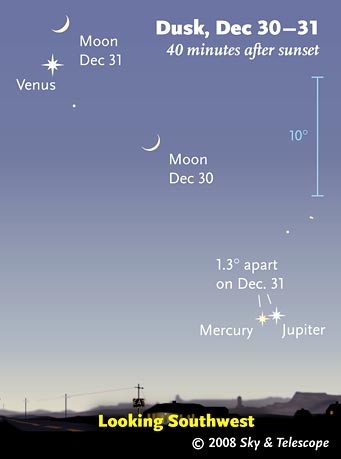
Sky at a Glance | December 26th, 2008
Venus shines ever brighter and higher in twilight, passing stars and Neptune and then pairing spectacularly with the Moon. Jupiter, far to its lower right, meets Mercury. Before dawn, Saturn's rings are the closest to edge-on you can see them for years to come.
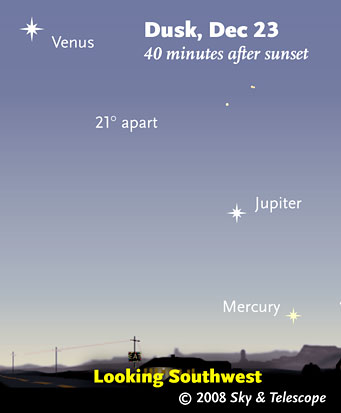
Sky at a Glance | December 19th, 2008
Venus shines brighter and higher in the southwestern twilight, passing stars and Neptune. Jupiter is sinking down far to its lower right. After dark, Orion season is now in full force. And at dawn, Saturn's rings are the closest to edge-on you can see them for years to come.
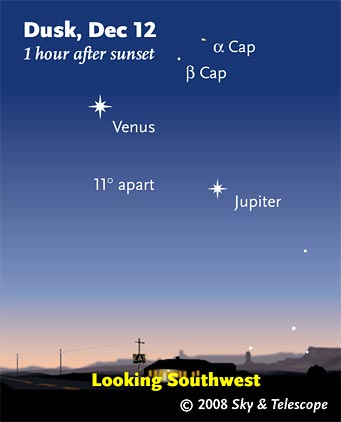
Sky at a Glance | December 12th, 2008
Venus and Jupiter continue to draw apart in the southwestern twilight. The Geminid meteor shower arrives amid bright moonlight. And Saturn, now with edge-thin rings, is very high in excellent telescopic view just before dawn.
Tycho's Supernova in Reruns
436-year-old light echoes give a look today at a blast in the Renaissance past. The catch? They're only a twenty-billionth as bright as the original.
Sky at a Glance | December 5th, 2008
Following their conjunction, Venus and Jupiter are now drawing apart in the southwest at dusk — still a striking sight. And Saturn, with its nearly edge-on rings, is a fine telescopic attraction if you can get yourself out before dawn.
Catch Ceres at Its Closest
Ceres, the biggest asteroid and the first to be discovered, has an extraordinary good apparition in February and March 2009.
A Very Oddball Comet
Periodic Comet Machholz 1 has such a unique composition that a researcher suggests it may have come from another solar system. Though the odds against this seem long.

Sky at a Glance | November 28th, 2008
The Venus-and-Jupiter pairing is at its peak in the southwestern twilight on November 30th and December 1st, with the Moon joining in!
The "Venus & Jupiter" Show
At the end of November and the beginning of December, the two brightest planets perform a dazzling dance in the evening twilight. On December 1st they're joined by the slender crescent Moon, which makes for a pretty trio in the Americas — and which will cover Venus in spectacular fashion for lucky skywatchers in Europe.
Sky at a Glance | November 21st, 2008
The Venus-and-Jupiter pairing is becoming ever more dramatic in the southwestern twilight, as these two brightest planets draw closer together toward their conjunction on November 30th and December 1st.
Sky at a Glance | November 14th, 2008
Every day Venus and Jupiter are drawing closer together in twilight. And on Monday the 17th, Venus scrapes by a 2nd-magnitude star.
Sky at a Glance | November 7th, 2008
Venus and Jupiter, the two brightest planets, shine in the southwestern twilight, drawing closer together every day. Later at night, watch for Taurid fireballs!
Sky at a Glance | October 31st, 2008
Venus and Jupiter shine in twilight. Watch them drawing closer together every day. At dawn, Saturn shines high and Mercury low.
Sky at a Glance | October 24th, 2008
Venus has become easy to spot at dusk. Orange Antares near it is less so. At dawn, Mercury is having its best morning showing of the year, while Saturn is tipping its rings very nearly edge-on to your telescope's line of sight.
