 SUNSET:

S&T's Audio Sky Tour for May 2009
Our monthly guide to the night sky tells you how to spot all five bright planets this month. Host: S&T's Kelly Beatty. (5MB MP3 download: running time: 5m 45s)
The Case of the Stolen Sundial
During his time at Caltech in the 1930s, Russell Porter cast this beautiful sundial to adorn the campus. But it was stolen sometime during the 1970s — do you know where it is?
Best-Ever Southern-Sky Galaxy Survey
Take one telescope, use it to record the spectra of 150 galaxies at a time for 4½ years, and what do you get? Awesome 3D maps of deep intergalactic space — and important clues to how the universe works.
S&T's Audio Sky Tour for April 2009
Brilliant Venus is gone from the evening sky and Orion is on the wane in the west, while the mighty lion Leo, accompanied by Saturn, now dominates in the east. Meanwhile, the Big Dipper crowns the sky overhead. Knowing where to to look to find these sky sights is easy…
IYA's 24-hour Scope-a-thon
Have you ever wanted to visit a famous observatory perched atop some faraway mountaintop? This weekend you can, thanks to the International Year of Astronomy's "Around the World in 80 Telescopes" — a live, 24-hour webcast.
NASA Readies Hubble Mission — Again
For the second time in six months, a Space Shuttle is perched on a Florida launch pad, awaiting the chance to visit the orbiting Hubble Space Telescope for the last time.

Craters Reveal Ice in the Martian Dust
High-resolution images from orbit reveal tiny craters — created within the past year — surrounded by splashes of water ice dredged up from just below the Martian surface.
Meteorites Found from Asteroid 2008 TC3
Last December a determined U.S. researcher traveled to Sudan to recover pieces of an asteroid that slammed into Earth's atmosphere only 19 hours after being spotted. It was a long shot that paid off beyond his wildest dreams.

(Drops of) Water on Mars?
Last year, as a camera aboard the Phoenix lander looked on, drops of supersalty water grew, merged, and even dripped on one of the spacecraft's landing legs.
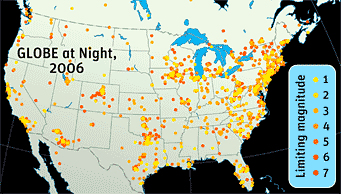
Count the Stars, Help Save the Night
The GLOBE at Night star count, now in its fourth year, takes place from March 16th through the 28th in 2009.
Sculpting the Asteroid Belt
New simulations show that when the giant planets shifted their orbits 4 billion years ago, the asteroid belt became a wild and crazy place.
End of the Line for "Skyline"
After 23 years of providing weekly updates to amateur astronomers, S&T's telephone news service has come to an end. Chalk up a victory for the internet.
Super Sendoff for Planet-Hunting Kepler
After a dramatic and flawless liftoff, NASA's newest space observatory is getting ready to observe a tract of Milky May with a single-minded purpose: find as many alien worlds as it can.
Saturn's Newest Moon is a Ringer
A tiny moonlet discovered around Saturn is the likely source of the planet's G ring.

Chinese Craft Whacks the Moon
Chang'e 1, a spacecraft that's been in lunar orbit for 16 months, has been sent crashing into the Moon by its Chinese handlers. The impact site was on the near side, but it's unclear whether anyone on Earth saw it — or was even looking for it.

Space Rock 2009 DD45 Buzzes Earth
Roughly 100 feet across, the tiny asteroid designated 2009 DD45 is about to get its 15 minutes of fame.
Tour March's Sky! | February 27th, 2009
Where in the sky will you find the ringed planet Saturn and a pair of cosmic twins? You'll spot them easily if you download our guided audio tour of the March evening sky.
S&T's Audio Sky Tour for March 2009
Brilliant Venus, still in the southwestern evening sky, makes its last stand this month. Orion and his cohort dominate in the south, but the mighty lion Leo, accompanied by Saturn, are gaining ground in the east. Knowing where to to look to find these sky sights is easy if you…
S&T's Audio Sky Tour for February 2009
Amid the sparkling midwinter are two planets that are a study in contrasts. Venus is a brilliant, unmistakable beacon in the southwestern evening sky. But to find Saturn you'll have to be a bit patient and know just where to look — it's easy to find by downloading our monthly…
A White House Star Party?
A Chicago-area amateur astronomer is spearheading an effort to have members of the First Family ogle the Moon and Saturn through telescopes set up in their backyard. No, really!
