 SUNSET:

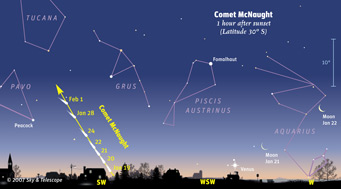
Comet McNaught, Spectacle of the Far-Southern Sky
As of January 18th, Comet McNaught is barely visible from the Northern Hemisphere, but the show is just beginning for observers at mid-southern latitudes.
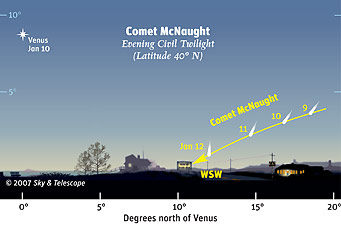
Comet McNaught Heading South
If you live in the Northern Hemisphere, Friday was your last good opportunity to catch Comet McNaught in the evening twilight — though January 13th isn't completely out of the question. On January 14th or 15th, the comet will become a showpiece for observers in the Southern Hemisphere.
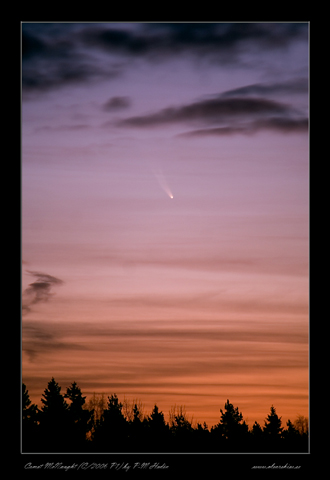
Comet McNaught Brightening
Comet McNaught has brightened rapidly in the last few days. It's now bright, beautiful, and, if you're fairly far north, easy to see at dawn and dusk — if you know where to look and have an unobstructed horizon and perfect conditions. It's now a naked-eye spectacle from far northern latitudes, where the observing geometry is most favorable. The farther south you live, the lower the comet is in the twilight.
The Ringed Planet Returns
After several months with no bright planet well placed in the evening sky, Saturn returns to easy visibility in January, making a striking formation together with the Sickle of Leo. And on Saturday, North Americans can witness a close conjunction of the Moon and Regulus, Leo's brightest star.
Best Meteor Shower of 2006
With only minor interference from the Moon, the Geminids should put on a great display late Wednesday night and Thursday morning. What's more, a major solar flare just erupted, providing a strong chance for a tremendous northern lights show on Thursday or Friday.

The Hyades Movie
The above is a still from a movie showing the rotation of the stars of the Hyades Cluster, separate from unrelated stars in Taurus.Anthony Brown In 1997 scientists associated with the Hipparcos satellite published a 3-D map of stars in the Hyades cluster. It was the first time that the…

Crescent Moon in Good Company
A 2½-day-old Moon lines up with two bright planets and a first-magnitude star — with an occultation thrown in for some well-situated observers.
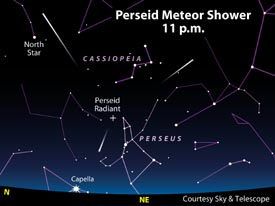
Moonlight Perseids
Although the peak has past, the Perseid meteor shower, an annual celestial event beloved by millions of skywatchers around the world, still has a few stragglers left to see. Try looking for some tonight.

Will all eight planets ever line up on the same side of the Sun?
Will there ever be a moment when all eight major planets are in a straight line on the same side of the Sun? Jean Meeus addresses this in Mathematical Astronomy Morsels (Willmann-Bell, 1997). He points out that you have to start by defining the question precisely. Let’s reduce the problem…

If you combine the magnitudes of all visible stars, how bright a star will you come up with?
Just wondering. . . . If you combine the magnitudes of all visible stars (down to 6th magnitude), how bright a star will you come up with? About 9,000 stars are brighter than magnitude 6.5, the traditional criterion for naked-eye visibility. Their combined magnitude is almost exactly –5, which is…

Why aren't Earth's night skies more colorful?
Why are Earth's skies so boring? You see pictures of galaxies, nebulae, clusters, etc., but they're always far away. Why couldn't Earth have been in the middle of a colorful nebula or some other non-boring zone of space? Celestial photos show what things would look like if your eyes were…

How does the Moon's phase affect the skyglow of any given location, and how many days before or after a new Moon is a dark site not compromised?
How does the Moon's phase affect the skyglow of any given location? How many days before or after a new Moon is a dark site not compromised? The answer is complicated because the Moon's glow is even more directional than light pollution. Skyglow is several times brighter near the Moon…

How do astronomers accurately determine wobbles in a star's motion?
The discovery of planets around other stars is based on wobbles in the stars' motions. Don't you have to measure from a stationary point in space to accurately determine this/ Isn't there an added wobble because Earth rotates on its axis and travels around the Sun? Yes, Earth's rotation and…

How many daylight hours do you get in a year?
No matter where in the world you live, do you get the same number of daylight hours over the course of a year? No. The equator actually gets fewer hours of daylight than most other latitudes. Any given place would be in daylight exactly 50 percent of a year’s time…
How do you pronounce “Vega” and “Canis Major”?
How do you pronounce “Vega”? “Canis Major”? In 1941 the American Astronomical Society formed a committee of Samuel G. Barton, George A. Davis Jr., and Daniel J. McHugh to consult with astronomers, educators, Arabic scholars, and planetarium lecturers and come up with a list of preferred pronunciations for common star…
Perseids Peak as Predicted
Preliminary analysis of the 2004 Perseid meteor shower confirms the forecast of an unusually brief and intense peak of meteor activity over Europe and Asia.
This Is a Quiet Sun?
A series of major solar flares from sunspot 696 has kept geomagnetic activity near or above "storm" level ever since November 7th.
The World-Series Eclipse
Scattered clouds seemed to be the norm across most of the eastern parts of Europe and almost all of the Americas: the visibility zone of the last total lunar eclipse until 2007.
Venus at Its Best
Venus is readily visible in the evening sky until late May during this most favorable apparition of its eight-year cycle.
Astro Image in the News:
Triple Shadow Transit Movie
A California amateur shot a remarkable sequence recording last March's triple shadow transit on Jupiter.
