 SUNSET:


Pluto and Charon’s Gravitational Dance
This image series, taken by NASA’s New Horizons spacecraft in late January 2015, reveals the dwarf planet Pluto and its largest moon, Charon, orbiting their common center of mass.
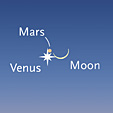
Venus and Mars Pair Tightly at Dusk
Earth's two closest planetary neighbors draw strikingly close together this week.

Before They Were (Binary) Stars
Astronomers have taken a behind-the-scenes look at a set of dense gas clumps, catching a quadruple star system in the fleeting act of formation.

Planck Upholds Standard Cosmology
The Planck team has finally released its full-mission data, revealing a remarkably detailed view of our universe and our galaxy.

The King Holds Court — Jupiter at Opposition
Jupiter reaches opposition on February 6, 2015. Find out how to see the planet king at its best.

Gap Reveals Potential Exomoon
Astronomers have confirmed that the star J1407 seems to have a companion with a gigantic, gap-ridden ring, inside which an “exomoon” might be forming.

Cosmic Inflation Signal Just Dust
The long-awaited analysis of spiraling polarization patterns called B-modes affirms that these signals, purportedly from the universe’s post-birth inflation, are probably from dust in our galaxy instead.

Yellowballs: A New View of Star Formation
Thanks to the help of the general public, astronomers have discovered a new signature marking a hidden phase of star formation.

BICEP's Big Bang Finding Reduced to Dust
Yes, it was too good to be true. The cosmic "discovery of the century" last March has officially blown up. Or will blow up next week when a new analysis of polarization in the cosmic microwave background is officially released. The excitement burst onto the world 10 months ago when…

Tour February's Sky: Two Conjunctions
Some of the prettiest nighttime sights involve the close pairing of two solar-system bodies, and February features events with the Moon and Jupiter, then Venus and Mars.

Where to See Comet Lovejoy Tonight
The new Comet Lovejoy, C/2014 Q2, should brighten from 5th to 4th magnitude from late December through January as it climbs into excellent viewing position for the Northern Hemisphere, high in the dark winter sky.

Exploring Exoplanet Origin Stories
Citizen scientists are exploring exoplanets’ birthplaces, classifying more than 1 million infrared sources and finding 37 disk candidates (so far) for follow-up study.

Ancient Five-Planet System Found
Astronomers have potentially confirmed a five-planet exoplanet system around an 11-billion-year-old star in our galaxy.

The Long-Lived Magnetic Fields of Meteorites
The magnetic fields in the asteroid parent bodies of two pallasite meteorites lasted hundreds of millions of years after our solar system’s formation.

Bright Comet Prospects for 2015
Has Comet Q2 Lovejoy stoked you to see more of these celestial travelers? We look into the crystal ball to see what's coming in 2015.

Rosetta Reveals Much About Comet 67P
Once the Rosetta spacecraft arrived at Comet 67P/Churyumov-Gerasimenko last August, European scientists used an array of instruments to assess every nook and cranny of the remarkable two-lobed nucleus.

Mountain-size Asteroid Glides Past Earth
With a small telescope and our sky charts, you can watch the sizable near-Earth asteroid 2004 BL86 race among the stars on the night of January 26–27.

Do Atmospheres Spin Worlds to Habitability?
The best place to look for nearby Earth-size planets are around the smallest, coolest stars. New research shows that any exoplanets tightly circling their stars might have a better chance of being habitable than previously thought.

Rare Triple Shadow Transit Not to Miss!
Get your scope ready for a rare event this Friday night when one after another three of Jupiter's brightest moons and their shadows parade across its face.
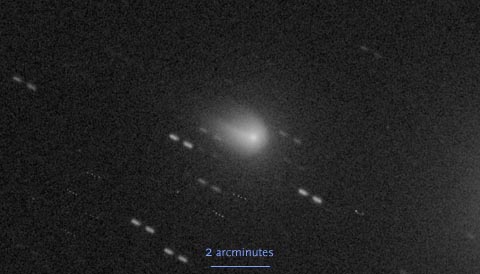
Catch Comet Finlay's Sudden Brightening
For the second time in as many months, the periodic comet 15P/Finlay has surged in brightness. Spot it soon — before the Moon interferes — using our exclusive sky charts.
