 SUNSET:

Create Great Images, Win Cool Stuff!
Are you up for a challenge? Work some computer magic on images obtained with the ESO telescopes, and you might win an all-expenses-paid trip to the Very Large Telescope in Chile.
Kicking SOFIA's Tires
Take a peek inside an amazing "flying telescope" now being readied for routine observing runs in the stratosphere.

My "Backyard" Radio Observatory
Nestled in the woods of suburban Boston is a 1,300-acre complex of radio telescopes that have served civilian astronomers — and super-secret defense projects — for nearly 50 years.

Darkness Still Reigns Over Kitt Peak
Since astronomers started calling Tucson home in 1958, the city's population has quadrupled to more than 500,000. Yet the night sky above the observatories on nearby Kitt Peak is as dark now as it was 20 years ago.
Big Bear's Big New Eye
The "first-light" image from the world's largest solar telescope reveals details in an Earth-size sunspot only 50 miles across.
One Star, Seven Planets
European astronomers had found a bustling solar system in the southern constellation Hydrus: a Sunlike star with at least five and probably seven worlds swarming around it.
Astro2010: U.S. Astronomy's Crystal Ball
If you had $12 billion to spend on ground- and space-based observatories over the next 10 years, how would decide what to build? A 255-page National Research Council study, just released, provides some answers.

Two Wide Eyes on the Sky
Astronomers are starting to make observations with the first Pan-STARRS telescope in Hawaii (seen here) and the LOFAR radio interferometer in the Netherlands.
A Cauldron of Newborn Stars
The Hubble Space Telescope has returned its high-definition gaze to a spectacular bubble of glowing hydrogen known as N 11 in the Large Magellanic Cloud.
"First Light" for a Flying Telescope
SOFIA, the Stratospheric Observatory for Infrared Astronomy, has finally feasted on starlight after a tortuous 14-year development.
The Hidden Face of M83
The Southern Pinwheel Galaxy is already famous as a gorgeous deep-sky showpiece. Now astronomers have probed its structure with a high-resolution infrared view.
Peak Picked for World's Largest Scope
If you were building a mega-telescope with an aperture half the length of a football field, where in the world would you put it?

Mystery Eclipse Caught in the Act
After struggling for decades to understand why Epsilon Aurigae's partial eclipses last so long, astronomers are finally watching the event as it happens.
World's Largest Solar Scope
If one final permit can be obtained — and some Hawaiian preservationists won over — construction on the Advanced Technology Solar Telescope should begin later this year.

WISE Sees First Light
Scientists unveil the first image from the Wide-field Infrared Survey Explorer satellite, which will map the sky in depth and detail at new wavelengths.
Mel's Arecibo Adventure
A globetrotting mascot gets a behind-the-scenes tour of the world's largest single-dish radio telescope.
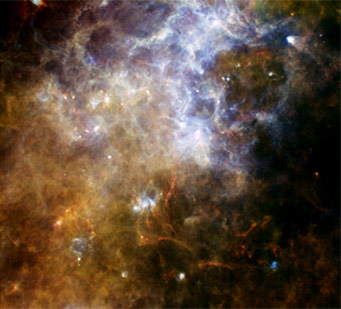
Big Pix from Herschel
Europe's new Herschel Space Observatory is up and running and showing what it can do. You've never seen the far-infrared sky like this.
ALMA Dish Takes the High Road
The Chajnantor plateau in Chile's Atacama Desert has an elevation of more than 16,000 feet — harsh conditions for humans, but perfectly suited to the world's greatest array of submillimeter-wave radio telescopes, now under construction.
Refurbished Hubble Shows Its Stuff
Hubble's upgraded cameras and instruments are fully up and running. NASA has released a bunch of new pictures and results showing off what the buffed-up scope can do.
Two Observatories Saved from Wildfire
Although Southern California's devastating Station Fire still rages nearby, the Mount Wilson and Stony Ridge observatories have escaped destruction.
