 SUNSET:

Light Pollution in North America
According to the Light Pollution Atlas, there's a fourfold variation in light pollution per capita among metropolitan areas in the U.S. and Canada.
Is the U.S. Bright or Dark?
Depending how you present the data, light pollution in the U.S. may appear anywhere from quite severe to fairly modest.

Ground Truth for the Light Pollution Atlas
Instrumental measurements suggest that the color zones from the World Atlas of Light Pollution — perhaps best known through its incorporation in the Clear Sky Chart — don't tell the whole story.
Abell 2199
Abell 2199 contains hundreds — maybe even thousands — of galaxies. We have selected 72 particularly prominent members to display in the chart on page 61 of the July, 2009, issue of Sky & Telescope. You can view data for these galaxies in one of two forms:: A tab-separated text…

The Amazing Galileoscope
Sky & Telescope has reviewed innumerable telescopes, and only a handful of the ones that we've tried and liked cost less than $200. Now we're going to recommend a telescope that's selling for $20, and your response is going to be "you're kidding, right?" No, we're not!
Venus at its 8-Year Best
Venus spent the last nine months as the Evening Star, but it's now faintly visible to the unaided eye just before sunrise — and possibly also just before sunset on the same day. For telescopic observers, this is the most exciting possible time to view Venus during broad daylight. But when doing this, be super-careful not to look at the Sun and blind yourself!

Rate Your Skyglow
Light pollution is most amateur astronomers' worst enemy. Learn here how to measure and describe how brightly your sky glows.
Catch Venus with a "Moon"
On Monday, November 17th, Venus passes very close to the 2.8-magnitude star Lambda Sagittarii (Kaus Borealis). Through a telescope, Lambda appears next to Venus very much like one of the Galilean Moons next to Jupiter.
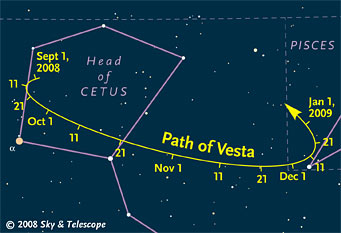
View Vesta at Its Brightest
Vesta, the brightest asteroid, is easy to observe during the last three months of 2008.
Count the Stars to Save the Sky
Schoolchildren, families, and citizen scientists around the world will gaze skyward after dark from October 20th to November 3rd. The Great World Wide Star Count, now in its second year, helps scientists map light pollution globally while educating participants about the stars.
Meteor Strike Forecast for Oct. 6-7
Many telescopes around the world are looking for asteroids that might potentially hit Earth. Every candidate has turned out to be a false alarm — until now!
Possible Fireball Outburst Sept 9-10
An unexpected meteor burst was detected on the night of September 8-9. Bill Cooke of the Marshall Space Flight Center is urging meteor watchers to see if the activity continues on the night of September 9-10.
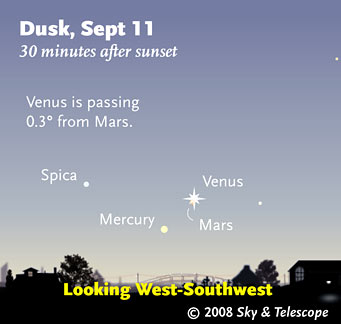
Venus Meets Mars
From September 9th through the 15th, Mars and Venus are closely paired low in the west-southwest just after sunset — fitting together easily in the same medium-power telescopic field for most of that time.
Equipment: Guides & Recommendations
The Oregon Star Party
Located 40 miles from the nearest town, the Oregon Star Party is one of the premier dark-sky astronomy gatherings in the United States.
The Amazing August Planet Show
All five of the classical planets are visible shortly after sunset in mid-August. But observers at mid-northern latitudes will need very clear skies, an unobstructed western horizon, and binoculars to see some of them.
Have You Seen Comet Boattini?
Comet Boattini, now faintly visible to the unaided eye from sites without light pollution, is climbing rapidly higher in the Northern Hemisphere's dawn sky.
The Four-Planet Dance of 2008
Every evening in August and September 2008, just after sunset, four planets and two first-magnitude stars combine to form fascinating and ever-changing patterns.
Comet Boattini: Barely Visible Now, Bright in July?
Comet C/2007 W1 (Boattini) has reached 5th magnitude as of early June. It's now visible only from the Southern Hemisphere. When it reappears for northerners in July, will it be naked-eye?
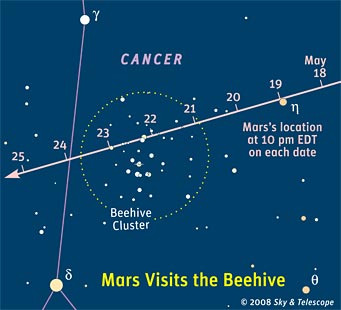
Mars Meets the Beehive
The Red Planet travels through one of the biggest and brightest star clusters in the sky from May 21st to the 24th. As a warm-up, stargazers watched Mars pass a hair's-breadth north of 5th-magnitude Eta Cancri on the evening of May 19th in easternmost America and the morning of the 20th in western Europe.
Catch Mercury at Its Best
Mercury is normally elusive, but it's putting on an extraordinarily good evening show for observers at mid-northern latitudes from late April through mid-May 2008.
