 SUNSET:

Traveling Without a Scope
While traveling in India, the author missed having a telescope for completely unexpected reasons.
Big Binocular Messier Survey
Big binoculars may not show much detail, but they certain make it easy to find deep-sky objects.
Calendars Throughout History
Some thoughts about the social significance of the Sun, the Moon, and regularity.
Ridiculously Small Optics
What's the smallest instrument you've ever used to view the night sky?
Moonset Eclipse
Missing totality makes an eclipse's partial phase all the more rewarding.
Vesta Visits Jupiter
The brightest asteroid swings by the King of Planets from August 28th to the 31st.
Astronomical Twilight
Here are some interesting facts about that time of night when it's too light for deep-sky astronomy but too dark to do anything else.
Discussions Restored
When we switched to new blog technology, all the existing discussions were lost. Now they're back!
Prepare for the Perseids
August is the best month to view meteors from the Northern Hemisphere. And conditions are ideal this year, with activity peaking on the new-Moon night of Sunday–Monday, August 12–13.
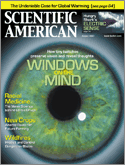
Microsaccades
An article in Scientific American suggests that training your eye to see faint objects may have a physiological basis.
Two Views of the North America Nebula
The North America Nebula in Cygnus is famously visible to the unaided eye under dark skies. But are we really seeing the nebulosity?
Increasing Chance of Meteors
The meteor rate is finally picking up after a multi-month drought.
Comet Envy
I've seen Comet LINEAR C/2006 VZ13 many times now — but not when it was most spectacularly placed.

Star Cluster/Comet Encounter
On Sunday evening Comet LINEAR (C/2006 VZ13) passes within kissing distance of the great globular star cluster Messier 3.
Pollution and Stargazing
Air pollution can be as much of a problem as light pollution for stargazers.
Galaxies and Clusters and Comet, Oh My!
A summer night in the Boston exurbs proves surprisingly rewarding.
