 SUNSET:

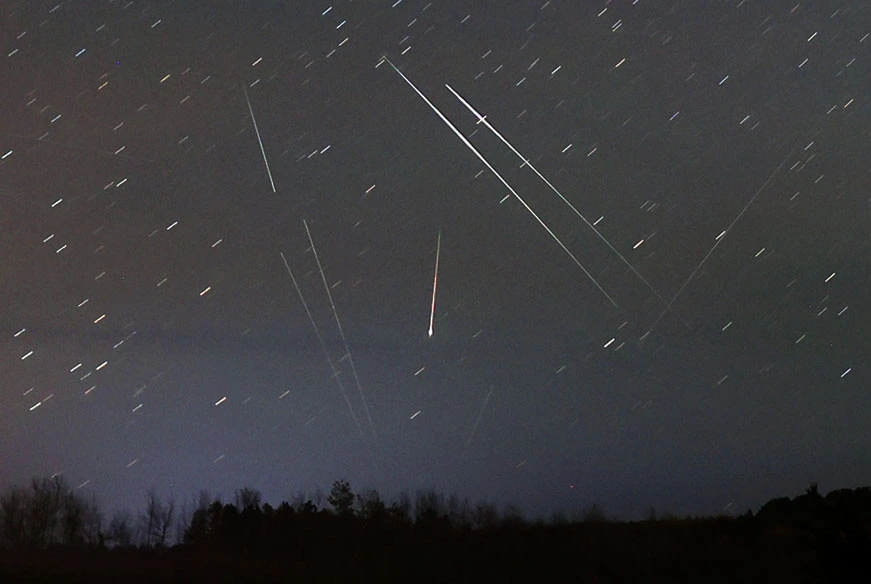
Satellite or Meteor? Dissecting Light Trails in Your Sky Photos
Here's a quick guide to tell meteors from machines in your wide-field images of the night sky.

Astronomers and Starlink Partner for Quieter Radio Sky
Astronomers and Starlink engineers have developed a technique to significantly reduce satellite radio pollution affecting astronomical observations.

Observers’ Report: First Views of the Chinese “Thousand Sails” Satellites
Amateur astronomers have shown that the first satellites of the Chinese Qianfan (“Thousand Sails”) constellation are bright enough to be seen naked-eye.

Starlink Flares Can Fool Anyone — Even Airline Pilots
Starlink satellites can flare as brightly as Venus, confusing ground observers and airline pilots alike.

How to See Freaky Starlink "Cluster Flares", Plus the Latest on Comet Lemmon
Alien invasion or flares from satellites in multiple orbits? It depends on your point of view. We also check in on Comet Lemmon, poised to possibly reach binocular-visibility.
A New Hope? Taming the Satellite Swarm
Going by the paperwork, 1 million satellites are headed for the skies. The question is, how many of these are real? New policy may help stem the tide.

The Bright BlueWalker 3 Satellite Threatens Astronomy
The bright BlueWalker 3 satellite, a prototype for the even larger Bluebird satellites, is one of the brightest objects in the sky.
Unintended Satellite Emission May Harm Radio Astronomy
Satellites’ leakage radiation, now detected for the first time, may become a major problem for radio astronomy, as “megaconstellations” keep on growing.

The Newest and Largest Starlink Satellites Are Also the Faintest
Despite being four times larger than the original Starlink satellites, the new "Mini" version is fainter — as dim as astronomers have recommended such satellites be.

Satellites and Space Debris Are Polluting Our Night Skies
Astronomers are sounding the alarm about low-Earth orbit satellites and space debris as significant contributors to light pollution that will affect even the remotest earthbound stargazer.

Satellite Trails Mar Hubble Images
An accounting of satellite streaks across two decades of Hubble Space Telescopes finds their appearance is increasing.
Bright New Satellites Join a Crowded Sky — Here’s How You Can Help
The imminent launch of a BlueWalker satellite, with a giant phased array antenna, portends a brightening night sky. Amateur astronomers can help record these changes with the goal of mitigating them.

Newest Starlink Satellites Have Gotten Brighter Again
Changes to the design of Starlink satellite spacecraft have made them brighter again, though still dimmer than the original design.

Space Storm Knocks Out Latest Batch of Starlink Satellites
A minor space storm took down much of the latest Starlink batch shortly after launch.

Starlink Satellites Not Impacting Science — Yet
A new study of Starlink satellites’ impact on astronomy gives the community cause for both relief and concern.

Did Astronomers See a Distant, Dying Star? Or an Earth-bound Satellite?
What seemed a lucky break — the discovery of a gamma-ray burst in the most distant known galaxy — might instead be the flash of passing space debris. As satellites fill low-Earth orbit, such events might become common.

Beyond Starlink: The Satellite Saga Continues
SpaceX has placed more than 1,000 Starlinks in orbit, and other companies are following suit. Here's the latest on what's being done to protect astronomy.

Starlink Satellites Are Fainter Now — But Still Visible
Measurements of Starlink's "VisorSat" show SpaceX has succeeded in making a less reflective satellite. But it's still visible from dark-sky areas.
Details of SpaceX's Starlink "VisorSat" Revealed
SpaceX has revealed new details on its plans to darken the Starlink satellites.

Starlink and the Astronomers: An Update
As Starlink satellites continue to enter low-Earth orbit — there are 360 of them now — SpaceX is working to mitigate the serious problems they pose for astronomy.
