 SUNSET:

 0
0FRIDAY, FEBRUARY 20
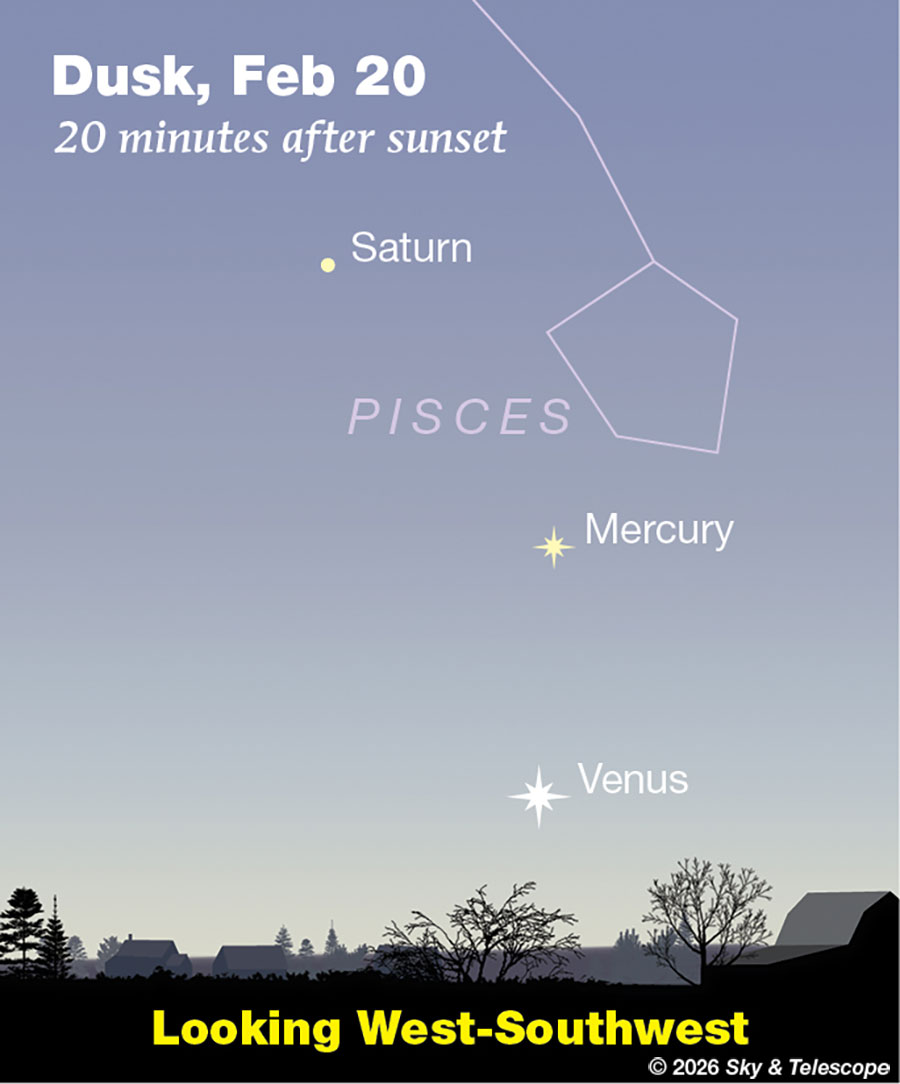
■ After sunset the waxing crescent Moon hangs high in the west-southwest. Watch the area down below it. As the sky fades into dusk, three of the solar system's five naked-eye planets glimmer into view there as shown below. Find an observing spot with a view down to the horizon to catch Venus. The line that Venus, Mercury, and Saturn make this evening is 18° tall, nearly two fists at arm's length.
■ By 8 or 9 p.m. the Big Dipper stands on its handle in the northeast. In the northwest, Cassiopeia also stands on end (its brighter end) at about the same height. Between them is Polaris, about as bright as most of the Big Dipper's stars.
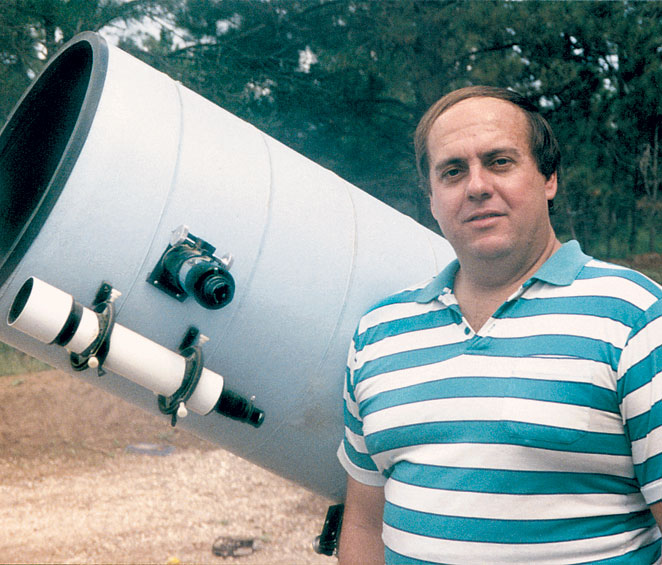
■ A binocular challenge: After dark, Kemble's Cascade awaits very high in the north-northwest, and there's only a little moonlight in the sky from the waxing crescent. The Cascade is a straight star chain 2¼° long, named in 1980 for its noticer Fr. Lucian Kemble in Canada. But it's located in dim, sprawling, shapeless Camelopardalis the Giraffe, difficult to navigate.
So here's a shortcut. Draw a line from Algol through Alpha Persei. Extend the line farther on by 1½ times that length. You're now very close to one end of the chain, a pair of stars magnitudes 6.8 and 6.2 a third of a degree apart.
In early evening the Cascade hangs down from the left star of those two (the fainter one), as shown below. Most of its 15 or so other members are 7th to 9th magnitude, so you'll need a dark sky. Averted vision helps, as always for faint sights.

Celestial north (the direction toward Polaris) is to the right. This frame is 3° tall, roughly half the width of a typical binocular's field of view. Image by Greg Parker and Noel Carboni
Lower left of its bottom end is a gentle arc of three brighter stars, mags 4.8 to 5.8, as seen above. These, combined with the mag-4.9 star near the middle of the Cascade, make a good finding aid.
Bonus for telescopes: That 6.2-mag star 1/3° to the right of the Cascade's top is the brightest of the sparse, small open cluster NGC 1502, only about 0.1° wide. Its next-brightest dozen stars are 9th and 10th magnitude.
And that 6.2-mag star near its the cluster's center is a wide telescopic double. Its components are nearly twins: mags 7.0 and 7.1, a nice 17 arcseconds apart.
SATURDAY, FEBRUARY 21
■ Have you ever seen Canopus, the second-brightest star after Sirius? As it happens, Canopus lies almost due south of Sirius: by 36°. That's far enough south that it never appears above your horizon unless you're below latitude 37° N (southern Virginia, southern Missouri, central California). And near there you'll need a very flat south horizon. Canopus crosses the south point on the horizon just 21 minutes before Sirius does.
So, when to look? Canopus is exactly due south whenever Beta Canis Majoris — Mirzam the Announcer, the 2nd-magnitude star about three finger-widths to the right of Sirius — is at its highest due south over your landscape. That's about 8 p.m. now, depending on how far east or west you are in your time zone. Drop straight down from Mirzam then.
■ Algol should be at its minimum brightness, magnitude 3.4 instead of its usual 2.1, for a couple hours centered on 9:22 p.m. EST.
■ Meanwhile, with a telescope watch for Jupiter's moon Io to slowly reappear out of eclipse by Jupiter's shadow at 8:53 p.m. EST. Io will swell into view almost half a Jupiter-diameter to Jupiter's celestial east.
SUNDAY, FEBRUARY 22
■ The thick crescent Moon shines below the Pleiades after dark. The Moon is a lesser distance upper left of the two or three brightest stars of Aries (for North America).
■ After dinnertime at this time of year, five carnivore constellations stand upright in a huge row from the northeast to the south. They're all presented in profile, with their noses pointing up and their feet (if any) to the right. These are Ursa Major the Big Bear in the northeast (with the Big Dipper as its brightest part), Leo the Lion in the east, Hydra the Sea Serpent in the southeast, Canis Minor the Little Dog higher in the south-southeast, and bright Canis Major the Big Dog in the south.
And hiding between Ursa Major and Leo is dim, poorly marked Leo Minor, and above that carnivore is Lynx, raising the total to seven.
MONDAY, FEBRUARY 23
■ Now the Moon shines just a degree or two from the Pleiades at nightfall. They're even closer later in the evening depending on your location.
TUESDAY, FEBRUARY 24
■ First-quarter Moon (exact at 7:28 a.m. EST). The Moon shines unusually high overhead around sunset; in fact the Moon goes right through your zenith if you're at the latitudes of southern Florida.
After dark you'll find that the Moon, in Taurus, is about one fist from the Pleiades on one side, a roughly similar distance Beta Tauri on the opposite side (Beta Tauri just misses 1st-magnitude status), and also from Aldebaran, which truly is 1st magnitude.
WEDNESDAY, FEBRUARY 25
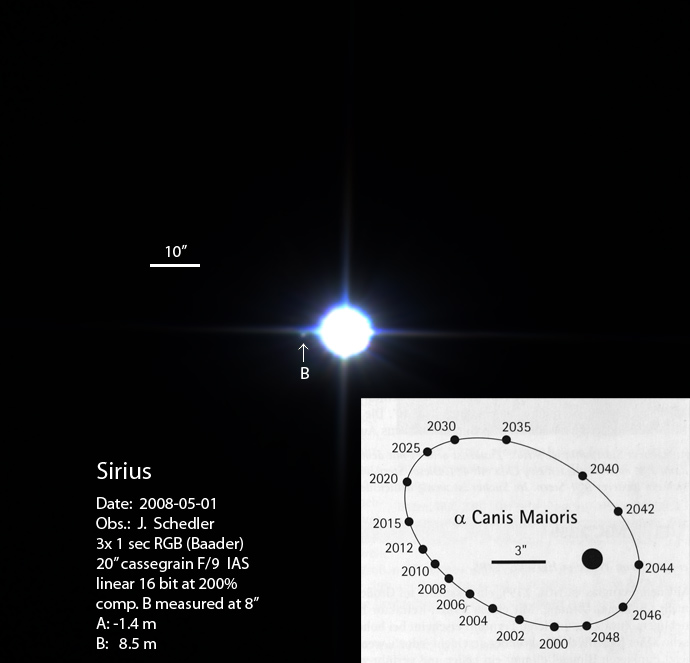
■ A serious challenge! Want to try for Sirius B, the famous white dwarf? Sirius A and B are still at about the widest apparent separation of their 50-year orbit: 11 arcseconds apart.
You'll want at least a 10-inch scope and a night of really excellent seeing. Keep checking night after night; the seeing makes all the difference for Sirius B. Clean optics help too. Use extreme high power, and look when Sirius is at its very highest in the south like it is these evenings. See the Sirius B hunting tips in Bob King's article Sirius B – A New Pup in My Life.
The Pup is northeast of the Dog Star and 10 magnitudes fainter: one ten-thousandth as bright. As Bob recommends, put a homemade occulting bar across your eyepiece's field stop: a tiny strip of aluminum foil held to the field stop with a bit of tape, with one edge crossing the center of the field. Use a pencil point to nudge the edge of the foil into sharp focus as you look through the eyepiece, holding the eyepiece up to a light source indoors.
In the telescope, rotate the eyepiece so you can hide dazzling Sirius A just behind the strip's northeastern edge.
If a diffraction spike gets in the way, rotate the telescope's tube if you can.
THURSDAY, FEBRUARY 26
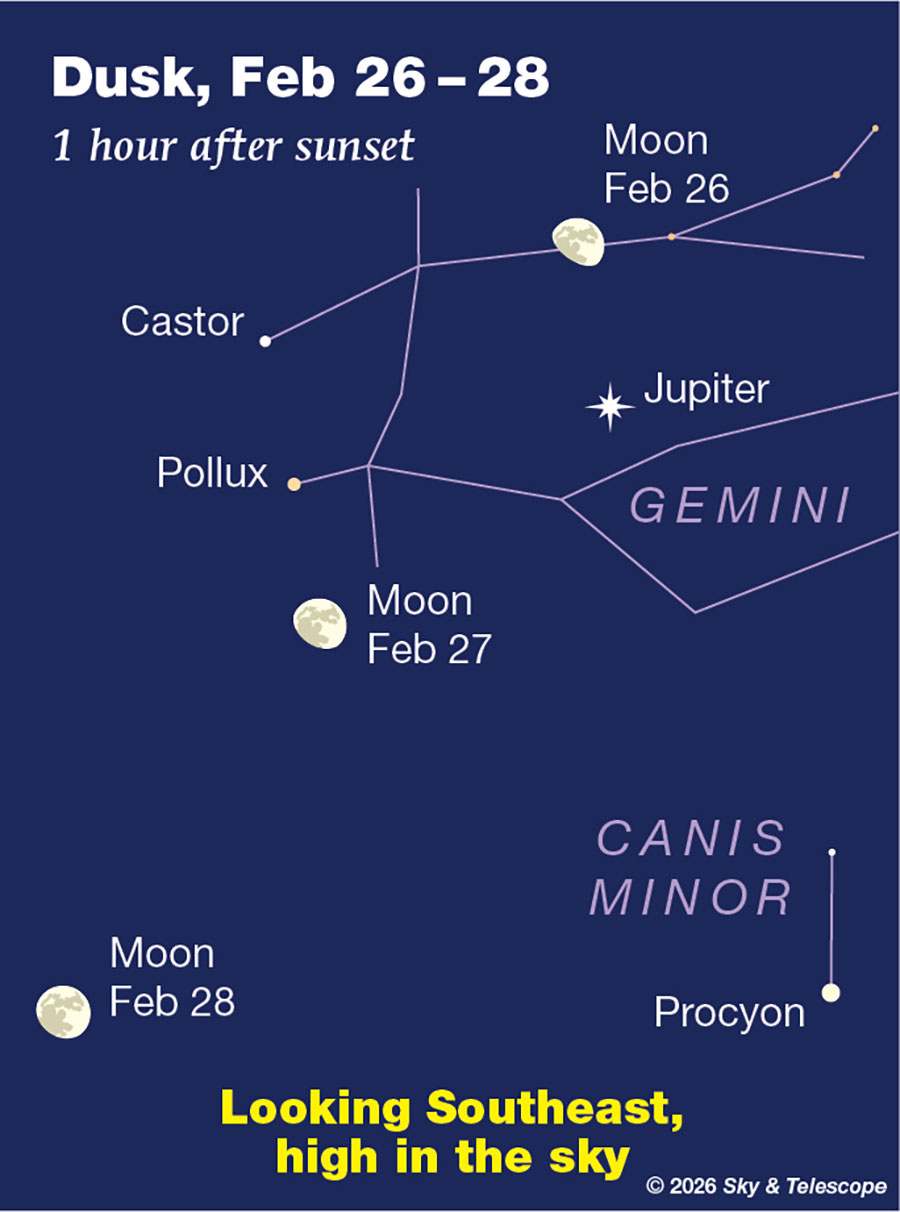
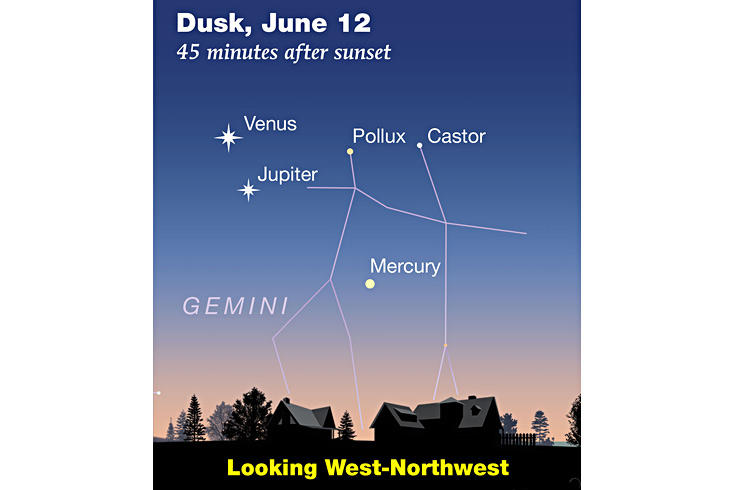
The gibbous Moon this evening forms a long rectangular box with Jupiter, Pollux, and Castor, as shown below. The exact position of the Moon, and thus the shape of the box, will depend on the time and on your location. The diagram is drawn for late twilight at latitude 40° north, 90° west, near the population center of North America. What will be its exact shape for you?
FRIDAY, FEBRUARY 27
■ Now the Moon, Castor, and Pollux form a more or less straight line, with Jupiter perpendicular to the line. More or less. How closely will the view for your location and time diverge from the pattern shown above? The difference is due to the nearness of the fast-orbiting Moon and your particular point of view toward it from Earth's large surface.
SATURDAY, FEBRUARY 28
■ This is the time of year when Orion stands straight upright due south as the stars come out. Later in the evening, and later in the month, he begins his long tilt down toward the west.
SUNDAY, MARCH 1
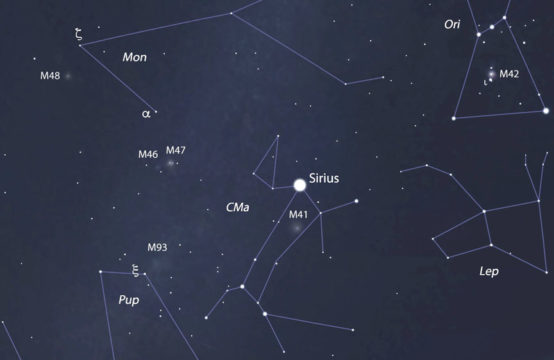
■ Sirius blazes high in the south on the meridian by about 8 p.m. now. Using binoculars or a scope at low power, examine the spot 4° south of Sirius (directly below it when on the meridian). Four degrees is somewhat less than the width of a typical binocular's or finderscope's field of view. Can you see a dim little patch of speckly gray haze there? That's the open star cluster M41, about 2,300 light-years away. Its total magnitude adds up to 5.0.
Sirius, by comparison, is only 8.6 light-years away — and being so near to us, it shines some 400 times brighter than that entire cluster.
Stellarium.
This Week's Planet Roundup
Mercury and much-brighter Venus pass each other quite low in the western twilight this week.
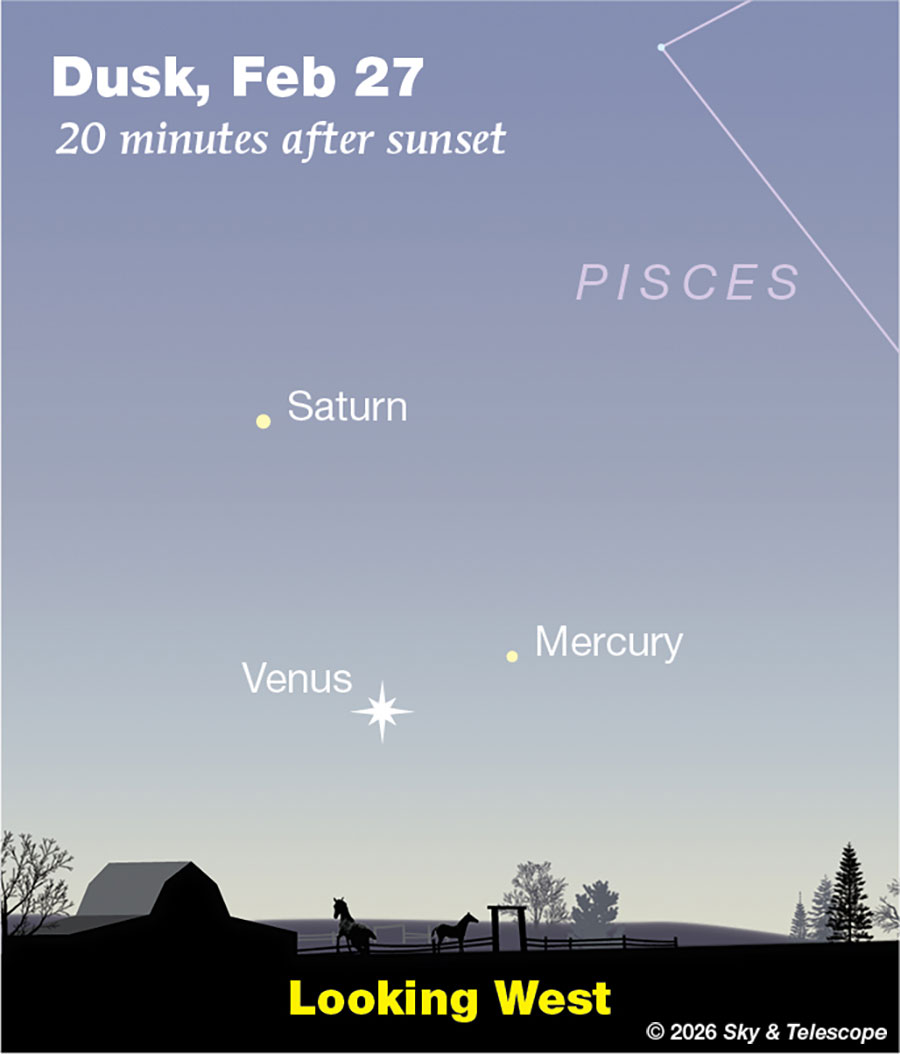
Venus, magnitude –3.9, is the lowest of the two. It gets the slightest trace higher in the sunset afterglow each day. Mercury, much fainter and fading fast, stands 8° above Venus on Friday the 20th, and 4½° to Venus's right or upper right at their conjunction on Friday the 27th. During this week Mercury fades fast: from magnitude –0.2 on the 20th to +1.6 on the 27th. That's a four-fifths drop in brightness! Bring binoculars.
Saturn, magnitude +1.0 watches this performance from above Mercury and Venus and a bit left. It's sliding down toward them day by day, on its way to passing Venus by 1° on March 7th and 8th. By then Mercury will be long gone.
Mars remains completely out of sight deeper in the glare of the Sun.
Jupiter is easy and obvious! It glares at magnitude –2.5 nearly overhead toward the south in early evening, and less high in the southwest later in the evening. In a telescope it's still 43 arcseconds wide, though it's shrinking and fading slightly as Earth pulls farther ahead of it in our faster orbit around the Sun. Jupiter doesn't set until far into the early morning hours.
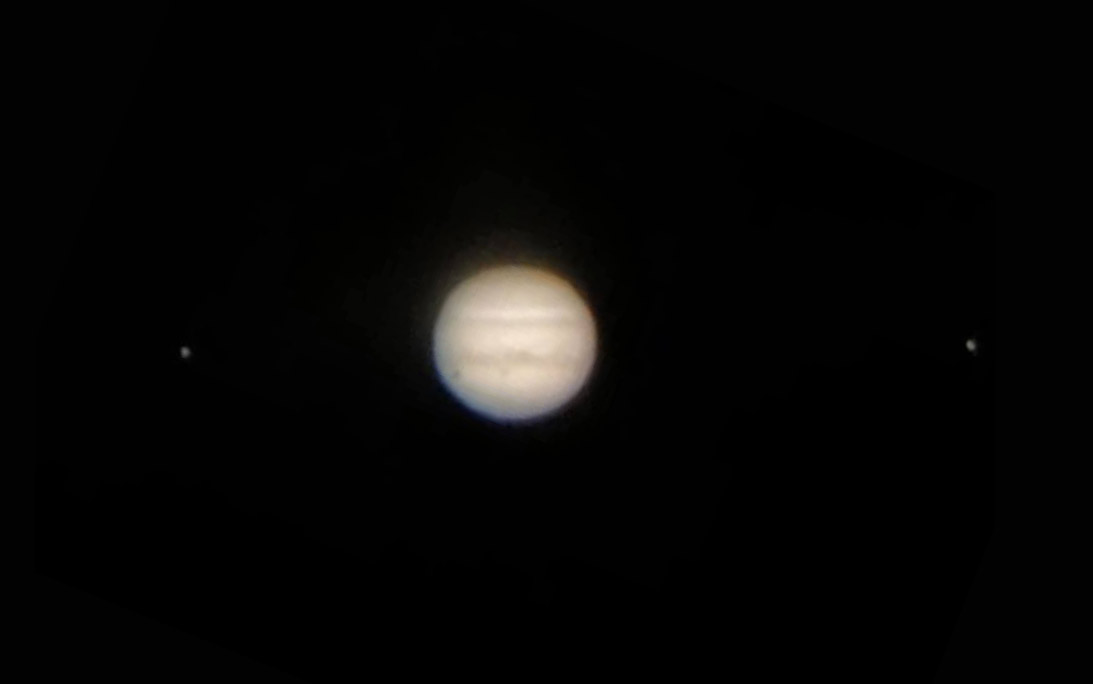
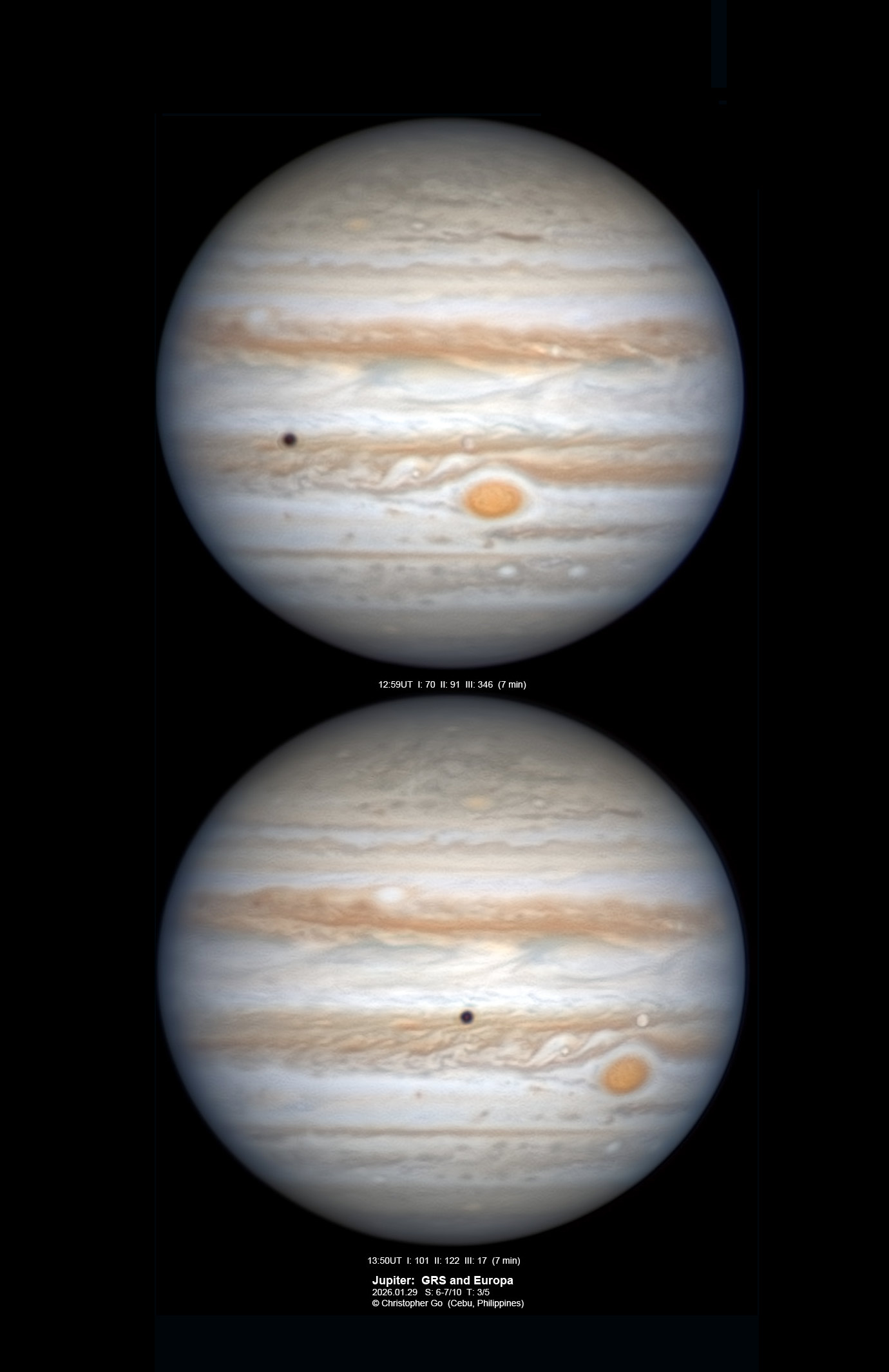
Jupiter's cloudtops always appear less bright toward the limb, making a bright-surfaced satellite like Europa stand out more distinctly when it's near the beginnings and ends of its transits.
Uranus (magnitude 5.7, in Taurus 5° SSW of the Pleiades) is high in the southwest these evenings. At high power in a telescope it's a tiny but non-stellar dot, 3.6 arcseconds wide. You'll need a detailed finder chart to identify it among similar-looking faint stars, such as the chart in last November's Sky & Telescope, page 49.
Neptune, magnitude 7.9, is 1° from sinking Saturn and is basically lost for the season.
All descriptions that relate to your horizon — including the words up, down, right, and left — are written for the world's mid-northern latitudes. Descriptions and graphics that also depend on longitude (mainly Moon positions) are for North America. Eastern Standard Time (EST) is Universal Time minus 5 hours. UT is also known as UTC, GMT, or Z time.
Want to become a better astronomer? Learn your way around the constellations. They're the key to locating everything fainter and deeper to hunt with binoculars or a telescope.
This is an outdoor nature hobby. For a more detailed constellation guide covering the whole evening sky, use the big monthly map in the center of each issue of Sky & Telescope, the essential magazine of astronomy.
For the attitude every amateur astronomer needs, read Jennifer Willis's Modest Expectations Give Rise to Delight.
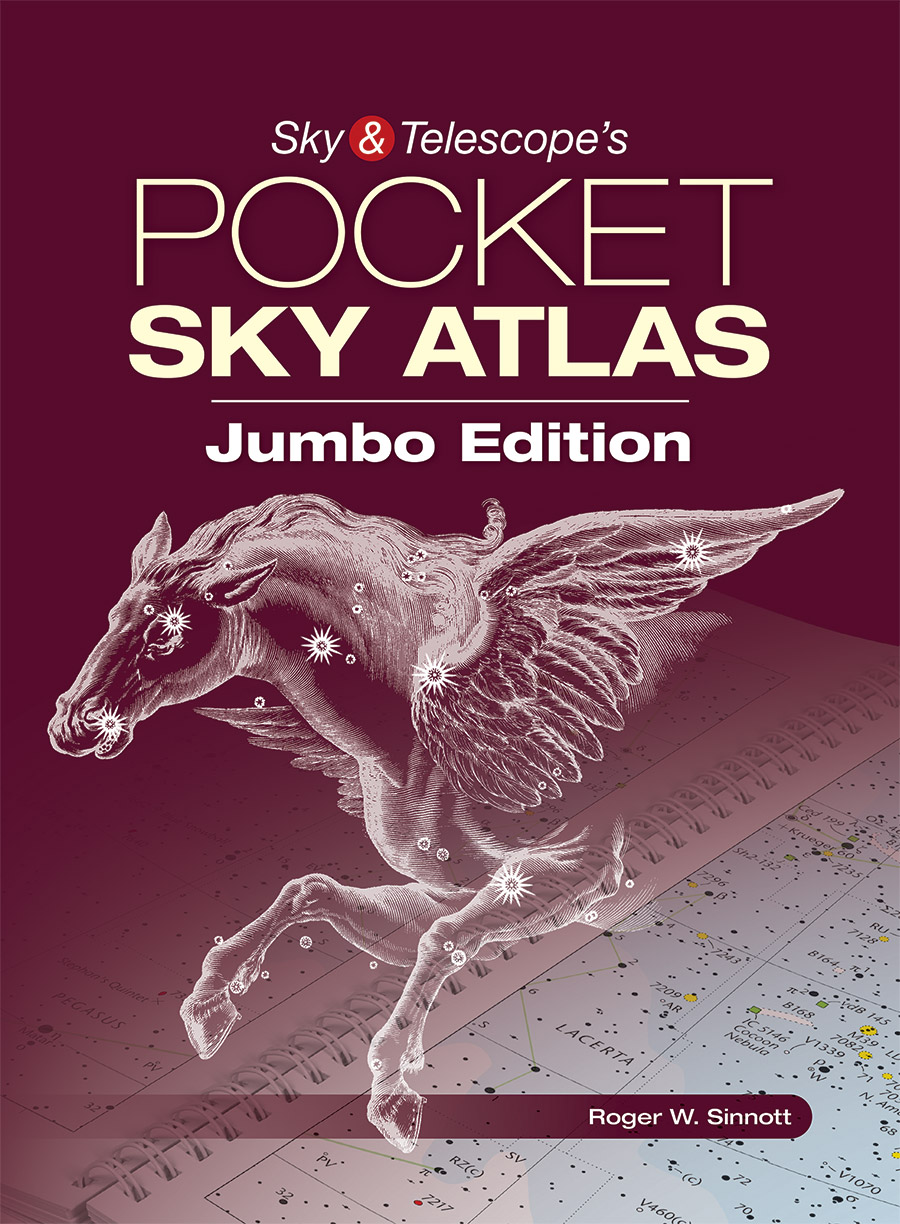
Once you get a telescope, to put it to good use you'll want a much more detailed, large-scale sky atlas (set of charts). The basic standard is the Pocket Sky Atlas, in either the original or Jumbo Edition. Both show all 30,000 stars to magnitude 7.6, and 1,500 deep-sky targets — star clusters, nebulae, and galaxies — to search out among them.
Next up is the larger and deeper Sky Atlas 2000.0, plotting stars to magnitude 8.5; nearly three times as many, as well as many more deep-sky objects. It's currently out of print, but maybe you can find one used.
The next up, once you know your way around well, are the even larger Interstellarum Deep-Sky Atlas (with 201,000+ stars to magnitude 9.5 and 14,000 deep-sky objects selected to be detectable by eye in very large amateur telescopes), and Uranometria 2000.0 (332,000 stars to mag 9.75, and 10,300 deep-sky objects).
Read How to Use a Star Chart with a Telescope. It applies just as much to electronic charts on your phone or tablet — which many observers find handier and more versatile, if sometimes less well designed, than charts on paper.
You'll also want a good deep-sky guidebook. A beloved old classic is the three-volume Burnham's Celestial Handbook. It was my bedside reading for years. An impressive more modern one is the big Night Sky Observer's Guide set (2+ volumes) by Kepple and Sanner. The pinnacle for total astro-geeks is the new Annals of the Deep Sky series, currently at 11 volumes as it works its way forward through the constellations alphabetically. So far it's up to H.
Can computerized telescopes replace charts? Well, I used to say this:
"Not for beginners, I don't think, unless you prefer spending your time getting finicky technology to work rather than learning how to explore through the sky yourself. As Terence Dickinson and Alan Dyer say in their Backyard Astronomer's Guide, 'A full appreciation of the universe cannot come without developing the skills to find things in the sky and understanding how the sky works. This knowledge comes only by spending time under the stars with star maps in hand and a curious mind.' Without these, 'the sky never becomes a friendly place.' "
But, things change. The technology has continued to improve and become more user-friendly — particularly with software that can now recognize any star field to determine exactly where the telescope is pointed — finally bypassing all aiming imperfections in the mount, tripod, gears, bearings and other mechanics, or in the user's skill in setting up.
The latest revolution is the rise of small, imaging-only "smartscopes." These take advantage of not only today's pointing technology, but also the vastly better capabilities of imaging chips and image processing compared to the human retina and visual cortex. The most sophisticated image stacking and processing can also come built right in. The result is decent deep-sky imaging from shockingly small, low-priced units. The image may be viewable on your phone or computer as it builds up in real time. Some can directly enable contributions to citizen-science projects.
Smartscopes are changing the hobby at the entry level. For more on this revolution see Richard Wright's "The Rise of the Smart Telescopes" in the November 2025 Sky & Telescope. And read the magazine's review of this especially small one.
If you get a larger, more conventional computerized scope that allows direct visual use, make sure that its drives can be disengaged so you can swing it around and point it readily by hand when you want to, rather than only slowly by the electric motors (which eat batteries).
 Audio sky tour. Out under the evening sky with your
earbuds in place, listen to Kelly Beatty's monthly
podcast tour of the naked-eye heavens above. It's free.
"The dangers of not thinking clearly are much greater now than ever before. It's not that there's something new in our way of thinking, it's that credulous and confused thinking can be much more lethal in ways it was never before."
— Carl Sagan, 1996
"Facts are stubborn things; and whatever may be our wishes, our inclinations, or the dictates of our passion, they cannot alter the state of facts and evidence."
— John Adams, 1770
About Alan MacRobert
Alan M. MacRobert became an avid Sky & Telescope subscriber in 1966 at age 14, joined the editorial staff in 1982, and is now a senior contributing editor, semi-retired. He played a role in practically every part of the magazine and the company's other products for more than a generation, both on the amateur-observing side and the science-reporting side. In 1994 a book collection of his observing how-tos and telescopic sky tours was published as Star Hopping for Backyard Astronomers. He has produced This Week's Sky at a Glance online every week since 1989.




Comments
You must be logged in to post a comment.