 SUNSET:

First Family to See First Light
Thanks to eight months of urging by amateur astronomers, President Obama and his family are about to host the first-ever star party at the White House.
LCROSS Readies to Shoot the Moon
Early Friday morning, two spacecraft will slam into a permanently shadowed crater near the Moon's south pole in the hope of finding water there.
Planet Trio Dances at Dawn
Jupiter, the King of Planets, has the evening sky pretty much all to itself. But three other planets — Venus, Mercury, and Saturn — are putting on quite a show in the east before dawn.
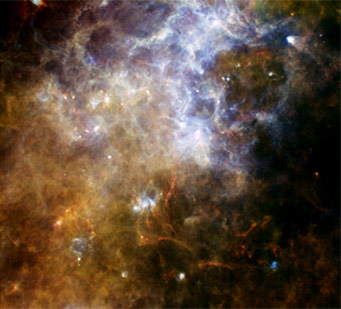
Big Pix from Herschel
Europe's new Herschel Space Observatory is up and running and showing what it can do. You've never seen the far-infrared sky like this.
Get Ready for "Galilean Nights"
Galileo saw some amazing sights when he turned his telescope to the heavens 400 years ago. Now you can relive his discoveries — and share the excitement with others!
The 2009 Lennart Nilsson Awards
Scientist Carolyn Porco and amateur Babak Tafreshi share a prestigious award for science photography.
Messenger's Third "Taste" of Mercury
Today a NASA spacecraft zipped past the innermost planet at close range, a move designed to set up a return visit in 2011 that will cap seven years of wandering through the inner solar system. Three flybys down, one orbit insertion to go!

The Humid Moon
Just-released infrared maps of the Moon reveal traces of water and hydrated minerals (colored blue) clinging to large tracts of the lunar surface. Is there enough of it for future astronauts to collect and drink?
ALMA Dish Takes the High Road
The Chajnantor plateau in Chile's Atacama Desert has an elevation of more than 16,000 feet — harsh conditions for humans, but perfectly suited to the world's greatest array of submillimeter-wave radio telescopes, now under construction.

Planck Sees "First Light"
European astronomers are delighted that their new microwave-background spacecraft has successfully begun making its highly detailed map of tiny temperature variations across the sky — the key to revealing insights about how the Big Bang happened and how the earliest galaxies formed.
Juno in the Spotlight
For the next few weeks, you have the opportunity to spot one of the first asteroids ever discovered.
CoRoT-7b, the Lava Planet
A "super-Earth" planet discovered last February turns out to be just as dense and rocky as Earth. But with its day side seared to perhaps 2,700°F, there might not be much solid ground to stand on.
Stellar Mystery Solved, Einstein Safe
Astronomers have resolved a long-standing discrepancy with general relativity.
Super-Earth "Planet From Hell" Refined
CoRoT-7b, a hot super-Earth orbiting an orange dwarf in Monoceros, had proved to be rocky, not gaseous. It's truly a Dante-like inferno, with liquid-lava temperatures on one side and unearthly cold on the other.
New Crater Picked for LCROSS Impact
When NASA slams a spacecraft into the dust near the Moon's south pole next month, the crater named Cabeus will briefly achieve worldwide fame.
Citizen Sky Wants You!
Backyard astronomers of all types and experience levels can participate in a real-world science project — and help solve a mystery involving the star Epsilon Aurigae that's puzzled astronomers since 1821.
Refurbished Hubble Shows Its Stuff
Hubble's upgraded cameras and instruments are fully up and running. NASA has released a bunch of new pictures and results showing off what the buffed-up scope can do.
Two Observatories Saved from Wildfire
Although Southern California's devastating Station Fire still rages nearby, the Mount Wilson and Stony Ridge observatories have escaped destruction.
McNaught Bags His 50th Comet
From his skywatching (ad)vantage under Australia's dark skies, super-sleuth Rob McNaught has found more comets than anyone else in history.
A Second SoCal Observatory in Peril
Stony Ridge Observatory, an amateur-built icon for 46 years, is endangered by the same California wildfire that has been threatening Mount Wilson.
