 SUNSET:

Strange Brew at LCROSS's Crash Site
NASA scientists haven't said much since a spacecraft and its carrier rocket slammed into a lunar crater on October 9th. One reason might be that they can't believe what they're finding there.

Galilean Nights in Argentina
Galilean Nights was a smash hit at the Galileo Galilei planetarium in Buenos Aires.
Blast from the Very Far Past
A gamma-ray burst seen to occur last April happened in the era of the earliest stars, when the universe was only 630 million years old and the "reionization era" was getting under way. But this news isn't exactly news.

Is Fermi Seeing Dark Matter?
A new analysis showing a cloud of high-energy particles hovering around the center of the Milky Way could be the signature of dark matter and evidence of a “dark force”, but not everyone is convinced.

Cosmic Blast Rattles Indonesia
As if this island nation hasn't been troubled enough by recent earthquakes, impact specialists confirm that a cosmic "bomb" — likely the most powerful in 15 years — exploded noisily (but harmlessly) over one of its provinces on October 8th.
How To See a Black Hole
Surprising advances in radio astronomy have put astronomers within reach of imaging the supermassive black hole in the Milky Way and the active galaxy M87.
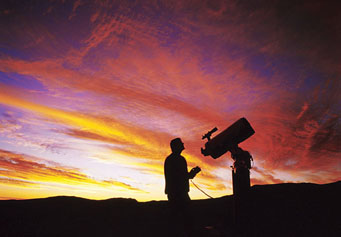
Tribute to Stefan Seip
Stefan Seip, who shot the cover photo for SkyWatch 2010, is one of the world's leading astrophotographers.

My Mexican Observing Expedition
Early this month astronomers made the first serious attempt to record the passage of a Kuiper Belt object in front of a star. Here's the story of Boston-area amateur Bruce Berger's trip to an observatory in Mexico to capture this historic event.
And Then There Were 400
Thirty new extrasolar planets are announced, including more super-Earths and some that orbit low-metallicity stars.
The Orionid Meteors are Here!
October's Orionid meteor shower isn't one of the year's richest, but it's a chance to see bits of dust shed long ago by Halley's Comet colliding with Earth's atmosphere. For the next few nights, with moonlight not a factor, you might spot an Orionid every few minutes from a dark-sky location.

Simulations Justify Earth's Existence
Theories of solar-system formation have a hard time explaining why Earth didn't spiral into the Sun. Now there's a possible explanation.
Podcast: Saving Mt. Wilson
What do you do when a wildfire threatens to engulf your observatory? In the latest episode of The Universe in Mind podcast Hal McAllister tells the story of the battle to save Mt. Wilson. Author Marcia Bartusiak puts the famous observatory in context with her new book about the discovery of the modern universe.
December 21, 2012
In case you haven't heard, there's a rumor going around that the world will end on December 21, 2012. Did the Mayans really predict the world would end then? Is the astronomy for real? Do we have anything to worry about? Not surprisingly, the answers are "no," "no," and "of course not."
Mel's Arecibo Adventure
A globetrotting mascot gets a behind-the-scenes tour of the world's largest single-dish radio telescope.
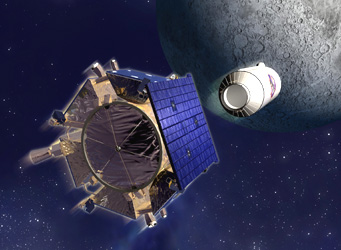
The LCROSS Impact, Continued
We've added updates our story on the Moon probe that NASA hoped would raise a big dust-and-vapor splash. The debris plume has indeed been seen. But how much information can be extracted from it?
Less Ado About Apophis
Now you can make plans for April 13, 2036, without worrying about a giant space rock crashing into Earth and ruining your day.
Stargazing with the Obamas
It was a star-studded Kodak moment: Last night, under clear skies, President and Mrs. Obama did a little stargazing from the White House South Lawn.
Saturn's New King of the Rings
Faint but real, a newly found ring encircles Saturn out to distances of 11 million miles.
A Fall to Earth, One Year Later
Planetary astronomers had less than a day's notice before asteroid 2008 TC3 crashed into Earth one year ago. But they've made the most of the strange black fragments of it that fell to the ground that day.
Veteran S&T Editor Wins Reporting Award
J. Kelly Beatty has received plaudits from the planetary-science community he has covered for 35 years.
