 SUNSET:

Dark Matter and Dark Energy Update
From the Milky Way's halo to the far reaches of the cosmos, the two dominating components of the universe are revealing more hints about themselves.
See the Stars with Worldwide Eyes
Have you ever wanted to try "virtual observing"? Here's your chance! This weekend you can view fabulous deep-sky objects in both the northern and southern sky by logging on to a special two-day event spearheaded by Astronomers Without Borders

WISE Sees First Light
Scientists unveil the first image from the Wide-field Infrared Survey Explorer satellite, which will map the sky in depth and detail at new wavelengths.
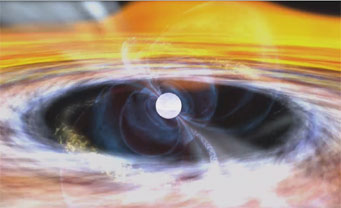
A "Treasure Map" of Millisecond Pulsars
The gamma-ray sky map assembled by the Fermi satellite points the way to finding natural, high-precision "clocks." These could be used in a cosmic GPS-like system to look for flexings of spacetime.

Black-Hole Bonanza
Astronomers announce supermassive double holes, an intermediate-mass hole that seems to have pulled apart a star, fast-spinning holes, and a screaming runaway.
Big News in Epsilon Aurigae Mystery
What's really eclipsing this naked-eye star? Astronomers using the Spitzer Space Telescope think they've finally solved a nearly two-century-old puzzle.
Kepler's First Exoplanet Results
NASA scientists announced this morning that the Kepler planet-hunting probe is working great, has produced a slew of results, and is working at high enough precision that it should be able to determine the abundance, or rarity, of Earth-size worlds galaxy-wide.
Eclipsing in the New Year
Skywatchers in Europe and Asia saw more than fireworks when they looked up on New Year's Eve.

Tour January's Sky! | December 31st, 2009
Midwinter evening skies are alive with celestial activity — after sunset you'll find Jupiter in the southwest, and Orion, Mars, and much more over in the east.Host: S&T's Kelly Beatty. (5.9MB MP3 download: running time: 6m 27s)
Eclipses in 2010
The first year of the new decade features four eclipses, two solars and two lunars. You'll want water wings to see the total solar eclipse on July 11th, which crosses only a few tiny bits of land. December's complete lunar coverup is the first in nearly three years.
Saturn's Prometheus: Just Plain Weird!
A remarkable new close-up of a "ring shepherd" reveals muted surface features that make it look more like a giant gray potato than a planetary satellite.

Meteor Showers in 2010
Everyone loves to watch "shooting stars" blaze across the sky. Sky & Telescope predicts that 2010's best meteor showers should be the Perseids in August and the Geminids in December.
A Breeding Ground for Cosmic Rays
It took 137 hours of staring at the starburst galaxy M82 by a quartet of large telescopes in Arizona, but astronomers have finally confirmed a long-held theory about where the universe's most potent particles originates.
December's Blue Moon? Bah, Humbug!
This month brings full Moons on the 2nd and 31st — a doubling-up that's neither rare nor noteworthy.
A Glint of Sunlight from Titan
With the Sun climbing higher in the northern hemispheres of Saturn and its retinue of moons, the Cassini spacecraft captured a specular reflection off the surface of Titan — and nailed the case for lakes of liquid ethane.

An Accidental Asteroid Occultation?
It's probably the smallest Kuiper Belt object ever seen, but the evidence is indirect, and not all are persuaded.
A Weird, Wonderful Waterworld?
The first super-Earth seen transiting its star has the same density as rocky Earth. Now a second one has a the same mass but a lower density — indicating that it's water almost all the way through, with a massive atmosphere to boot.
Hubble Goes Deep(est) Again
A remarkable new view from the reinvigorated Hubble Space Telescope reveals primordial galaxies seen only about 600 million years after the Big Bang.
WISE: A Very Cool Space Telescope
Early this morning a Delta rocket soared into the predawn darkness over California. It carried aloft a space observatory designed to map hundreds of millions of hidden cosmic treasures at infrared wavelengths.
