 SUNSET:

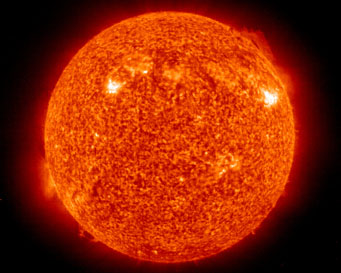
The Sun is Back!
After a couple of relatively dormant years, the Sun is showing signs of major activity again.
Future Shock From Gliese 710
Is our solar system's Oort Cloud in danger of being stirred up by a passing star? A fresh analysis of Hipparcos observations argue that the answer is most likely "yes" — but not for another 1.4 million years.

Phenomenal Phobos
On March 7th, the European orbiter Mars Express had a close encounter with a little moon about which scientists have big questions.
NASA to Upgrade, Overhaul Its "Big Ears"
Day in, day out, the radio antennas of NASA's "Deep Space Network" handshake with dozens of spacecraft across the solar system. Now the network's three stations are getting improvements that will keep them operating for decades.
The Milky Way's Killer Instincts
Don't let its graceful spiral form fool you: our home galaxy is a cannibal. It's long been accused of having gobbled up smaller dwarf galaxies in its vicinity — and two new observations make an ironclad case for the prosecution.
Zodiacal Light's Mystery Solved
Eerie and elusive, the zodiacal light is created from sunlight glinting off countless dust particles in the inner solar system. At last, astronomers have figured out where all that grit comes from.

Fastest Known Binary Star
In the time it takes you to read this news story, the ultra-tightly paired stars known as HM Cancri will have completely spun around each other.
Zodiacal Light in the Evening
The zodiacal light is on its best display in the Northern Hemisphere on moonless evenings from February through April.
Ski Luna!
Geologists once believed the Moon was utterly dry. But just-announced results argue that abundant water ice lies stashed inside lunar craters near the north pole.
Chilean Observatories Survive Quake
All the major amateur and professional telescopes in Chile are in good working order despite Saturday's powerful earthquake.
Is Kepler Finding "Lite" White Dwarfs?
One year after launch, NASA’s Kepler mission draws out the brainpower of the astronomical community to solve a stellar paradox.
Halfway to Pluto
Zipping outward at more than 36,000 miles per hour, NASA's New Horizons spacecraft has reached a point where it's closer to its target, Pluto, than it is to the Sun. Only 1½ billion miles to go!

Tour March's Sky! | February 25th, 2010
What a difference a month makes! The lengthening days, together with a switch to daylight time, mean that the evening constellations are changing rapidly. So use this easy-to-follow audio tour to figure out what's what. Host: S&T's Kelly Beatty. (6.5MB MP3 download: running time: 6m 52s)
Ancient Galaxies Finally Get Together
It's taken some 10 billion years, but a compact group of small galaxies is at last merging into a single big one.
Globe at Night is Happening Now!
Globe at Night, an effort to measure light pollution around the world, runs from March 3-16, 2010. Will you help meet this year's target of 15,000 more participants?
Supernova Mystery Remains Just That
Despite a recent claim, astronomers still don't understand an important class of exploding stars.
Spiral Galaxies Exist — But Why?
New observations of the early universe, combined with models of how galaxies formed and collided in the eons since, are helping cosmologists understand why so many beautiful pinwheels dot the sky.
WMAP Refines "Precision Cosmology"
With seven years of data, the WMAP cosmology satellite has refined the age of the universe and other key cosmic parameters. The results strengthen the "standard model" of inflationary cosmology.
NASA's New Eye on the Sun
Thursday's launch of the Solar Dynamics Observatory gives astronomers the power to reveal the goings-on deep inside our star.
Stargaze Locally, Party Globally!
Get ready for a worldwide star party! Global Astronomy Month will feature a host of activities, large and small, throughout April.
