 SUNSET:

Rare Occultation by a Double Asteroid
Early on Tuesday, July 19th, lucky observers along a 120-mile-wide path from north-central California to central Saskatchewan have a chance to watch a big, enigmatic double asteroid briefly cover a relatively bright star in Aquarius.
Even if you're nowhere near the path, one enterprising observer plans a live webcast of the view through his telescopes during the event.

Neptune in Motion
Sky and Telescope's editor Sean Walker puts together NASA's anniversary images of Neptune to create a movie that shows a day on the blue planet.
Happy Birthday, Neptune!
On July 12th, Neptune completed one full circuit around the Sun since its discovery on the night of Sept 23-24, 1846.

Tour July's Sky! | June 30th, 2011
Look low in the west at sunset to spy fleet Mercury, toward southwest for Saturn, and in the south for red-hued Antares, the "rival of Mars."
Is Asteroid 2011 MD Space Junk?
For a while, it seemed possible that the asteroid that will buzz Earth on Monday is actually the upper stage of a rocket.
Asteroid To Buzz Earth Monday, June 27th
Asteroid 2011 MD is expected to pass less than 8,000 miles above Earth's surface around 1 p.m. EDT (17:00 UT) on Monday.
June 15th Lunar Eclipse Observed
Many people in the Eastern Hemisphere enjoyed a long, satisfying, and extraordinarily dark lunar eclipse on June 15, 2011.

A Comet Worth Waiting For?
Observers using the automated Pan-STARRS 1 telescope in Hawaii have found a new comet. As of right now, it might brighten to 1st magnitude in early 2013, but it's far too early to be certain of that.
June 15th's Deep, Eastern Lunar Eclipse
Those of you in the Eastern Hemisphere are in for a treat: the deepest, longest total lunar eclipse in more than a decade.

Video: Remarkable Explosion on the Sun
After three years of minimal activity, the Sun has come alive. This video of a 3-hour eruption earlier today beats anything you've seen.
Supernova Erupts in Whirlpool Galaxy
Supernova 2011dh in M51 seems just past its peak at around magnitude 12.7. With the Moon now gone from the evening sky, the next clear nights are your best chance. It should be visible through an 8-inch telescope in any but the worst skies.
Tour June's Sky! | May 31st, 2011
Saturn stands nearly motionless in Virgo all month, as other zodiacal constellations parade to its left and right on these early summer evenings.

Uranus and Neptune in 2012
Uranus and Neptune are easy to find with the aid of the charts in this article.
Uranus and Neptune in 2011
Uranus and Neptune are easy to find with the aid of the charts in this article.
5,000 Megapixels of Sky
Seattle amateur Nick Risinger had an idea and some free time. One year and more than 37,000 images later, he's created an awesome panorama of the entire celestial sphere.
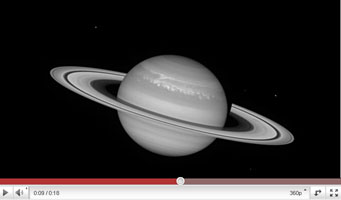
Saturn in Motion
Watch Saturn rotate in this high-definition time-lapse video courtesy of the Hubble Space Telescope and S&T imaging editor Sean Walker.
Watch a Star Wink Out on August 10th
On the evening of Wednesday, August 10th, the Moon will cover the 2.9-magnitude star Pi Sagittarii for the eastern half of North America.

See the Eta Aquarid Meteor Shower
The Eta Aquarids might be the best meteor shower that you've never heard of. Best viewed at southerly latitudes, this shower is strong in the predawn hours from May 4th through May 8th.
A Great Time for Space-Station Watching
For the next week, the enormous International Space Station will be slam-dunk easy to spot in the evening sky — if you know where and when to look for it.
The Fickle Lyrid Meteors
Even though moonlight will interfere with this year's Lyrid meteor shower, skywatchers should be alert for a possible outburst on the mornings of April 22nd and 23rd.
