 SUNSET:


Meteor Showers 2013
Sky & Telescope predicts that 2013's best meteor shower should be the Perseids in mid-August, but this will also be a good year for the lesser-known Eta Aquariids in early May.
ALMA Minds the (Planet‑Forming) Gap
For the first time, astronomers have imaged a key stage in planet formation, witnessing the gas streams that signal two gas giant planets sweeping up material around a star.

Tour January's Sky! | January 1st, 2013
Jupiter is the unrivaled king of the evening sky this month. Use it as a benchmark to find a pair of star clusters and other interesting celestial sights.
Triple Stars in Far-Flung Relationships
New simulations suggest that sometimes "three's a crowd" when stars form — and that chaotic interactions can leave two stars close together and fling a third (such as reddish Proxima Centauri, at left) into a distant orbit.

Catch the Quadrantids in Moonlight
Undeniably one of the year's best, the Quadrantid meteor shower peaks on the morning of Thursday, January 3rd. The best viewing opportunity comes between 1 a.m. and dawn, but you'll have competition from a waning gibbous Moon.
Radio Astronomy in the Aussie Outback
It's not easy to get to the Murchison Radio Observatory in Western Australia. Being in one of the most remote regions of the country means there's hardly any radio interference that might otherwise compromise the astronomical observations. It's one of the most radio-quiet zones on the planet.
Sutter's Mill: A Meteoritic Gold Mine
When a brilliant daylight fireball broke apart over California on April 22nd, professional and amateur meteorite hunters sprang into action — and their effort to recover fragments quickly has been dramatically rewarded.
Will the World End on December 21st?
Editor in Chief Robert Naeye goes out on a limb and predicts that the world will not end today. But with tongue in cheek, let's count the ways the world could end.
Planets Around Tau Ceti? Not So Fast.
News media have pounced on the recent announcement of a five-planet system around Tau Ceti, a nearby Sun-like star. But is the hubbub merited?
Toutatis Revealed by Chinese Spacecraft
Chang'e 2, a Chinese spacecraft that was orbiting the Moon 18 months ago, has wowed space-watchers around the world by returning detailed images of asteroid 4179 Toutatis taken during a close-in, high-speed flyby.
On the 40th Anniversary of Apollo 17
Forty years after the last human visitors departed the Moon aboard Apollo 17, space historian Andrew Chaikin talks about why we should return.
See Ceres at Its Best for 2012
Ceres, the biggest asteroid and brightest dwarf planet,shines at magnitude 6.9 or brighter from December 12-25.

Hubble Takes Galaxy Census
New observations by the Hubble Space Telescope reveal some of the earliest galaxies in the universe.
Big River on Titan
The Cassini spacecraft has spotted what could be the longest river system seen beyond Earth. The river looks like it's feeding into a sea on Saturn's moon Titan.
Sir Patrick Moore, 1923-2012
Britain's celebrated skywatcher and night-sky popularizer, synonymous with astronomy worldwide, died peacefully on Sunday at age 89.

Spacetime Ripples on the Horizon?
Scientists might be closer to detecting one prediction of Einstein's theory of gravity than they thought they were.
“Sky-Is-Falling” Asteroid Flies By
The Earth-crossing asteroid 4179 Toutatis is making one of its close flybys, gliding among the stars and awaiting your telescope. Its magnitude will be 10.9 to 10.5 from December 11th through 14th.
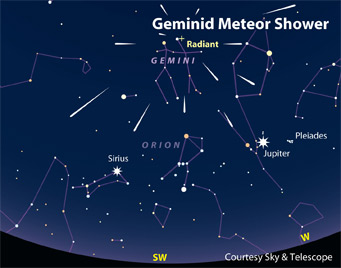
Geminid Meteors to Peak the Night of Dec. 13th
If it’s clear late Thursday night, December 13th, keep a lookout overhead for meteors of the Geminid shower.

Tour Jupiter with Our Newest App
Jupiter reigns big and beautiful over December's sky. Now you can take our newest app with you as a guide to Jupiter's moons, Great Red Spot, and more.
Gravity Probes "See" Deep Lunar Secrets
Just by circling the Moon every 2 hours while keeping hyper-accurate track of each other's motions, twin spacecraft named Ebb and Flow have mapped the lunar gravity field in unprecedented detail — and opened a window on the Moon's ancient, battered interior.
