 SUNSET:


Lessons from the Russian Meteor Blast
Friday's meteorite explosion over Russia offers the strongest motivation yet for investigation of near-Earth objects.
Culprit Pegged for Cosmic Rays
Astronomers working with the Fermi Gamma-ray Space Telescope say they might finally have the “smoking gun” they’ve needed to convict supernova remnants as the origin of energetic particles called cosmic rays.
Asteroid 2012 DA14 to Zip Past Earth
On February 15th, a 150-foot-wide rock will make the closest pass by Earth of any asteroid predicted far in advance. You may be able to follow it in a telescope.
A Whirlwind South Pole Tour
S&T contributing editor Govert Schilling tells the story of his recent expedition to the unique science laboratory located at the inhospitable South Pole.
Name Pluto's Moons!
Two of Pluto's moons have no proper names, but that's about to change. Planetary astronomer Mark Showalter announces a contest where you can help name the newest discoveries.

Curiosity Digs In During Drill Test
Six months after landing inside Gale crater, NASA's beefy rover finished the last major equipment check when it drilled deeply into a Martian rock.
Five Amateurs Share Edgar Wilson Award
Discovering a comet remains one of amateur astronomy's greatest accomplishments, and five individuals are being honored for doing just that.

Uranus and Neptune in 2013
Uranus and Neptune are easy to find with the aid of the charts in this article.
Amateurs Help Hubble Unveil Spiral
Robert Gendler stitched together a stunning mosaic of spiral galaxy M106, filling in gaps in Hubble coverage with his own and Jay GaBany's ground-based observations.
Harbingers of Death: Predicting Supernovae
A massive outburst may give a month’s advance notice of when certain giant stars will go supernova. That’s not great for evacuation plans, but perfect for observers who want to catch a supernova in action.
Earth-Size Planets Common, But Are They Habitable?
The best place to look for nearby Earth-size planets might be the smallest, coolest stars — but these stars could also be bad for creating Earth-like planets.

Tour February's Sky! | February 1st, 2013
Evening skies feature two bright planets: Mercury, which lurks low in the west after sunset around the 16th, and Jupiter, which reigns high in the southern sky all month long.
The First-Ever Meteorite from Mercury?
Is this a piece of the innermost planet? Northwest Africa 7325 is a meteorite like no other — in fact, it's a near-perfect geochemical match to the surface of Mercury.
Water Once Flowed Under Mars's Surface
Fossilized wrinkles in impact craters suggest once again that water might once have flowed on Mars — this time, beneath the surface.
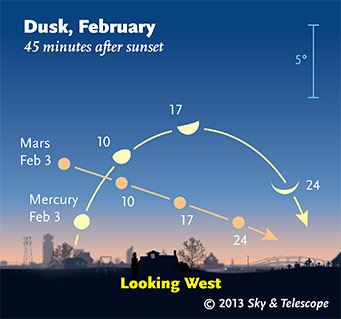
Mercury in February 2013
Mercury has a fine evening apparition in February 2013, featuring an extraordinarily close conjunction with Mars.
Mercury Meets Mars
Mercury and Mars, the two smallest planets, appear spectacularly close to each other shortly after sunset on Thursday and Friday, February 7th and 8th.
Amateurs Help Find Multi-Planet System
Amateur astronomers perform a crucial role in detecting exoplanets by a technique called microlensing, including the most recent discovery of a multiple-planet system.
(Really) Cool View of Andromeda Galaxy
Nearing the end of its mission, ESA's Herschel Space Observatory has delivered a highly detailed map of extremely cold gas and dust in the iconic Andromeda Galaxy.
Dead Stars: Good Exoplanet Targets?
White dwarfs can have stable habitable zones for a few billion years, and planets with Earth-like atmospheres might be much easier to detect around these stellar remnants than normal, hydrogen-fusing stars.
The Evening Zodiacal Light in 2013
The zodiacal light shows very well from dark locations at mid-northern latitudes starting about 80 minutes after sunset on moonless evenings from late January to early April.
