 SUNSET:

Celebrate the Night — This Week, This Month
Anytime is a good time for a star party, but April offers some of the best opportunities to get out under the night's beauty. Take your pick: there's Globe at Night, International Dark-Sky Week, Astronomy Day, and Global Astronomy Month.
Black Hole Wakes for a Light Snack
Astronomers might have glimpsed a supermassive black hole snacking on a brown dwarf in a galaxy 47 million light-years away.
The Oldest, Loneliest Supernova
A distant explosion of a white dwarf, the oldest of its kind, may help reveal the cause of death for other, closer dwarfs.
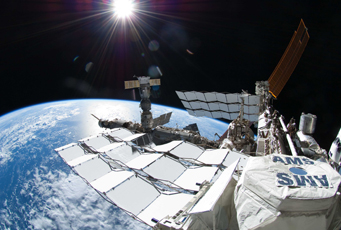
Possible Dark Matter Signal?
Scientists using an instrument aboard the International Space Station have measured a signal that might come from dark matter — or might not.
Can Stars Form in our Galaxy's Center?
Observations of Milky Way’s chaotic center show hints of stars forming just two light-years away from our galaxy’s supermassive black hole.
Comet PanSTARRS Offers M31 Photo Op
For observers at high northern latitudes, Comet PanSTARRS is now visible in a dark sky right at the end of twilight. And this week it's passing the Andromeda Galaxy.
Scientists Share Absurdly Exciting News
This year's April Fools' was a productive day for astronomers — catch up on all the shenanigans.

Tour April's Sky! | March 29th, 2013
Celebrate "Global Astronomy Month" by strolling outside to take in all the evening sky sights. Jupiter and Sirius frame Orion nicely in the west, while Saturn is low in the east an hour or two after sunset.
Is Saturn's Family Showing Its Age?
A detailed analysis of Cassini images suggests that the rings of moons of Saturn are ancient creations that in recent times have been coated to varying degrees by a dark, reddish patina.

Mission Planning for the Public
A NASA web-based tool plots trajectories to your favorite planet or near-Earth object.
Closest Brown Dwarf System Discovered
Two newly discovered brown dwarfs lie just 6.5 light-years away, making them the closest brown dwarfs known, the third-closest star system known, and best of all, a promising target for exoplanet studies.
Does a Famous Nova Have a "Suicide Pact"?
The usual fate for a recurrent nova is that a white dwarf fattens up at the expense of its companion and then explodes as a supernova. But the two stars of the system T Pyxidis might be bringing about their own destruction in an unusual way.
March 28th's Celestial Sandwich
If you're up in late evening on Thursday, March 28th, check out the brilliant, nearly full Moon and its two lovely attendants: the ringed planet Saturn and the icy-white star Spica.

Curiosity Wades Into Mudstone and More
In the six months since it landed onto the floor of Gale crater, NASA's newest rover has found plenty of evidence that this bit of Mars was soaking wet — and probably more than once.
Planck: Best Map Yet of Cosmic Creation
Planck mission scientists have released the first half of their observations of the cosmic microwave background. The results are a stunning confirmation of today's standard model for how the universe formed and grew. But they also raise some head-scratchers.
Radar Reveals Martian Flood Channels
Using a ground-penetrating radar instrument, researchers have "unearthed" new details about one of the Red Planet's most recent catastrophic floods.

Watching GRAIL's Demise
When a pair of small spacecraft crashed into a mountain on the Moon last December 17th, NASA's eagle-eyed Lunar Reconnaissance Orbiter looked on — and recorded not only the debris kicked up by each impact but also the tiny craters they made.

Fifty Years of Quasars...And Fifty More?
As we celebrate the golden anniversary of quasars' discovery, some astronomers are pausing to question the direction of the field.

How to Spot Comet PanSTARRS in Twilight
Here's how to find Comet PanSTARRS low in the west in evening twilight. It should be at its best from about March 12th to 18th for the latitudes of the U.S. and Canada. But it's tiny and faint.

Restoring a History-Making Telescope
Lowell Observatory's 24-inch Clark Telescope has watched astronomical history unfold for the past 117 years. Now the observatory has launched a fundraising campaign to overhaul the oft-used and much-valued scope.
