 SUNSET:

WISE Identifies Mystery Sources
Astronomers are using infrared observations from NASA's WISE spacecraft to identify sources seen at energies a million times greater. The work may help astronomers figure out whether they've detected unknown cosmic phenomena.
Tour May's Sky! | April 15th, 2012
Follow the giant arc of bright planets that leads eastward from the just-set Sun: Venus low in the west, Mars midway up in the south, and Saturn over in the east. Then look overhead for the Big Dipper — the "Swiss Army knife" of the night sky.

International Dark Sky Week
Light pollution affects more than just astronomy. Learn what you can do to save energy and baby sea turtles — and keep our skies dark.
Titanic's Celestial Connections
The ill-fated ship — and the movie of the same name — were influenced by the heavens in a number of ways.

Dark Energy BOSSes Around the Universe
Astronomers are honing in on the nature of dark energy, a mysterious, repulsive energy that pervades all of space. Among the questions they're trying to answer: does dark energy exist?

Comet Pan-STARRS: Still on Track
The inbound comet C/2011 L4, discovered last year, has been brightening steadily the past few months. It could still fizzle — or it could become a pretty bauble in post-sunset skies next March.

Far-out Black Hole Hints
“Star cities” orbiting galaxies may reveal the mass of the gargantuan black hole hidden deep in the galaxy’s heart. The new relation could be more evidence for a large-scale black hole-galaxy link — or, it could mean one of the latest revolutions in astrophysics isn’t the full story.
Honoring Titanic's 100th Anniversary
In honor of Titanic's 100th anniversary, read S&T's article from the April 2012 issue about the moon's role in sinking the unsinkable ship.
New ALMA Images Stoke Exoplanet Flame
Astronomers have released the first new science results from the Atacama Large Millimeter/submillimeter Array (ALMA), a still-under-construction network of 66 antennas in northern Chile. The new observations suggest the contentious Fomalhaut star system may have two small planets shepherding its gigantic ring.

Sky & Telescope's New Moon Globe
The year-long effort was time consuming and tedious, but S&T's staff is proud to unveil the first wholly new globe of the lunar surface in more than four decades.
Kepler Mission Gets Four More Years
NASA's incredibly successful planet-hunter has had its mission extended to 2016 — giving it extra time to find Earthlike worlds in Earthlike orbits.
Outer-Planet Moons Found — and Lost
A decade ago, astronomers used big scopes and deep exposures to find dozens of new moonlets around Jupiter and Saturn. But due to orbital uncertainties, 17 of them appear to be lost.
Venus Passes the Pleiades
Venus is passing through the Pleiades in a breathtaking spectacle that reaches its peak on April 3rd. This unique pairing is part of a series of Venus events in 2012, culminating in the June transit of the Sun.

The World Celebrates Astronomy
People are coming together this April for Global Astronomy Month 2012, a planetwide celebration of astronomy designed to bring people together through star parties, music and artistic performances, online observing events, and much more.
Giant Telescope Starts with a Bang
Crews have begun to remove 3 million cubic feet of rock from a mountaintop in the Chilean Andes to make room for what will be the world’s largest telescope.

Vesta: A Study in Black and White
NASA's Dawn spacecraft is scrutinizing the second-largest asteroid from close range. Yet some aspects of Vesta's surface — especially splashes of very bright and very dark material — are puzzling.
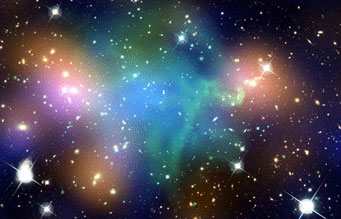
Hubble Images Stir Up Dark Matter Debate
Dark matter in the "Train Wreck" galaxy cluster (Abell 520) appears to behave in unusual ways. Now, new Hubble images are heating up the debate.
Hubble's Hidden Treasures Competition
Try your hand at creating a beautiful Hubble image and you might win an Apple iPod Touch or iPad.

An Emerald-Cut Diamond in the Rough
Astronomers have discovered a rare, rectangular galaxy 70 million light-years away. The dwarf galaxy's unique history presents a challenge for current theories of galaxy evolution.
Did the Moon Come From Earth?
New findings show that the Moon might have incorporated more of Earth when it formed than previously thought — a problem for the widely accepted "big splat" hypothesis.
