 SUNSET:

A Speedy Asteroid — Captured!
It was faint, and it zipped across the sky at 3° per hour— but 2007 TU24 could be spotted with a good scope if you knew where and when to look.

A Stardust-Free Comet
When NASA sent a spacecraft to grab samples of a comet and return them to Earth, scientists had high hopes that they'd finally be able to decipher how the solar system formed. Boy, were they wrong!
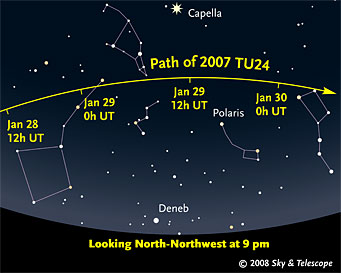
Here Comes Asteroid 2007 TU24
An 800-foot-wide chunk of rock will pass less than a half million miles from Earth on the night of January 28th.
Mercury, Messenger, and Observers
As the first images are released from Messenger's flyby of the innermost planet, previous ground-based observations are proving to be surprisingly accurate.
Telescope Companies Bury Hatchet
A dispute between rival telescope companies has ended with an amicable settlement and a clear definition of "Ritchey-Chrétien."
Darth Meets Physicists
Is teleportation possible? Sort of. But it's still fun to think about.
A Bird's-Eye View of the Sun
What's it like to coast high over our star? The European-built spacecraft Ulysses is doing that right now — for its third and likely final time.
Can Dunlap Obervatory Be Saved?
David Dunlap Observatory, north of Toronto, has many supporters that don't want to see it go.
A Neutron Star's Hard Core
Astronomers have found some pulsars that appear unusually massive, calling into question our understanding of neutron-star interiors.

Reunion with Mercury
For the first time in nearly 33 years, mission controllers have guided a spacecraft past Mercury, a fire-and-ice world that may hold many keys to the solar system's formation.
Monster Black Holes Soon to Collide?
The members of a binary black hole in Cancer, one of which is unbelievably massive, look to be on a collision course.
Mars Dodges a Bullet
Fortified with two months of telescopic tracking, dynamicists say there's now virtually no chance that a small asteroid will strike Mars later this month.
More Google Sky Goodness
Google's interactive star map has a bunch of new features.
Martian Crater Named for “Chick” Capen
A crater on Mars has been officially named for the American scientist Charles F. Capen.

Stars in the Middle of Nowhere
Astronomers have found several young star clusters that don't belong to any particular galaxy.
Astronomers Find Double Einstein Ring
A unique example of gravitational lensing in the universe gives clues to the distribution of dark matter in galaxies.
A New Cycle is Dawning
It's nothing more than an inconspicuous blemish in the Sun's northern hemisphere, but a new sunspot has heralded the start of the next 11-year-long cycle of solar activity.

High Hopes for Hubble
Preparations are well under way for the August 2008 servicing mission to the Hubble Space Telescope.
Catch the Quadrantids
The Quadrantid meteor shower peaks on the morning of Friday, January 4th, with the best viewing opportunity between 1 a.m. and dawn.
