 SUNSET:

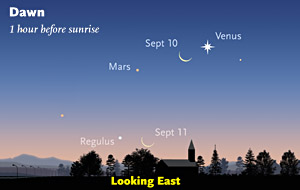
Tour September's Sky: A Lunar Eclipse!
This month's stargazing features pretty planetary treats in the eastern sky before dawn — and the last total lunar eclipse visible until 2018.

Planning for America's Great American Eclipse in August 2017
Dozens of solar specialists are coordinating outreach activities for a coast-to-coast total solar eclipse that's only two years away.

Our Late Night Under the Perseids
Meteors bright and faint rewarded patient watchers of the 2015 Perseid meteor shower. And the show continues tonight.

Moonless Nights Make for Fine 2015 Perseids
This year there's no Moon, and the Perseid meteor shower should peak at just the right time for North America. Every three years, more or less, the Moon is new around the peak night of the Perseid meteor shower — and it's that time again. New Moon falls on August…

Plan for the Perseids!
Conditions are ideal for watching this year's Perseid meteor shower. Plan ahead!
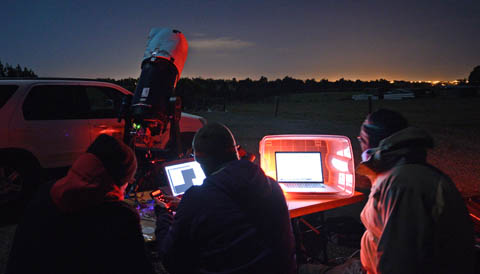
Down-Under Observers Track Pluto Cover-up
Deep snow, high winds, and dropped cameras didn't stop dozens of observers in New Zealand and Tasmania from recording Pluto's occultation of a bright star on June 29th.

C/2014 Q1 (PanSTARRS): Next Naked-Eye Comet?
Comet C/2014 Q1 PanSTARRS has been skirting the northern horizon since mid-June. Now it's ready to dip Down Under, where it may be visible with the naked eye in evening twilight.

Photos of the Venus-Jupiter Conjunction
For the last few weeks, countless numbers of the world’s 7 billion people watched the western evening sky as the two brightest planets, Venus and Jupiter, edged closer and closer to one another. Last night, June 30th, they reached their least separation: 0.3° apart (at the time of twilight for the Americas).

Venus and Jupiter: Together at Last
The two brightest planets are gliding closer together in the early evening sky, and their celestial dance culminates with an ultra-close pairing on June 30th.

Tour July's Sky: Saturn and the Scorpion
Stargazing in July is warm and pleasant. After sunset Venus and Jupiter are together in the west and Saturn is low in the south amid the stars of Scorpius.
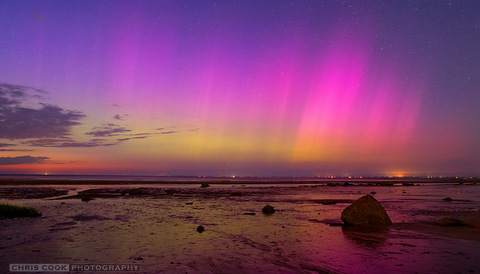
Solar Storm Triggers Widespread Auroras
An auroral display on June 22nd surprised and delighted viewers in Northern America, Europe, and southern Australia.

See Icarus Wing By Earth This Week
It's no myth. Icarus makes a rare flyby of Earth this week. Here's how to see it in your telescope and live online.

Watch the Moon Occult Uranus Live
On June 11, 2015, the moon will occult Uranus. Here's a webcast.

Tour June's Sky: An Epic Planet Pairing
Watch as the two brightest planets — Venus and Jupiter — edge closer together and culminate on June 30th with a dramatically close pairing.
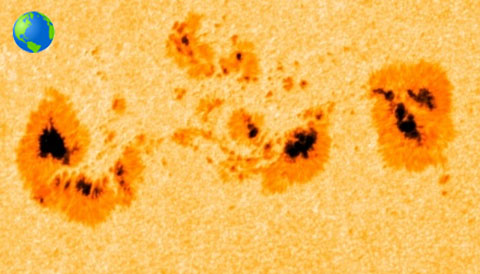
Big Sunspot Group Now in View
For sunwatchers who've been disappointed by this weak solar maximum, Active Region 2339 offers something to cheer about.
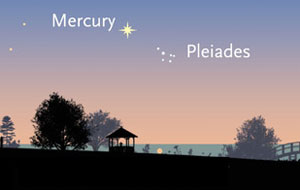
Tour May's Sky: Planet Trifecta
The three brightest planets — Venus, Jupiter, and Saturn — grace our evening skies this month. Elusive Mercury makes a brief appearance too!

Nova Sagittarii: What a Long, Strange Fade It's Been
A 6th-magnitude nova erupted inside the Sagittarius Teapot and reached 4th magnitude. Now it has started fading.
Lyrid Meteor Shower in 2015
Although typically weak, the annual Lyrid display will benefit from moonless skies. This year's peak, late on April 22nd, favors Europe over North America.

Celebrate the Night Sky During April
Amateur skygazers can satisfy their celestial cravings with Globe at Night, International Dark-Sky Week, Astronomy Day, and Global Astronomy Month.
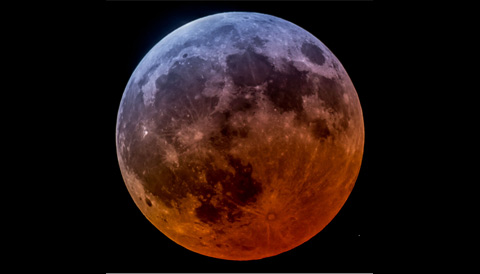
The Lunar Eclipse Wasn't Total After All?!
In a borderline eclipse of the Moon like last Saturday's, the difference between "total" and "partial" depends on some crucial assumptions.
