 SUNSET:

Are Super-Earths Really Super?
Most alien planets are nothing like what we've got in the solar system. Scientists are homing in on these mysterious worlds to see what they’re made of.

Exotic Stellar Trio Includes Pulsar
Imagine a three-star system with two white dwarfs and a wildly spinning, superdense neutron star, all packed within a space no bigger than Earth's orbit.
Huge Sunspot Group Now Observable
The Sun is off to a fast start this new year. An enormous sunspot group, big enough to be seen (carefully) by eye, has rotated into view.

Deep Space Network's 50th Anniversary
Our lifeline to outer space began as a temporary, manually run network of radio dishes. NASA's Deep Space Network, which turns 50 this year, now communicates with spacecraft traversing the whole solar system.
A New Year's Resolution
Let's commit to stopping the spread of light pollution, the single greatest threat to our enjoyment of the night sky.
Small Asteroid 2014 AA Hits Earth
Spotted on New Year's Eve by a telescope in Arizona, a small asteroid struck Earth over the Atlantic Ocean — apparently unnoticed — less than one day later.
Try Spotting Your Record-Thin Moon
Soon after sunset on New Year's Day, you may have a chance to set your lifetime youngest-Moon record.

Meteor Showers in 2014
Sky & Telescope predicts that 2014's best meteor shower won't be one of the traditional displays. Instead, on May 24th the predawn skies over North America might come alive with a robust display of "shooting stars" shed by Comet 209P/LINEAR.
Eclipses in 2014
This year features three celestial cover-ups that favor North Americans: total lunar eclipses on April 15th and October 8th, and a partial solar eclipse on October 23rd.

Tour January's Sky! | December 27th, 2013
Start the new year right with a little evening stargazing! Venus is dropping from sight low in the west just as Jupiter and mighty Orion are ascending in the east.
Mapping the Milky Way's Arms
Astronomers continue to debate whether our home galaxy has big arms and some smaller appendages — or, as new results suggest, four major arms.
Quadrantid Meteors Ring in 2014
Start the new year right by viewing an excellent but short-lived meteor shower, called the Quadrantids, which peaks on Friday, January 3rd.

New Telescope? Learn How to Use a Telescope and See Amazing Sights
Thousands of telescopes are given and received as gifts during the holidays. But once you've assembled your new treasure, then what? The editors of Sky & Telescope show you where to look first.

New Cutoff for Star Sizes
Astronomers have found a size gap between stars that fuse hydrogen in their cores and so-called failed stars, which never muster the ability to sustain fusion. This boundary could help observers precisely identify the smallest stellar citizens.
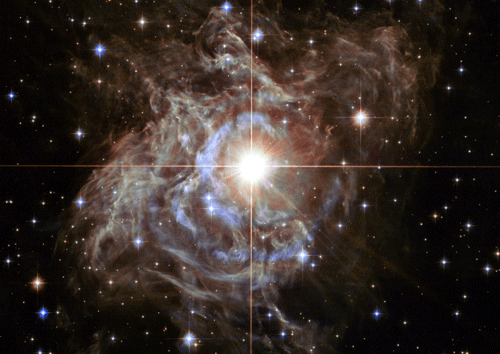
Watch a Mesmerizing Light Show
The gossamer veil of reflective dust surrounding the star RS Puppis reflects its flickering light in a fantastic display.
Putting Exoplanets on the Scale
Astronomers have come up with a new technique for measuring an alien planet’s mass, and therefore its composition and potential habitability, even when standard methods don’t work.
Gaia Launches to Pinpoint a Billion Stars
Gaia launched flawlessly Thursday morning at 9:12 UTC (4:12 a.m. Eastern Standard Time). This long-awaited mission will precisely map the distances and motions of 1 billion stars in our galaxy.
See Venus's Thin Crescent
Venus usually appears pretty boring through a telescope. But from mid-December to mid-February it's a spectacularly long, thin crescent.
The Crab's Surprise Molecule
Astronomers have identified a molecule containing the noble gas argon in the Crab Nebula. It's the first such molecule detected in space and confirms predictions of where a certain argon isotope is created in the cosmos.

Chang'e 3 Brings Rover to Lunar Surface
For the first time since 1976, a spacecraft has landed safely on the Moon. Within hours, the Chinese spacecraft Chang'e 3 had deployed an instrumented rover.
