 SUNSET:

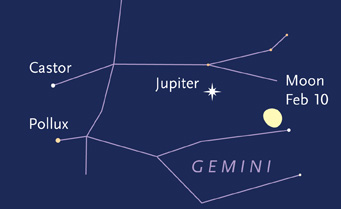
Tour February's Sky! | February 1st, 2014
Jupiter is well up in the east as darkness falls, surrounded by a cohort of bright winter stars and constellations.

Mystery of the Missing Galaxy Clusters
Astronomers have counted up the number of galaxy clusters in the cosmos and found a problem: the number is much lower than they expected. What's going on?
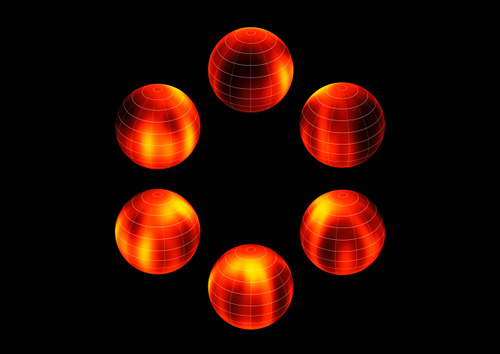
Weather-Mapping a Brown Dwarf
Astronomers using a novel technique have mapped a brown dwarf's visible surface — even though they can't resolve the object in telescopes.
Sleep of Death for China's Lunar Rover?
Reports suggest that something went wrong as the Yutu rover prepared to hibernate through the long lunar night. The glitch could be the end of the little robot.

Lighting Up the Cosmic Web
A rare alignment of a quasar’s “flashlight” beam and a filament of the cosmic web illuminates the universe’s large-scale structure.
Opportunity's 10-year Martian Marathon
Can you believe it? A robotic rover designed to last 90 days on the Red Planet is celebrating 10 years of successful exploration on the Red Planet — even taking a "selfie" for its handlers back on Earth.
Mercury's Best Show of 2014
Mercury puts on its best show of the year for mid-northern latitudes around the end of January.

"Dwarf Planet" Ceres Exhales Water
There'll be a new wrinkle facing NASA's Dawn spacecraft when it reaches Ceres next year: what's causing this big round ball to give off puffs of water vapor?
New View of Lagoon Nebula
A new image of the Lagoon Nebula from the Paranal Observatory in Chile provides a stunning view the iconic object, which lies 5,000 light-years from Earth in Sagittarius.

F+W Media Acquires Sky & Telescope
For only the second time in its 73-year history, ownership of Sky & Telescope has changed hands. On Friday, January 17th, F+W Media, Inc. acquired New Track Media, LLC, the parent company of Sky & Telescope magazine.
The End of Rosetta's Big Sleep
Europe's comet-chasing spacecraft woke up after a 957-day-long hibernation to begin the most comprehensive comet study to date. Part of its mission: attempt to place an instrumented lander on a comet’s nucleus for the first time.
Galaxies Grow By Snacking
Evidence from observations and computer simulations supports a picture of galaxy growth that isn't dominated by the rough-and-tumble crashes of big galaxies. Instead, most of the universe's stellar metropolises appear to feed themselves with nibbles instead of feasts.

John Dobson, 1915-2014
Ask any long-time stargazer who has had the greatest impact on amateur astronomy, and the name of this barnstorming, telescope-making revolutionary will surely come up.
Starbugs: Mini Robots Go Observing
Miniature robots crawling along glass plates will help big surveys collect light from hundreds of thousands of galaxies.

Weather on Alien Worlds
From high-altitude clouds discovered on a super-Earth to massive, hurricane-force storms on a nearby brown dwarf, a bevy of results show that the age of “astrometeorology” is upon us.
Galaxies Trace Early Cosmic History
Astronomers have used the Hubble Space Telescope to peek into the universe's early eras using the light from galaxies that existed several hundred million years after the Big Bang.
Cosmologist Halton Arp (1927-2013)
A contentious yet gifted astronomer, Arp challenged a key underpinning of the Big Bang throughout the 1970s and 1980s and ultimately fell into disfavor among his colleagues.
Galactic Runts Carry Beefy Black Holes
Astronomers have found supermassive black holes in 151 dwarf galaxies, surprising expectations and providing a time machine into black hole formation.
Last Chance to Vote: Comet ISON Photo Contest
The comet's come and gone, we've selected our photo-contest finalists, now it's your turn! Tell us which photos you think should take 1st, 2nd, and 3rd place. The polling booth closes on January 22nd.
Auroras in Our Future?
UPDATE: No significant auroras were reported Thursday morning following the Sun's whopper coronal mass ejection on January 7th. But there's still some chance of a mid-latitude light show as the hours go by.
