 SUNSET:


Last Chance to Enter S&T's Comet ISON Photo Contest
The "comet of the century" famously lost its battle against the Sun, but you can still enter our photo contest for a chance to win some hefty prizes. Don't miss the December 31st deadline!
Curiosity Finds a Once-Habitable Mars
Ancient Mars seems to have had all the necessities as a comfy habitat for microbial life.

Hubble Homes in on Hazy Worlds
Two teams have announced the discovery of water on alien worlds. But they found less water than expected, suggesting these planets are surrounded by a high-altitude haze.
Plumes on Europa
New Hubble Space Telescope observations provide the best evidence yet that Jupiter's icy moon spits out water vapor from its surface. If real, such plumes could reach more than 100 miles above the little world's surface and rain down an extraterrestrial form of snow.
Comet ISON: What We've Learned
Comet ISON's untimely demise didn’t prevent scientists from studying it, revealing the comet to be smaller than previously thought and harboring high concentrations of carbon.
A Double Black Hole?
Strange emission from a distant galaxy paints an enigmatic picture of what’s happening inside its core. One solution: instead of one supermassive black hole, the galaxy hosts two trapped in a tight dance around each other.
New View of Saturn's Hexagon
NASA's Cassini spacecraft has captured phenomenal images of the gigantic weather system at Saturn's north pole. This so-called "hexagon" is nearly three times wider than Earth is.
An Outburst of Andromedid Meteors
Astronomers report that a nearly forgotten meteor shower — famous for its prodigious "storm" in 1872 but long since inactive — has displayed surprising activity.

Geminid Meteors to Pierce the Moonlight
Bits of rock from a fried asteroid flash across the night sky in the mid-December sky — but bright moonlight will diminish the performance.
Tour Chile with S&T!
Join Sky & Telescope as we travel to Chile, the "astronomy capital of the world." From March 27th to April 4th, 2014, we'll visit world-class observatories, see breathtaking landscapes, and observe in crystal-clear night skies.

Lovely Comet Lovejoy
Comet ISON has come and gone, but lovely Comet Lovejoy (C/2013 R1) is still going strong. It is now at or near peak brightness, and well placed in the Northern Hemisphere's predawn sky.
Naked-Eye Nova in Centaurus
A new star near Alpha and Beta Centauri peaked at about magnitude 3.6 on December 5th, faded, re-peaked ten days later, and has been bumping around oddly since.
So It Ends for Comet ISON
After more than a year of anticipation, there is no dazzle, only a dud.
China Launches Lunar Mission
If all goes well, on December 14th the Moon will host its first soft-landing spacecraft since 1976.
Triple Collision in Infant Galaxy
A complex of three bright, star-forming clumps called Himiko is merging in the early universe. With its light reaching us from when the universe was only 800 million years old, this primordial galaxy could yield insight into the elusive process of early galaxy formation.

Tour December's Sky! | December 1st, 2013
December's crystal-clear skies offer Venus low in the west after sunset, a “tower of brilliance” (including Jupiter) rising in the east, and the prospect of a nice showing by Comet ISON in the predawn sky early in the month.
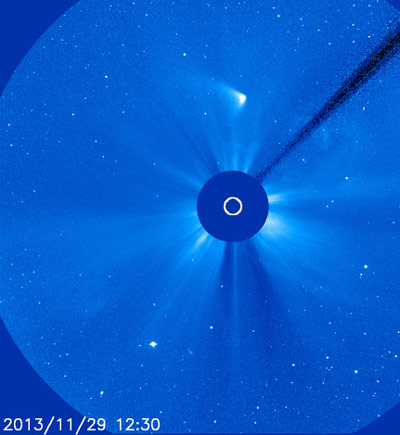
Latest Updates on Comet ISON
Only a dim, fading, dispersing cloud of dust remains of the once grand Comet ISON. Nothing will be visible in the December dawns. Skilled electronic imagers and the Hubble Space Telescope may or may not detect the last trace when it enters a dark sky in mid-December.
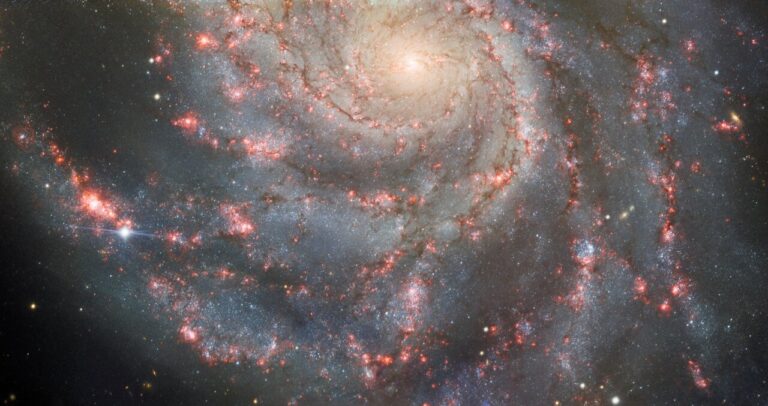
Downsizing a Black Hole
Astronomers have revealed a supposedly monster black hole to be rather ordinary in size.
Oddball Pulsar Origin?
A few whirling neutron stars might get their start as very different objects, at least if a new analysis is correct.

Comet ISON Becomes a Nail-Biter
Is the comet dying, just three days before its closest pass by the Sun? There are signs that its nucleus has stopped producing anything.
