 SUNSET:


Can You Spot Comet ISON at Perihelion?
It won't be easy by a long shot, but it just might be possible to spot the comet in broad daylight as it passes nearest the Sun.
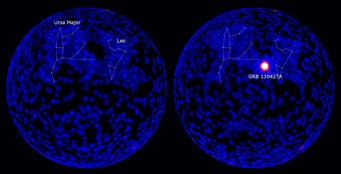
Monster Burst Challenges Theories
Observations of one of the most powerful supernovas ever recorded suggest that the standard model for gamma-ray bursts might be missing a piece of the puzzle.
Cassiopeia A in 3D
Explore a supernova remnant with this fun interactive simulation, created from detailed space- and ground-based observations in multiple wavelengths.
Comet ISON Diving Sunward as its Moment of Truth Nears
Tiny, greenish white, and harder to see every day, Comet ISON is descending toward the sunrise horizon and its November 28th perihelion.
Arizona Astronomy & Science Expo
New gear, hands-on demos, and renowned speakers awaited visitors to last weekend's astronomy expo in Tucson, Arizona.
MAVEN Heads to Mars
NASA's next orbiter has successfully launched and is en route to the Red Planet. When it arrives, it will pry into the secrets of Mars's climate, both past and present, and hopefully reveal how the cold, dry world lost most of its ancient atmosphere.
Older Updates on Comet ISON:
February to mid-November 2013
For the more recent updates, see SkyandTelescope.com/ISON.
Comet ISON Comes to Life!
Veteran comet observer John Bortle reports that Comet ISON is undergoing a major outburst. It was six times brighter when he observed it this morning (November 14th) than on the previous morning.
Black Hole Spews Atoms
Observations reveal ionized metals in the jet shot out by a black hole, long-sought information that will help astronomers understand how these objects create their powerful beams.
"Tails" of a Very Unusual Asteroid
What at first looked to be a comet that had snuck its way into the asteroid belt now appears to be a bizarre, fast-spinning space rock that's occasionally shedding tails of dust.
The Next New Meteor Shower
Astronomers confirm that debris from Comet 209P/LINEAR should create a sky show on May 24, 2014 — but it looks less likely that a “storm” is in the works.
Will This New Technology Transform Astronomy?
Astronomy is ready for the next generation of detectors, and superconductors are at the heart of the coming revolution.

The Other Great Morning Comet
While Comet ISON is brightening rapidly, Comet Lovejoy (C/2013 R1) is far more impressive right now, and also much better placed in the sky. It's shown here passing Messier 44, the Beehive Cluster.
New Chelyabinsk Results Yield Surprises
The mega-meteor that exploded over Russia last February has provided impact specialists with some surprising — and sobering — revelations.
Kepler Mission Hits 3,500 Candidates
The Kepler team has released its analysis of the mission’s first three years of observations. The haul includes 10 Earth-size (and probably rocky) exoplanets in their stars’ habitable zones, and the stats show such planets are common.
Indian Mars Mission Launches
India's first mission to the Red Planet launched successfully November 5th from a barrier island off the country's coastline. The mission will study Mars's atmosphere and surface and is an important milestone for the country's space agency.
November’s Hybrid Eclipse: First Reports
From high over the western Atlantic to the sandstorm-swept plains of northern Kenya, adventurous eclipse-chasers converged along the Moon’s ultra-narrow shadow on November 3rd to get fleeting views of the Sun’s blackened disk.
A Bite-Size Planetary System
Planet Hunters citizen-science program identifies 14 exoplanet candidates the Kepler mission missed, including a seventh planet in a known system, making it the first seven-planet system discovered.

Tour November's Sky! | October 31st, 2013
Returning at last to standard time, you'll find Venus low in the west at sunset, Jupiter rising in late evening, and the winged horse Pegasus galloping across the November night sky.
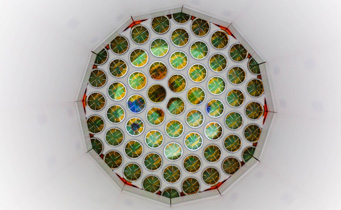
Two Blows for Dark Matter Model
Two recent experiments limit physicists’ favorite candidate for the elusive and invisible matter lurking in the universe.
