 SUNSET:

October 18th's Penumbral Lunar Eclipse
Careful skywatchers in the eastern half of North America can watch the full Moon just graze Earth's outer shadow.
A Night to Howl at the Moon
You can gawk, study, sketch, image, or just howl. No matter how you do it, head outside on October 12th to celebrate International Observe the Moon Night.
Triple Shadow Transit across Jupiter Tonight
Triple shadow transits, where three moons cross the face of Jupiter, happen only once or twice a decade. Catch the show tonight.
ISON’s Chances for Survival 50/50
Observations and calculations suggest that the comet's nucleus has a 50% chance of surviving its close passage to the Sun, but there are a lot of unknowns that could swing the result either way.
South Pole Science
A behind-the-scenes look at the construction of the IceCube Neutrino Observatory in Antarctica, plus more information about science done at the South Pole. (This blog is an online companion to our January 2014 feature article on IceCube.)
Juno's Hi-and-Bye Flyby
A NASA spacecraft bound for Jupiter made a close flyby of Earth to gain speed for the long trek outward, and amateur astronomers prepared to watch its passage.
Crash Course in the Higgs
The 2013 Nobel Prize in Physics has been awarded to two physicists who postulated the existence of the Higgs field, the source of many elementary particles' masses. For those still scratching their heads on what the Higgs is, here's what you need to know.
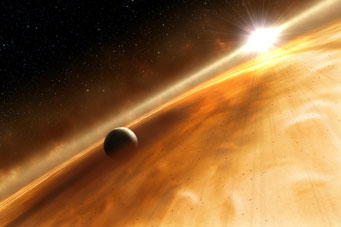
Fomalhaut Star System Actually a Triple
Turns out “the lonely star of autumn” has not just one, but two distant companions, making it one of the most widely separated systems known.
Is Oxygen a False Positive for Alien Life?
Photosynthetic life has infused Earth's atmosphere with abundant oxygen that otherwise wouldn't be here. So can oxygen be used as a dependable signature for life on other worlds? Maybe not, according to a new analysis.
Donate to Eclipse-Glasses Effort
Astronomers Without Borders is raising funds to get 40,000 sets of eye-saving viewers into the hands of African schoolchildren for next month's solar eclipse.
A Cloudy Exoplanet
Visible and infrared observations suggest that the hot Jupiter Kepler-7b has a large patch of clouds on one side.
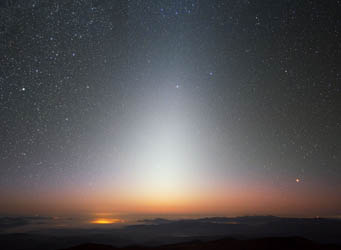
The Quest for Zodiacal Light
The first half of October 2013 is a good chance for early risers to catch the zodiacal light, the faint eastern glow preceding dawn.
Supervolcanoes on Mars
A new analysis of data from spacecraft orbiting the Red Planet suggests that gigantic calderas lie disguised on the planet’s surface. If the features are volcanoes, they could help explain the mysterious, fine-grain debris that coats Mars.

Sky-High Adventures at Scout Jamboree
An astronomy program at this summer’s massive National Scout Jamboree gave thousands of Boy Scouts a taste for sky-gazing.

Tour October's Sky! | October 1st, 2013
Venus blazes low in the west at sunset, while Jupiter rules the late-night sky. This month also features a penumbral lunar eclipse, a minor meteor shower, and the Great Worldwide Star Count.
Uranus's Unlikely Companion
Astronomers have discovered a sizable object sharing the orbit of Uranus. Its existence defies the odds — and within 1,000,000 years it'll slip from the planet's grasp.
Will BBC Cancel The Sky at Night?
Stargazers in Great Britain learned this week that their beloved broadcast about all things celestial, inaugurated by the late Patrick Moore in 1957, might be canceled at year's end.

Astronomer Seager Wins “Genius Grant”
Exoplanet hunter and S&T author Sara Seager is among 24 scientists and artists granted one of 2013’s prestigious MacArthur Fellowships, commonly known as the “genius grant.”
To Catch a Comet
A balloon-borne mission launching from the Southwest will aim a telescope at the approaching Comet ISON. While it won't observe the comet at its best, the mission might reveal details about the composition of the icy body and the family it comes from.
Pulsar on the Fence
Astronomers have discovered a neutron star that switches between X-ray and radio emission within a few days. The find is fabulous news for theorists, who have long predicted that the two pulsar types were connected.
