 SUNSET:

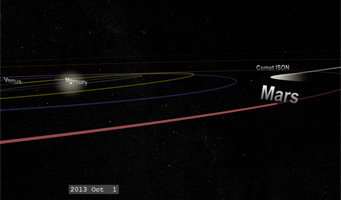
Comet ISON to Fly By Mars
On October 1st, Comet ISON will pass closer to Mars than it ever will to Earth. The Red Planet’s rovers and orbiters are ready to send home postcards of the event.

Is Phaethon a "Rock Comet"?
An oddball asteroid discovered 30 years ago apparently gets so hot when near the Sun that rocky minerals on its surface crack, pop, sizzle, and fly off into space.
Methane Goes Missing on Mars
The Curiosity rover conducted super-sensitive tests of the Red Planet's atmosphere for methane — the most abundant hydrocarbon in the solar system — and found none. What does this finding mean for the search for Martian life?
Deep Impact Meets Its End
Primarily known for its up-close comet observations, the Deep Impact spacecraft went on the fritz in mid-August. The mission team scrambled to reestablish communication, but efforts were unsuccessful.

New 3D Maps of Milky Way's Bulge
New 3D maps of the Milky Way's central bulge of stars show a distinctively peanut-like shape. The maps give clues about how our galaxy evolved to its present-day form.
Equinox Arrives September 22nd
Although many of us are already seeing seasonal changes, autumn for the Northern Hemisphere officially begins on Sunday, September 22nd, at 20:44 Universal Time. But why is the time of the equinox so specific? S&T's editors explain.
Asteroid Scheme Still Under Way
Despite funding pushback in the House of Representatives, NASA is full steam ahead in plans for its asteroid retrieval mission.

Comet ISON Preview (Video)
S&T senior editor Alan MacRobert tells you what you need to know to get ready for Comet ISON.
Hisaki: A New Orbiting Planet-Watcher
Japan's latest spacecraft is designed to study gas escaping from the atmospheres of Earth's neighbors in the solar system.

Onward, Voyager 1, to the Stars!
With the release of new results this week, NASA scientists are now confident that their plucky probe, launched 36 years ago, has entered interstellar space.

Albert Jones (1920–2013)
Albert Jones, a legendary variable star observer, passed away this week, leaving behind a voluminous legacy of observations.

Glimpse Into Sun Befuddles Theorists
Scientists sneaked a peek into the Sun’s interior, but what they saw contradicts the assumptions made by models predicting solar activity.
A Legacy of Space Exploration
Timeless images released as part of the European Planetary Science Congress reveal milestones in our quest to understand the solar system.

CubeSats on Space Patrol
A constellation of miniature telescopes plans to survey space for satellite-harming debris.
17-Day ALMA Strike Ends in Resolution
The 17-day strike at the world’s largest ground-based observatory ended Saturday, and ALMA's revolutionary observations of the millimeter/submillimeter sky restart today.
Crescent Moon and Venus Put on a Show
Keep an eye to the early-evening sky on Sunday, September 8th. You'll be rewarded with a stunning pairing of a thin crescent Moon next to dazzling Venus.
LADEE Leaves for Luna
NASA's Lunar Atmosphere and Dust Environment Explorer left Earth on Friday night — an event widely seen up and down the East Coast — on a mission to solve a 45-year-old mystery.
Skinny Stars or Fat Planets?
New studies of the coolest brown dwarfs are helping astronomers explore the mysterious objects that bridge the gap between stars and planets.
An Annular Eclipse on Mars
Not content merely to record the Martian landscape, a camera on NASA's Curiosity rover recently pointed skyward to watch Phobos cross the face of the Sun.
Sun Loses Lithium with Age
Observations of two solar twins — one old and one young — confirm that the Sun has probably destroyed the fragile element as the star has grown older.
