 SUNSET:

Get Ready for the 2013 Perseids
Plan to be up late on the nights of August 11-12 and 12-13. Weather permitting, that's when Perseid meteors will flash across virtually Moonless skies.
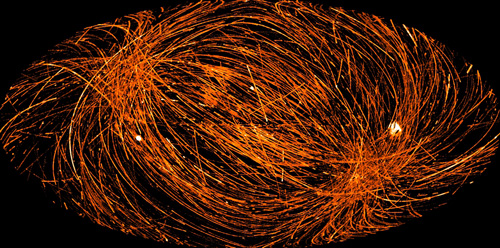
Glimpse the X-ray Sky
Time and tide wait for no man. So the XMM-Newton space telescope is making every second count. As the telescope shifts its gaze from source to source, it's recording the X-ray sky.

What Powers the Van Allen Belts?
Thanks to a pair of NASA probes launched last year, space physicists have confirmed that relativistic electrons in the radiation belts surrounding Earth arise from "homegrown" acceleration processes.
Seeking the Cosmic Dawn
Astronomers have finally detected a much-hoped-for pattern in the afterglow of the Big Bang, and it might help reveal inflation's signature.
Bright supernova in M74
An exploding star in the galaxy M74 in Pisces, discovered on July 25th, peaked at magnitude 12.5 in mid-August and was still V magnitude 13.2 as of September 5th.

Tour August's Sky! | July 26th, 2013
This month is famous for the Perseid meteor shower, which arrives like clockwork on the 12th and 13th. It's also the best time of year to see the beautiful Milky Way arching overhead in early evening.

The Weakest Solar Cycle in 100 Years
Scientists are struggling to explain the Sun’s bizarre recent behavior. Is it a fluke, or a sign of a deeper trend?
Snack Starts Swinging Around Black Hole
Astronomers around the world are watching as the gaseous object called G2 heads for a close pass around the Milky Way's central supermassive black hole. Now it looks like the distended cloud is starting to swing back toward us.
Spacecraft Look Back at Planet Earth
July 19th was a Big Day for our home planet, as two spacecraft, Cassini and Messenger, took snapshots of Earth and Moon from great distances.
Catch a "Shooting Star"
The Delta Aquariid meteor shower ramps up in late July, and you already have everything needed to enjoy the show: your eyes.
Wave at Saturn (But Will Cassini See You?)
Cassini is taking our picture on Friday, but how much light do we humans actually reflect? We've crunched the numbers, and the answer may surprise you.
A Fix for the "Faint Young Sun"
For 40 years astrobiologists have wrestled with how to make the early Earth warm enough to support life even though the young Sun was at least 30% fainter than it is now. New climate models, powered by supercomputers, are converging on a solution.
Magnifying Quasars
Twinkle, twinkle, quasi-star: cosmic lenses could tell us what you are.

Neptune's Newest Moon
Using Hubble images taken in several patches over a six-year period, astronomers have spotted a tiny object circling Neptune. This find, the first in a decade, brings the planet's moon count to 14.
The Sun's Heat Wave
Astronomers at the American Astronomical Society's Solar Physics Division meeting discussed new evidence that magnetic waves are the reason our star's corona is blazing hot.
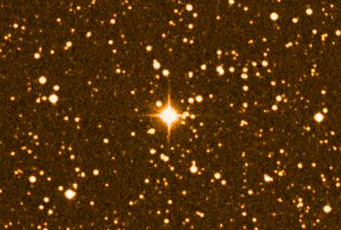
The Chaotic Music of Variable Stars
Space-based observations of RR Lyrae variable stars, once considered the paragon of simplicity, are revealing turmoil in their daily vibrations.
A Tale of the Sun's Tail
Using observations from NASA's Interstellar Boundary Explorer, space physicists now realize that the solar wind forms a tail that likely extends light-years downwind from the Sun across interstellar space.
A Glassy Blue Jupiter
For the first time, astronomers know the true color of an exoplanet — and it appears an un-Earthly shade of blue. But don't pack your bags…
The Ultimate New-Moon Sighting
A French astrophotographer used luck and some special gear to capture a razor-thin lunar crescent precisely at the moment of New Moon on July 8th.
Moon Occults Spica
On the evening of July 15th the Moon will occult Spica as seen from parts of the Pacific and the Americas. But even if you're not one of the lucky few with the right view, you can enjoy the pair's pirouette.
