 SUNSET:

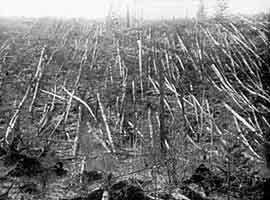
Has a Tunguska Crater Been Found?
Italian researchers think they've found a hole in the Siberian forest where an extraterrestrial rock famously slammed to Earth 99 years ago.

Kenneth L. Franklin, 1923–2007
Renowned astronomer and astronomy popularizer Kenneth L. Franklin died on June 18, 2007, two weeks after undergoing heart surgery. He was 84 years old.
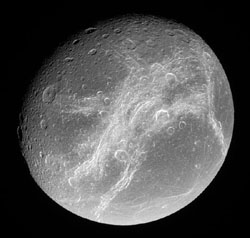
Saturn's Smoking Guns
Following a trail of charged particles, Cassini scientists find that two more of Saturn's moons may be active.
Spectacular Occultation and Graze of Regulus
The year's best grazing occultation in North America occurs on June 19-20, 2007, when the waxing crescent Moon covers Regulus (Alpha Leonis).
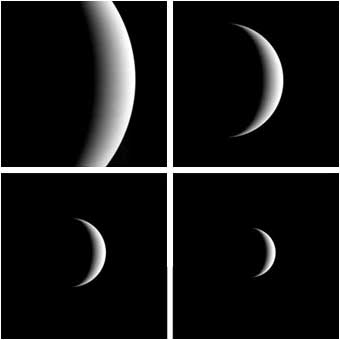
So Long Venus, Onward to Mercury
Scientists release the first pictures taken during the Messenger spacecraft's flyby of Venus last week.
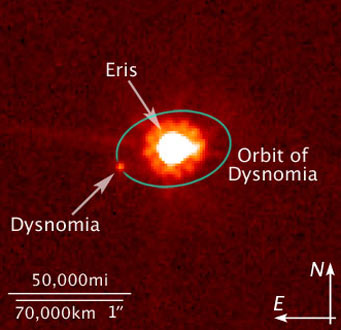
It's Official: Eris Outweighs Pluto
By examining the orbit of Eris's moon, a team of researchers has concluded that Eris is significantly more massive than Pluto.
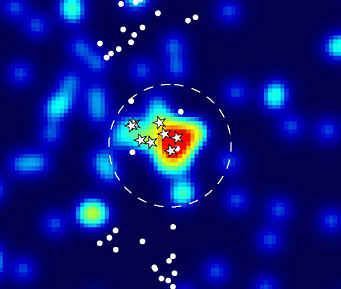
A Pristine Galaxy Heading Our Way
A dwarf galaxy apparently untouched since the beginning of the universe is offering a view into the past.

Venus's Daytime Vanishing Act on Monday
Brilliant Venus will disappear behind the dark limb of the crescent Moon on Monday, June 18th, for observers in the Middle East and India — and in daytime for Europe and the northeastern tip of North America.
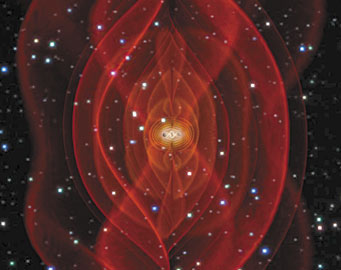
Why Monster Black Holes Don't Run Away
It’s hard to kick a monster around, especially when the beast weighs millions or even billions of times the mass of our Sun. But in recent months, computer simulations by five independent groups have shown that something astonishing can happen when two supermassive black holes spiral together and combine in the aftermath of a galaxy merger.

Crescent Moon to Occult Regulus Tuesday
When a star or planet ducks behind the Moon, it's a dramatic celestial sight. This month many lucky viewers will have the chance to see either a planet (Venus) or a bright star (Regulus) play peekaboo.
Messenger's Last Visit to Venus
NASA's Mercury-bound spacecraft scrutinized Earth's sister planet with its complement of instruments and teamed up with Europe's Venus Express orbiter.
OGLEing a MACHO
By using an observing method that mimics human depth perception, astronomers have found a potential dark-matter object.

Overgrown Planet, or Dwarf in the Desert?
Astronomers have uncovered a fascinating heavy object orbiting close to its star. The problem is, they aren't sure what to call it.

A Hot Earth-Neptune Hybrid
With 236 exoplanets now known, most new discoveries meet with indifference. But when one of them introduces a new class of planets, a data point on a graph turns into a real world that stirs the imagination.
Danger Signals From the Sun
Scientists have found a new way to detect harmful radiation explosions from the Sun.
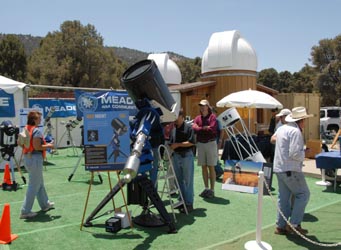
Big Bear's 2007 Astronomical Extravaganza
A pair of annual astronomical events drew hundreds of amateurs to the resort town of Big Bear Lake in the San Bernardino Mountains east of Los Angeles this past Memorial Day weekend.

Dwarfs, Dwarfs Everywhere
Using the infrared Spitzer Space Telescope, astronomers have found thousands of previously unknown dwarf galaxies.

A Stunning Look Into Spiral Galaxy M81
Hubble has taken a super-high resolution image of M81 — and found star clusters, dust, glowing regions of gas, and more.

Planets of Massive A Stars
Stars more massive than the Sun have planets too. But they don't fit the familiar pattern.

Did a One-Two Punch Form the Solar System?
Using state-of-the-art techniques to precisely time the formation of ancient meteorites, scientists find that our solar system had a violent beginning.
