 SUNSET:


Tour March's Sky! | March 1st, 2014
A stunning array awaits you overhead once the Sun sets. Brilliant Sirius, along with Procyon, Betelgeuse, and even-brighter Jupiter, form a giant diamond in the evening sky.

Catch a Comet Buzzing Earth
On Thursday, May 29th, Comet 209P/LINEAR will pass just 5 million miles (8 million km) from Earth, one of the closest comet approaches in history.

Moon and Venus Dance at Dawn
If your dawn sky is clear on Wednesday, February 26th, don't miss the lovely pairing of brilliant Venus with a very thin crescent Moon.

Supernova in M82 Passes Its Peak
Supernova 2014J, in the galaxy M82 in Ursa Major, peaked at magnitude 10.5 in early February and is now down to 11.2. Spot it with your telescope above the Big Dipper.

How to See Jupiter: Big, Bright, and Beautiful
Jupiter, the King of Planets, is a captivating sight no matter how you look at it.
Ceres and Vesta in 2014
The two brightest asteroids are very close to each other in the sky in 2014, fitting in a single field of view through binoculars and some telescopes.
Tour February's Sky! | February 1st, 2014
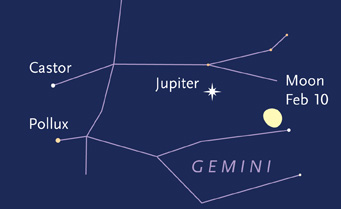
Jupiter is well up in the east as darkness falls, surrounded by a cohort of bright winter stars and constellations.
Mercury's Best Show of 2014
Mercury puts on its best show of the year for mid-northern latitudes around the end of January.
Auroras in Our Future?
UPDATE: No significant auroras were reported Thursday morning following the Sun's whopper coronal mass ejection on January 7th. But there's still some chance of a mid-latitude light show as the hours go by.
Huge Sunspot Group Now Observable
The Sun is off to a fast start this new year. An enormous sunspot group, big enough to be seen (carefully) by eye, has rotated into view.
Try Spotting Your Record-Thin Moon
Soon after sunset on New Year's Day, you may have a chance to set your lifetime youngest-Moon record.

Meteor Showers in 2014
Sky & Telescope predicts that 2014's best meteor shower won't be one of the traditional displays. Instead, on May 24th the predawn skies over North America might come alive with a robust display of "shooting stars" shed by Comet 209P/LINEAR.
Eclipses in 2014
This year features three celestial cover-ups that favor North Americans: total lunar eclipses on April 15th and October 8th, and a partial solar eclipse on October 23rd.

Tour January's Sky! | December 27th, 2013
Start the new year right with a little evening stargazing! Venus is dropping from sight low in the west just as Jupiter and mighty Orion are ascending in the east.
Quadrantid Meteors Ring in 2014
Start the new year right by viewing an excellent but short-lived meteor shower, called the Quadrantids, which peaks on Friday, January 3rd.
See Venus's Thin Crescent
Venus usually appears pretty boring through a telescope. But from mid-December to mid-February it's a spectacularly long, thin crescent.
An Outburst of Andromedid Meteors
Astronomers report that a nearly forgotten meteor shower — famous for its prodigious "storm" in 1872 but long since inactive — has displayed surprising activity.

Geminid Meteors to Pierce the Moonlight
Bits of rock from a fried asteroid flash across the night sky in the mid-December sky — but bright moonlight will diminish the performance.

Lovely Comet Lovejoy
Comet ISON has come and gone, but lovely Comet Lovejoy (C/2013 R1) is still going strong. It is now at or near peak brightness, and well placed in the Northern Hemisphere's predawn sky.
Naked-Eye Nova in Centaurus
A new star near Alpha and Beta Centauri peaked at about magnitude 3.6 on December 5th, faded, re-peaked ten days later, and has been bumping around oddly since.
