 SUNSET:


Super-close Pairing of Ceres and Vesta
Two bright asteroids now appear extremely close to one another in the evening sky. Here's how to spot them in binoculars or a small telescope.

Iapetus Comes Over to the Bright Side
Astronomers now know the secret of this moon's strange two-faced appearance, but it's still remarkable to watch the "now you see it, now you don't" performance as it moves around Saturn.

Summer Quest for Noctilucent Clouds
Noctilucent clouds form at the boundary between Earth and space. Their electric blue billows incite the imagination and inspire us to keep watch at dusk for their arrival.

Comet PanSTARRS Keeps Getting Better
Since C/2012 K1's discovery two years ago, this first-time visitor from the outer solar system has brightened steadily and is now within reach of a small telescope and even binoculars.

Tour July's Sky: Moon Hugs Mars & Saturn
Sky & Telescope's audio sky tour makes it easy to discover the night sky. During July, the Moon makes very close brushes with Mars and Saturn.

Tour June's Sky: Three Planets in View
For anyone north of the equator, days are longest and nights shortest during June. But you can still get an eyeful of celestial sights, starting with a parade of Jupiter, Mars, and Saturn in the evening sky.
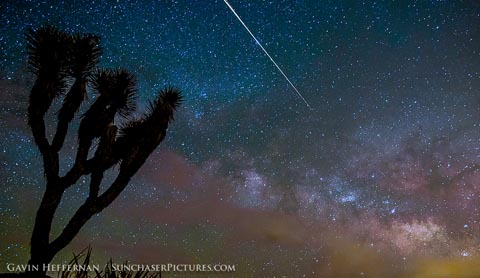
First Reports: Camelopardalids Disappoint
Dynamicists had predicted that Comet 209P/LINEAR would create an active meteor display in the early morning of May 24th. But reports from observers across the U.S. and Canada suggest that the Camelopardalid meteor shower was weak at best.
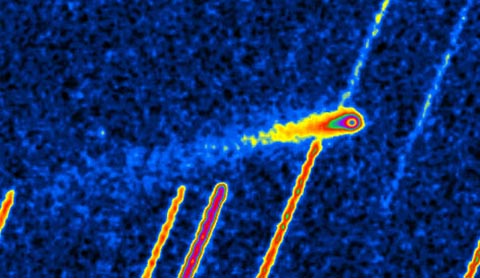
Ready for May's Surprise Meteor Shower?
The dim, obscure periodic comet 209P/LINEAR is about to pass close by Earth — and bring with it a trail of debris that could make for an exciting meteor shower during the predawn hours of Saturday May 24th for North America.
Amateur Comet Hunters Get 2013 Award
Now in its 15th year, the Edgar Wilson Award recognizes comet discoveries made by amateur observers. The 2013 awards honor seven dedicated individuals who scan the skies.

Eta Aquariid Meteors in 2014
Seen each year in early May, the Eta Aquariid meteors are spawned by none other than Halley's Comet. This shower is best seen before dawn's first light.

How to See Saturn at Its Best
The rings were tilted 15° on February 7, 2012, when Robert English in Kentucky took this fine image using a 20-inch Newtonian reflector. Saturn is entering the early evening sky this spring just as Jupiter begins its exit in the west. Here's a quick guide to spotting the ringed planet…
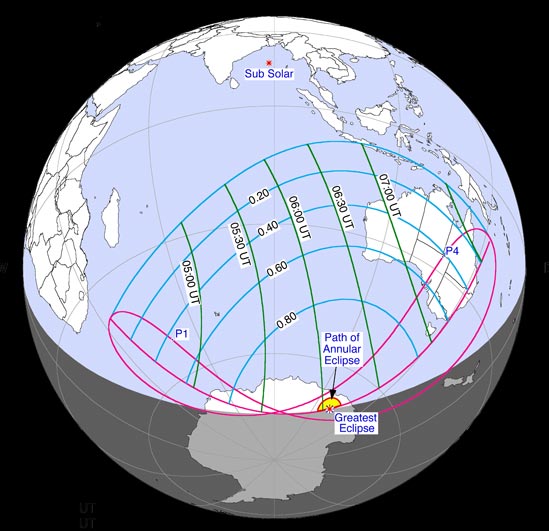
April 29th's "No Show" Annular Solar Eclipse
The first and only annular solar eclipse of 2014 has a path that just clips Antarctica, at a location so remote that no one on Earth will get to see the event. Update: Partial phases of April 29th's solar eclipse were widely seen across the southern part of Australia. See…

Tour May's Sky: Evening Planets Align
This month you have a chance to spot four planets in the evening sky at once: Mercury, Mars, Jupiter, and Saturn. As a bonus, you might be treated to a spectacular display of meteors on the morning of May 24th.

Jupiter's Not-So-Great Red Spot
Astronomers don't know why Jupiter's iconic Great Red Spot has been gradually shrinking since the 1800s — or why the downsizing has accelerated during the past two years. Update: On May 15th, NASA released newly taken images of the Great Red Spot (at bottom below) to show its declining size…

April's Total Eclipse of the Moon
North Americans haven't seen a total eclipse of the Moon since 2011. But this long dry spell breaks late on the night of April 14–15 as the Moon makes a leisurely pass through Earth's deepest shadow.

Brightest Mars in Six Years
Mars is making its nearest and brightest appearance in the night sky since the end of 2007.
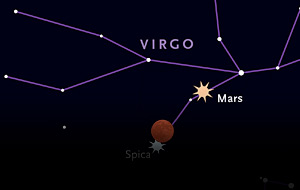
Tour April's Sky: One Last Look at Winter's Stars
It's a great month, celestially speaking: the brilliant stars of winter crowd in the southwest at nightfall, Jupiter is joined by Mars, and the first total lunar eclipse in 2½ years occurs at mid-month.

Global "Fail" for the Big Regulus Cover-up
There was widespread hope that thousands of skywatchers would see the bright star Regulus briefly occulted by an asteroid early on March 20th. In the end, likely <u>no one</u> saw it. Here's why.
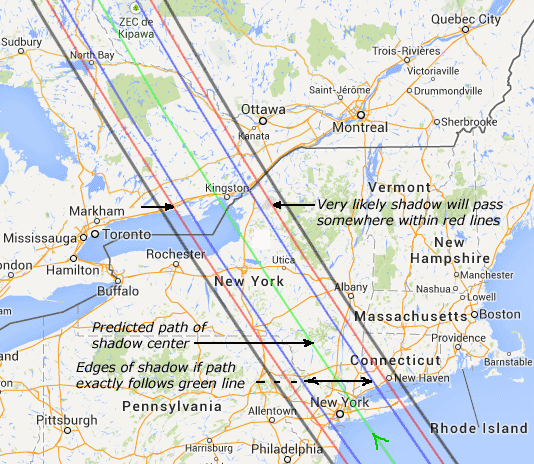
Asteroid to Black Out Bright Star Regulus
Bright Regulus will dramatically snap out of view behind a faint asteroid for several seconds very late Wednesday night for well-placed viewers — if the sky clears!!

Uranus and Neptune in 2014
Uranus and Neptune are easy to find with the aid of the charts in this article.
