 SUNSET:

Asteroid 2012 DA14 to Zip Past Earth
On February 15th, a 150-foot-wide rock will make the closest pass by Earth of any asteroid predicted far in advance. You may be able to follow it in a telescope.

Uranus and Neptune in 2013
Uranus and Neptune are easy to find with the aid of the charts in this article.

Tour February's Sky! | February 1st, 2013
Evening skies feature two bright planets: Mercury, which lurks low in the west after sunset around the 16th, and Jupiter, which reigns high in the southern sky all month long.
Mercury Meets Mars
Mercury and Mars, the two smallest planets, appear spectacularly close to each other shortly after sunset on Thursday and Friday, February 7th and 8th.
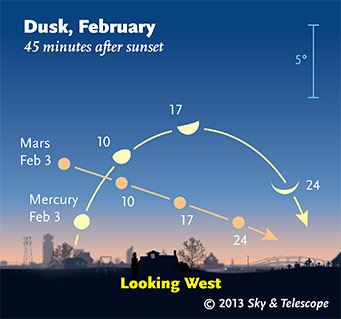
Mercury in February 2013
Mercury has a fine evening apparition in February 2013, featuring an extraordinarily close conjunction with Mars.
The Evening Zodiacal Light in 2013
The zodiacal light shows very well from dark locations at mid-northern latitudes starting about 80 minutes after sunset on moonless evenings from late January to early April.
Jupiter Dances with the Moon
On the night of Monday, January 21, 2013. Jupiter, the second-brightest planet, appears less than a finger-width from the Moon as seen from North America. And in much of South America, the Moon passes in front of Jupiter, hiding it from view.
Watch the Moon Pass Mars
A beautiful crescent Moon passes Mars shortly after sunset this weekend. But make sure you find the right spot to skygaze, or you might not see it.
Follow the Morning Moon
The Moon is the great highlight of the early morning sky this week, as it heads for a spectacular rendezvous with Venus at dawn on Thursday, January 10th.

Meteor Showers 2013
Sky & Telescope predicts that 2013's best meteor shower should be the Perseids in mid-August, but this will also be a good year for the lesser-known Eta Aquariids in early May.

Tour January's Sky! | January 1st, 2013
Jupiter is the unrivaled king of the evening sky this month. Use it as a benchmark to find a pair of star clusters and other interesting celestial sights.

Catch the Quadrantids in Moonlight
Undeniably one of the year's best, the Quadrantid meteor shower peaks on the morning of Thursday, January 3rd. The best viewing opportunity comes between 1 a.m. and dawn, but you'll have competition from a waning gibbous Moon.
See Ceres at Its Best for 2012
Ceres, the biggest asteroid and brightest dwarf planet,shines at magnitude 6.9 or brighter from December 12-25.
“Sky-Is-Falling” Asteroid Flies By
The Earth-crossing asteroid 4179 Toutatis is making one of its close flybys, gliding among the stars and awaiting your telescope. Its magnitude will be 10.9 to 10.5 from December 11th through 14th.
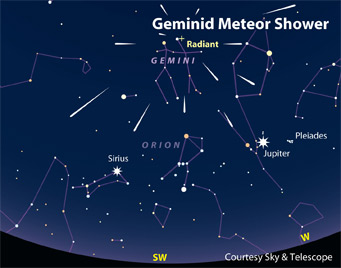
Geminid Meteors to Peak the Night of Dec. 13th
If it’s clear late Thursday night, December 13th, keep a lookout overhead for meteors of the Geminid shower.

Tour December's Sky! | November 30th, 2012
Mars lurks low in the west after sunset, just as Jupiter rises dramatically in the east. Meanwhile, a mythic tale unfolds among the stars and constellations overhead.
The 2012 Leonid Meteor Shower
The annual Leonids should peak early Saturday morning. While they probably won't make a big impression this year, an absent Moon and the possibility of a second meteor peak next week raise the cool factor.
Totality Down Under
The total solar eclipse on November 13-14 drew tens of thousands of umbraphiles to northeastern Australian and onto several ships in the South Pacific.
Not in Australia? Watch Today's Eclipse Online
Watch today's total solar eclipse even if you haven't traveled Down Under. At 3:35 p.m. EST, the Moonwill cover the Sun for a maximum of 4 minutes and 2 seconds. Two sites will let you see the spectacle live online.

Tour November's Sky! | November 1st, 2012
Mars is very low in the west after sunset, and Jupiter rises a couple hours later. But most of the planetary action is in the eastern sky before dawn.
