 SUNSET:


April's Total Eclipse of the Moon
North Americans haven't seen a total eclipse of the Moon since 2011. But this long dry spell breaks late on the night of April 14–15 as the Moon makes a leisurely pass through Earth's deepest shadow.
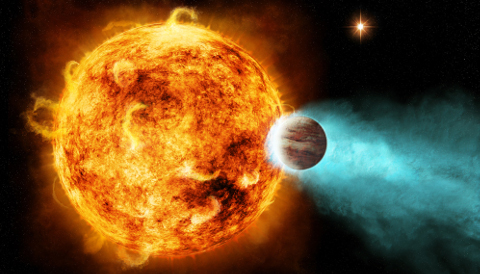
Hot Jupiters Keep Their Stars Young
Sizzling gas giants circling close to their host stars — so-called hot Jupiters — keep their host stars young and active, a new study suggests.

An Asteroid to Rule Them All
Scientists have new insight into the damage caused by a Rhode Island–size asteroid that hit Earth more than 3 billion years ago, making the rock that wiped out the dinosaurs look like a lightweight.

Amateurs Flocking to NEAF this Weekend
The Northeast Astronomy Forum in Suffern, NY, will welcome visitors from across the world on April 12–13, 2014. Sky & Telescope will be there. Will you?

Quasars Track Expanding Universe
The most precise measurement yet of the Hubble parameter illuminates dark energy — the elusive entity that’s accelerating the universe’s expansion.

LADEE Skims the Moon Before Crash
NASA has a fully functioning spacecraft orbiting the Moon, all science goals completed, and a lunar eclipse coming up. It's a perfect opportunity to make some risky but potentially rewarding swoops within 2 miles of the lunar surface.

Brightest Mars in Six Years
Mars is making its nearest and brightest appearance in the night sky since the end of 2007.

A New Galactic Yardstick
Astronomers have developed a new method to measure distances to bright but faraway galaxies, a tool which will help better constrain the expansion rate of the universe.
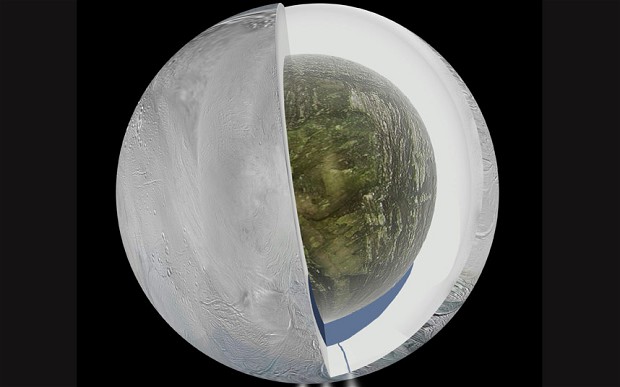
The Subsurface Ocean of Enceladus
Data from NASA’s Cassini spacecraft have provided further evidence that Saturn’s tiny moon Enceladus harbors a liquid ocean under its surface.

Celebrate the Night Sky This Month
Join the world’s largest celebration of astronomy — Global Astronomy Month — throughout April.

Fooling with the Universe
This year’s April Fools' provides a wealth of alarming results. Catch up on all the scientific shenanigans here.
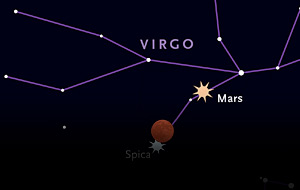
Tour April's Sky: One Last Look at Winter's Stars
It's a great month, celestially speaking: the brilliant stars of winter crowd in the southwest at nightfall, Jupiter is joined by Mars, and the first total lunar eclipse in 2½ years occurs at mid-month.

Dust in the Heart of Circinus
Infrared observations of the Circinus Galaxy may help reveal the shape of the dusty region fueling its active galactic nucleus and shed light on what governs dust structures in other galaxies.

Rosetta Spots Its Comet
The European Space Agency’s comet-chasing spacecraft has imaged its destination for the first time since waking up from 957 days of hibernation.

Global "Fail" for the Big Regulus Cover-up
There was widespread hope that thousands of skywatchers would see the bright star Regulus briefly occulted by an asteroid early on March 20th. In the end, likely <u>no one</u> saw it. Here's why.

Chariklo: An Asteroid with Rings
An international team of observers has made the surprising discovery that a distant asteroid has two distinct, dense rings.

New Object Offers Hint of "Planet X"
Astronomers have kicked around the idea of a distant "Planet X" for decades. But the recent discovery of 2012 VP<sub>113</sub>, located in an orbital "no man's land" roughly twice as far away as Pluto, has stoked the possibility that it really exists.

Dark Matter Spotted in the Milky Way?
A team of astronomers claim to have the most compelling case for annihilating dark matter yet.
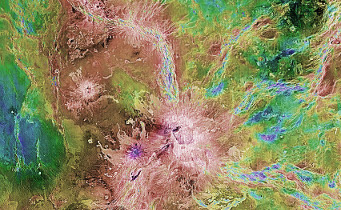
Active Volcanoes on Venus?
New images of Venus show features that look like hot spots, hinting there may be active volcanoes on the planet today.

Interactive Mosaic of Moon's North Pole
With the first interactive lunar north pole mosaic released by the NASA’s Lunar Reconnaissance Orbiter Camera team you can explore an area of the Moon’s northern hemisphere about the size of Alaska and Texas combined.
