 SUNSET:

March 19th's "Super Moon" Over Boston
S&T senior editor Dennis di Cicco took full advantage of a crystal-clear sky and a panoramic setting to record breathtaking views of an extra-big full Moon rising over the Boston skyline. Here's the story of how he did it!

Tour April's Sky! | March 31st, 2011
Look out! Jupiter is no longer ruling the evening sky, and sky critters are on the march in the north, east, and south.
Messenger Gets to Work
With about 30 orbits of Mercury under its belt and another 700 to go, a NASA spacecraft is starting to reveal the innermost planet's true identity.
An Amazing Aurora Video
Night after freezing night, Norwegian photographer Ole Salomonsen gathered aurora photos — 50,000 in all — to produce a breathtaking video that reveals the northern lights' true splendor.

New Insights on Lunar Swirls
Comet impacts? Magnetic oddities? Crashed alien spaceships? Soon scientists hope to solve the longstanding mystery of bright swirls like Reiner Gamma on the lunar surface.
The Coolest Stars Ever Found?
Astronomers have found what could be the first-ever members of a new stellar class — "stars" with surface temperatures lower than that of a hot cup of coffee.

Best-yet Value for Universe's Expansion
A new study with the Hubble Space Telescope pins down the universe's expansion rate with unprecedented accuracy.
Mercury at Its Evening Highest
This week, Mercury reaches its highest in the evening sky for observers in the Northern Hemisphere.

The March 19th "Supermoon": Hardly Super
Saturday's full Moon is indeed the closest and biggest in 18 years. But not by enough to notice.
Messenger: Mercury's New Moon
The fleet-footed planet of the ancients has a new companion — a NASA spacecraft that will now call it home after a convoluted, 6½-year-long, 5-billion-mile interplanetary cruise.
What Makes Iapetus So Weird?
Now that scientists have puzzled out this moon's yin-yang appearance, they're tackling the cause of its out-of-round shape, slow spin, and bizarre equatorial ridge.
Is Water Flowing on Mars?
Spacecraft images are keeping an eye on little surface flows on Mars that show up in midsummer, then fade over time. It's the strongest suggestion yet that the Red Planet can get wet.

Inside Sky & Telescope's May 2011 Issue
Sky & Telescope's May 2011 issue is now available to digital subscribers.
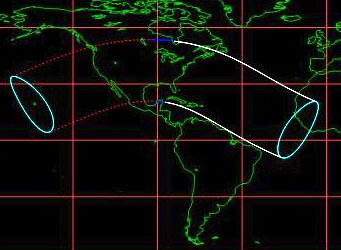
Watch a Star Wink Out on Sunday
On Sunday, March 13th, not long after sunset, a 3rd-magnitude star will disappear suddenly as it's covered by the dark edge of the Moon for parts of eastern North America.
Remembering James Elliot, 1943–2011
The co-discoverer of Uranus's rings and Pluto's atmosphere has passed away at age 67.
Best Mercury of 2011
Mercury's best evening apparition of 2011 for Northern Hemisphere observers takes place this March. And with Jupiter to point the way, Mercury is unusually easy to locate from March 12–18.

Video: Tips on Orion's 3-inch Altaz Reflector
If you've bought Orion's 3-inch SpaceProbe Altazimuth Reflector, or are thinking of doing so, take a look at this video for some tips on how to use the scope.
Game Plan for NASA's Planetary Missions
If you had billions of dollars to spend on interplanetary spacecraft, which ones would you choose and why? After an exhaustive, two-year assessment, a blue-ribbon panel turned over its top picks to NASA.
The Four-Planet Dance of 2011
Every morning in May 2011, just before sunrise, four planets combine to form fascinating and ever-changing patterns.
Kepler Finds Planets in Tight Dance
It can get pretty crowded in the solar systems discovered by NASA's Kepler observatory. In one case, four candidate worlds are locked in a tight orbital dance.
