 SUNSET:

Forced "Hibernation" for SETI Telescope
Astronomers have shut down the innovative Allen Telescope Array in northern California — a huge blow to the ongoing search for extraterrestrial intelligence.
The Allen Telescope Array: SETI's Next Big Step
SETI researchers have long had to beg time on instruments built for conventional radio astronomy. Now they've built one of their own.

Video Interview with Tony Flanders
Tony Flanders talks about his job at Sky & Telescope and the strange sequence of events that led him to work for Sky.
McDonald Observatory Dodges Wildfire
The Rock House Fire has consumed more than 300 square miles in West Texas and came within about a mile of the telescopes atop Mount Locke before abating. But the nearby town of Fort Davis wasn't so fortunate.
Royal Birth Heralded by a Supernova?
Why didn't 17th-century observers see the exploding star that created the Cas A supernova remnant? According to a controversial new hypothesis, British royal historians — but not astronomers — saw the event in 1630.
A Great Time for Space-Station Watching
For the next week, the enormous International Space Station will be slam-dunk easy to spot in the evening sky — if you know where and when to look for it.
The Fickle Lyrid Meteors
Even though moonlight will interfere with this year's Lyrid meteor shower, skywatchers should be alert for a possible outburst on the mornings of April 22nd and 23rd.
Lyrid Meteor Shower in 2013
Even though moonlight will interfere with this year's Lyrid meteor shower, skywatchers should be alert for a possible outburst on the night of April 21–22.

SkyWeek App for Android
To celebrate its 70th anniversary, Sky & Telescope is releasing a free app, S&T SkyWeek for Android.

Sky & Telescope June 2011
Sky & Telescope's June 2011 issue is now available to digital subscribers.

NEAF: Bigger and Better Than Ever
Record crowds swarmed into the Northeast Astronomy Forum last weekend to examine amateur astronomy's latest telescopes, cameras, gizmos and gear.
T Pyxidis Finally Blows Again
A very overdue recurrent nova is having its long-awaited outburst. You can follow it with binoculars right after dark.

Come to NEAF April 16-17
Make plans to attend the largest annual astronomy trade show in America: the Northeast Astronomy Forum & Telescope Show.
So-So Prospects for Comet Elenin
Discovered in December, an inbound comet will reach perihelion in September and likely be a nice sight in binoculars — but barely visible, if at all, to the unaided eye.
Kepler's Bonus: New Insights on Stars
Using observations from NASA's Kepler spacecraft, astronomers have found that about one-fourth of stars like the Sun slowly throb in ways that reveal their sizes and masses as never before.

Video Interview with Sean Walker
Sean Walker talks about his job at Sky & Telescope and how he started astrophotography.

Video Interview with Pat Coppola
Pat Coppola discusses her background in illustration and how she uses her creativity to produce a magazine that is both accurate and beautiful.
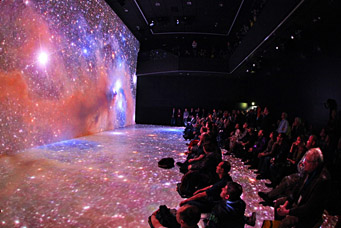
The Central European Deep Sky Imaging Conference
The Biennial CEDIC in Austria brought together hundreds of astrophotographers to share their techniques and imagery.

The "Pioneer Anomaly": Case Closed
A mysterious force has been slowing down the starbound Pioneer 10 and 11 probes for decades. A fresh analysis confirms the suspicion that it was nothing more than heat reflecting off each probe's big communication dish.
Global Astronomy Month 2011
April is Global Astronomy Month. So try to think of one little extra thing that you can do bring the glories of the night sky to the attention of the general public.
