 SUNSET:

The Great Eclipse of 2009
The century’s longest solar eclipse is about to sweep across China and the Pacific. Eclipse-chasers from around the world are counting down the hours until July 22nd.
New Candidates for Midsize Black Holes
Astronomers are hot on the trail of a new class of cosmic curiosity that's not too small, not too big, but somewhere in between — an intermediate-mass black hole.
"First Light" for New Lunar Orbiter
It's just a calibration image, but this early view from NASA's Lunar Reconnaissance Orbiter shows off the stunning potential of its mapping cameras.

Ulysses Gets a Final Farewell
Ground controllers have finally ended the 18½-year mission of a plucky probe that taught scientists virtually everything they now know about the Sun's polar regions.
Tour July's Sky — By Ear and Eye!
Saturn is sinking in the west, while Jupiter rises (late) in the east. Spot these planets and more by listening to Sky & Telescope downloadable guided tour of the night sky.
Einstein's Gravity Protects Earth
Newton's laws of gravity have about a 60% chance of wreaking havoc in the inner solar system. Einstein's corrections lower these chances to about 1%.
U.S. Lunar Probes Go Loopy
Two NASA spacecraft, launched last week, have successfully swung past the Moon. One is getting ready to study it; the other is a few months away from crashing into it.
Supernovae: Cosmic-Ray Superfactories
Now we know for sure. The cosmic-ray particles that bombard Earth from deep space originate in very exotic places: the shock waves in supernova remnants.
A "Briny Deep" Inside Enceladus?
Planetary scientists are crazy about Saturn's most active moon but can't agree on what powers the towering plumes gas and particles erupting from near its south pole. New findings, published this week, hint that the water vapor might be slowly evaporating from a salt-laced ocean in deeply buried caverns.
A Glowing Vision of the Early Universe
Astronomers shed new light on our picture of the early Universe.

U.S. Physicians Join Light-Pollution Fight
Thanks to a full-court press by a cardiologist with a passion for astronomy, the American Medical Association has taken a stance in the fight to make outdoor lighting more benign to humans — and to the stars above.
Solar Sleuths Tackle the "Quiet Sun"
New insights, announced this week, help explain why solar activity has been in the doldrums for an unexpectedly long time.
NASA Returns to the Moon
Two U.S. spacecraft are on their way to survey the Moon as never before — and to settle the debate over whether water lies frozen at the lunar poles.
Planetary Preemies?
Protoplanetary disks around three young stars turn out to have large central holes, which were presumably cleared by still-growing Jupiter-mass planets. But there’s a problem: the stars are too young.
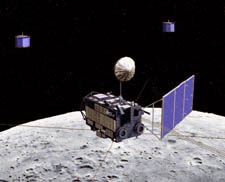
Kaguya Mission Ends with a Flash
After circling the Moon for two years, the Japanese spacecraft Kaguya slammed into the lunar surface on June 10th — an event captured by an observatory in Australia.
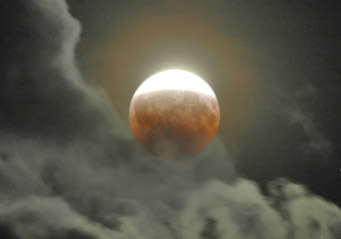
Partial Lunar Eclipse Yields Key Finding
Who knew? A lunar eclipse is not just a pretty sky show. Just-published observations show that there's real science in the umbra's dim, ruddy light.
MIT's Apollo Reunion
At the "Giant Leaps" symposium, an astronaut-studded cast recalled the glory days of human space exploration — and where we might be headed next.
New York Teen Finds Wimpiest Supernova
On November 7, 2008, 14-year-old Caroline Moore of Warwick, New York, discovered a supernova in the galaxy UGC 12682, making her the youngest person ever to find an exploding star.
Kaguya To Hit the Moon
On June 10th at 18:25 Universal Time the Japanese lunar orbiter Kaguya is ending its two years of science with a final impact experiment. Astronomers are poised to capture the crash.
Black Holes, GRBs and Masers from Pasadena
The American Astronomical Society's 214th meeting in Pasadena, California, kicked off in earnest on Monday.
