 SUNSET:

Update on Hubble Mystery Object
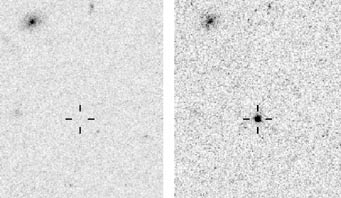
It steadily brightened, then steadily faded in a way like no known variable object. Now astronomers have a tentative distance for it: about 1.8 billion light-years. And it was full of carbon.
Watch Antares Disappear on Saturday Night
The Moon will be only about 16 hours from full when, on Saturday evening June 6th in the Americas, it will cross the 1st-magnitude red supergiant star Antares. The occultation will be visible across much of the United States and Canada, all of Central America and the Caribbean, and northern South America. Surrounding areas get a still-spectacular near miss.
Black-Hole Missing Link Found?
Astronomers are searching galaxies with no central bulges for intermediate-mass black holes — the missing links between the small black holes that result from collapsing stars and the monsters in the cores of bulge galaxies. A team reports that it's found one — or maybe three.
The Chance of Finding Aliens
Frank Drake's famous equation helps to quantify our chance of finding ETs — or at least to pose the essential questions.
A Different Kind of Acid Rain
A meteorite kept in the freezer retains its cosmic fizz
New Eclipsing Binary: It’s Spica!
Who knew? One of the brightest stars in the spring sky has a secret to tell.
Whirlpool Awash with Hints and Promise
A picture perfect Whirlpool galaxy bodes well for the scientific promise of the newly launched Herschel Space Telescope.
A Now-You-See-It, Now-You-Don’t Quasar?
Poring over sky-survey data, a Dutch schoolteacher noticed a starless blue-green blob near a faint galaxy. Astronomers think "Hanny's Voorwerp" is a cloud of intergalactic gas lit by an active galactic nucleus (AGN) hidden in the galaxy just to its north. But if so, why don't we see the AGN?

Tour June's Sky — By Ear and Eye!
You can hunt planets in the evening and early-morning sky by listening to Sky & Telescope downloadable guided tour.
Why Are We Moving Away from the Sun?
A few years ago astronomers became aware that the Sun-Earth distance, the astronomical unit, is gradually growing larger. Now a team of Japanese theorists have looked to the tides for an explanation.

Why You Missed the Supernova in M82
Radio astronomers have spotted emission from a supernova that went unnoticed when it exploded more than a year ago in the nearby galaxy M82.
At Last, an Exoplanet by Astrometry
After decades of frustration and false alarms, astronomers may finally have a new method in their toolkit for finding planets around other stars: astrometry.
Equipment: Guides & Recommendations
Additional Videos from NEAF 2009
Watch Sky & Telescope's videotaped interviews at the 2009 Northeast Astronomy Forum.
Exoplanet Mapping Tested on Earth
Researchers are developing a method to detect oceans and clouds on planets orbiting other stars. To test this idea, they aimed the telescope aboard NASA’s Deep Impact probe toward Earth, and made a rough map of our world.

RTMC Astronomy Expo 2009
The 2009 Riverside Telescope Makers' Conference Astronomy Expo enjoyed beautiful mountain weather and an abundance of enthusiasm.
How (every single one of) Your Ancestors Survived
Times were tough, but life may have survived the worst bombardment in Earth's history.
How Did the Brown Dwarf Get Its Spots?
A binary pair of brown dwarfs, measured with high precision, seems to defy models of star formation — unless one of them is covered with starspots.
From White Dwarfs to the White House
Astrophysicist Donald Lamb shares his experiences as part of Barack Obama's science team during the presidential race.
Space Shuttle Crew Bids Hubble Farewell
The Hubble repair crew carried out their fifth and final spacewalk on Monday, May 18th. On Wednesday they answered reporters' questions about what the job was like.
Spitzer Warms, Its Discoveries May Cool
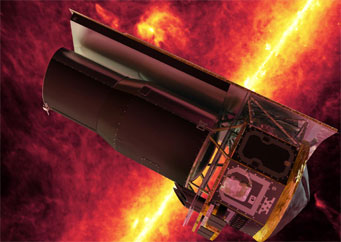
NASA’s infrared Spitzer Space Telescope finally ran out of its liquid helium coolant and entered its “warm mode” last Friday, May 15th.
