 SUNSET:


(Drops of) Water on Mars?
Last year, as a camera aboard the Phoenix lander looked on, drops of supersalty water grew, merged, and even dripped on one of the spacecraft's landing legs.

Taking a Right Turn in Albuquerque
Last week David Levy visited Georgia O'Keefe Elementary School in Albuquerque, New Mexico, to help inspire young students to ask questions and connect with the night sky.
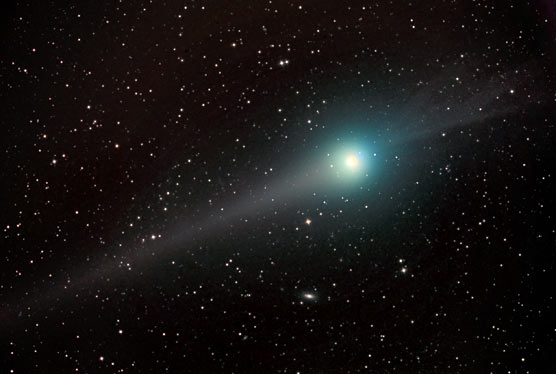
Comet Lulin on the Way Out
Now departing from both Earth and Sun, Comet Lulin is 7th magnitude and fading this week. But it's high in the evening sky, and there's no moonlight problem until around March 29th.
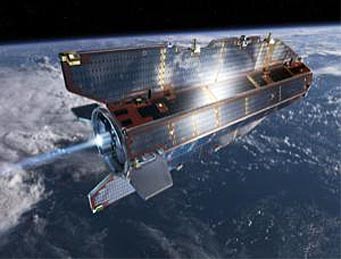
Probing Earth's Gravity in Best Detail Yet
Measure anything really, really accurately, and there's no telling what new things doing this will reveal. Europe's GOCE satellite will map Earth's gravitational field to determine, better than ever before, deep ocean currents. And perhaps much more.
Orbiting Pulsars @ Home
Einstein@Home, a computer screensaver that searches for space-time ripples, will now hunt for pulsars that whip around other stars or black holes. These could put general relativity to its toughest test yet.
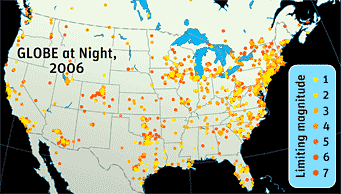
Count the Stars, Help Save the Night
The GLOBE at Night star count, now in its fourth year, takes place from March 16th through the 28th in 2009.
Venus at its 8-Year Best
Venus spent the last nine months as the Evening Star, but it's now faintly visible to the unaided eye just before sunrise — and possibly also just before sunset on the same day. For telescopic observers, this is the most exciting possible time to view Venus during broad daylight. But when doing this, be super-careful not to look at the Sun and blind yourself!
Sculpting the Asteroid Belt
New simulations show that when the giant planets shifted their orbits 4 billion years ago, the asteroid belt became a wild and crazy place.
The Lost Siblings of the Sun
The Sun and solar system formed 4.6 billion years ago amid a rich cluster of other newborn stars. Where are they now?
End of the Line for "Skyline"
After 23 years of providing weekly updates to amateur astronomers, S&T's telephone news service has come to an end. Chalk up a victory for the internet.
Super Sendoff for Planet-Hunting Kepler
After a dramatic and flawless liftoff, NASA's newest space observatory is getting ready to observe a tract of Milky May with a single-minded purpose: find as many alien worlds as it can.
One Dozen Deceptions
Are the fundamental parameters of our universe are mere coincidences or the products of deep natural laws?
From Venus to Gaia… and back down to Earth
One of the many big differences between Earth and Venus that could have a bearing on habitability is the absence of a strong magnetic field on Venus. So is it just dumb luck that we have a magnetic field and Venus doesn’t? Or is something deeper going on here?
A Comet Goes to the Swift
NASA's Swift spacecraft reveals new aspects of Comet Lulin when viewing it in X-rays and the ultraviolet.
Saturn's Newest Moon is a Ringer
A tiny moonlet discovered around Saturn is the likely source of the planet's G ring.
Enjoy the Rest Flandrau, We’ll Miss You
After 34 years, Tucon's Flandrau Planetarium will close its doors, a victim of the current world recession.

A Worldwide Astronomy Marathon
If you have a telescope, mark April 2–5, 2009, on your calendar. The world is coming your way. An unprecedented string of public skywatching events will be packed into this brief period, all designed to engage people and bring them out for a worldwide star party.

Longest-Period Transiting Exoplanet Yet
Valentine's Day this year brought a big surprise from 190 light-years away: the unlikely transit of an unusual planet.

Chinese Craft Whacks the Moon
Chang'e 1, a spacecraft that's been in lunar orbit for 16 months, has been sent crashing into the Moon by its Chinese handlers. The impact site was on the near side, but it's unclear whether anyone on Earth saw it — or was even looking for it.

Space Rock 2009 DD45 Buzzes Earth
Roughly 100 feet across, the tiny asteroid designated 2009 DD45 is about to get its 15 minutes of fame.
