 SUNSET:

Researchers Discuss Frozen Worlds
A hot topic at December's AGU meeting was the various geological processes on frigid bodies in the solar system.
Obamastronomy
Imagine if America's leaders had to have an astronomical background? Sky & Telescope contributing editor David H. Levy has been thinking about that.
Our Roving Martian Ambassadors
NASA's long-lived rovers, Spirit and Opportunity, have survived five (Earth) years on Mars, far exceeding their planned 90-day missions. How much longer can they last?
Big Developments in Chinese Astronomy
The world's most efficient spectroscopy survey is now in shakedown phase, and construction has begun on the world's largest radio telescope.

The Year of Astronomy Begins
The International Year of Astronomy kicked off in Paris with pomp and circumstance.
A Night of Service
Community service can mean bringing the cosmos down to Earth, as Sky & Telescope contributing editor David H. Levy explains while "On the Road."
A Secret Sneak Peek and Fun for Friday
Psst. Microsoft's virtual observatory," the WorldWide Telescope, is coming to your Web browser.
The Curious Case of Martian Methane
Mars, it seems, is not quite dead. A team of observers has found methane in the Red Planet's atmosphere. This finding proves either that Mars has (or once had) life — or that the planet's interior occasionally burps.
A Crescent Voyage
An amateur astronomer in New Orleans has built an observatory intended to withstand whatever Gulf weather may bring.
New Cosmic Background Radiation Found
Astronomers have found something in the very distant universe filling the sky with a radio roar at frequencies they did not expect. No one knows what it is.

Exoplanets Dance in the Same Plane
Three planets orbit the red dwarf star Gliese 876, and at least two of them do so in nearly the same plane, according to an ingenious new study of their interaction.
Surprising Trove of Gamma-Ray Pulsars
Pulsars flash in radio, but some of them flash a lot more powerfully in gamma rays, due to different processes happening in different places around them.
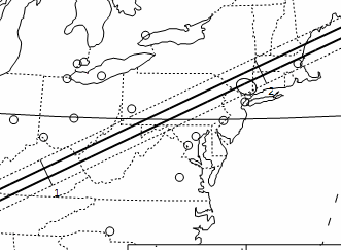
Asteroid to Occult Star on Morning of Friday, Jan. 9
On the morning of Friday, Jan. 9, from 10:55 to 11:06 UT, asteroid 1963 Bezovec occults the 8.3-magnitude star HIP 64220 in a narrow path from Baja California through Texas to New England and Nova Scotia.
Black Holes First, Galaxies Second
Back when the universe was young, a new study finds, galaxies grew their central black holes faster than the holes' starry surroundings. But how?
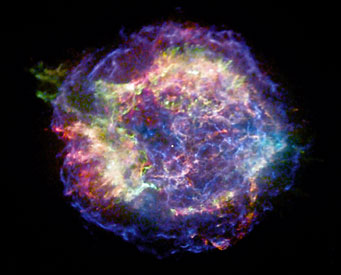
Fly Through a Supernova Remnant in 3-D
Astronomers have figured out the three-dimensional structure of Cassiopeia A, an expanding supernova remnant. From this, it looks like the star blew up in two parts.
The Mystery of the Missing Brown Dwarfs
Fewer of these dim, glowing coals exist than astronomers once expected. And in particular, they shy away from associating with normal stars.
Milky Way Doubles Its Mass
Our Milky Way Galaxy rotates 15 percent faster and is twice as massive as formerly believed — making it an equal match for the Great Andromeda Galaxy rather than its little brother.
Tour January's Sky! | January 2nd, 2009
What's that brilliant beacon in the southwestern evening sky — a supernova? a UFO? Nope, it's Venus, this winter's dazzling "evening star." Learn more about Venus and other celestial showpieces by downloading our monthly guide to the night sky!
