 SUNSET:

Betelgeuse is Making Waves
The famously red supergiant star that marks Orion's shoulder is creating an enormous shock wave as it plows through the interstellar medium. New infrared views from a Japanese space observatory called Akari show what's going on with unprecedented clarity.
Chandrayaan 1 is a Hit
India's first deep-space mission has chalked up another success during the first days of its two-year mission: slamming an instrumented probe into the lunar surface.
Sleuthing Reveals Mars's Watery Past
New findings announced this week suggest that the Red Planet may have had an ancient ocean after all and that buried glaciers of ice have turned up in surprising places.
Another Direct Exoplanet Image
A tiny, glowing dot apparently orbits just inside the inner edge of the dusty debris disk surrounding the star Beta Pictoris, 64 light-years away.
New Eyes on the Cosmic-Ray Sky
High on the Argentinian pampa, 1,600 water-filled "eyes" await the arrival of the most powerful high-energy particles in the universe.
Catch Venus with a "Moon"
On Monday, November 17th, Venus passes very close to the 2.8-magnitude star Lambda Sagittarii (Kaus Borealis). Through a telescope, Lambda appears next to Venus very much like one of the Galilean Moons next to Jupiter.
First True Exoplanet Images…Probably
Although questions remain, it appears that astronomers have at last taken images of actual planets orbiting other stars.
Phoenix Chills Out, Mission Ends
As the Sun set slowly over the Martian polar plain, a dust storm robbed NASA's plucky lander of the sunlight it needed to operate.The craft's most recent and presumably final communication came on November 2nd.
Chandrayaan 1 in Lunar Orbit
So far, so good for India's first attempt to explore the Moon. Chandrayaan 1 is safely in lunar orbit after a two-week series of rocket burns.
Telescope Mirrors from Antifreeze?
Buy a jug of ethylene glycol at the auto-supply store. Add iron-oxide powder and shake vigorously. Pour into a shallow pan, spray on a pinch of powdered silver, and turn on a magnetic field. Voilà! — instant mirror! Can it really be that easy? Not yet, but a promising new technology suggests that, someday, the answer might be "yes."

Tour November's Sky! | November 6th, 2008
With the return of standard time in the Northern Hemisphere, evenings arrive much sooner than they did just a few weeks ago. That makes it a snap to get in some quick stargazing before dinnertime.
Amazing Close-ups of Enceladus
Ever wonder what it'd be like to view the icy terrain of Saturn's enigmatically active moon as if you were just 12 miles above it? Now you can, thanks to Cassini's close brush with Enceladus on Halloween.
Hubble Returns to Work
After a month-long hiatus caused by an electronics failure, the Hubble Space Telescope has resumed its observations of the cosmos. But a final house call by Space Shuttle astronauts will have to wait until NASA engineers can round up some spare parts.
Mercury Gets a Second Look
When NASA's Messenger spacecraft flew past the innermost planet on October 6th, it mapped another 30% of the surface never before viewed by spacecraft and gave scientists tantalizing hints of what Mercury is all about.
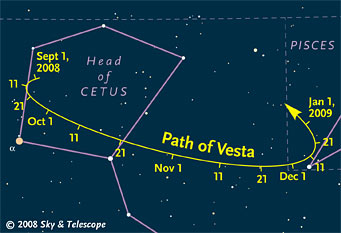
View Vesta at Its Brightest
Vesta, the brightest asteroid, is easy to observe during the last three months of 2008.

India's First Moon Shot
There's a new player in deep-space exploration, as India launches a highly instrumented spacecraft destined for lunar orbit.

Light Pollution in the Spotlight
A flurry of articles, editorials, and even Congressional briefings has provided much-needed momentum for the fight against astronomers' Public Enemy #1.
Count the Stars to Save the Sky
Schoolchildren, families, and citizen scientists around the world will gaze skyward after dark from October 20th to November 3rd. The Great World Wide Star Count, now in its second year, helps scientists map light pollution globally while educating participants about the stars.
NASA Satellite Spots New Type of Pulsar
The Fermi Gamma-ray Space Telescope has made its first major discovery.
Speaking of the VLT
Next month, James Bond heads to Chile's Very Large Telescope. That can't be good.
