 SUNSET:

Possible Fireball Outburst Sept 9-10
An unexpected meteor burst was detected on the night of September 8-9. Bill Cooke of the Marshall Space Flight Center is urging meteor watchers to see if the activity continues on the night of September 9-10.
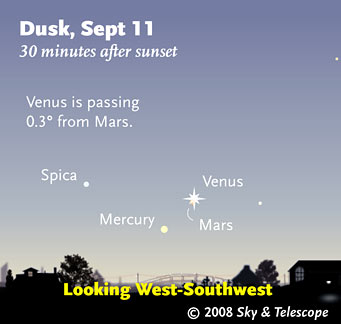
Venus Meets Mars
From September 9th through the 15th, Mars and Venus are closely paired low in the west-southwest just after sunset — fitting together easily in the same medium-power telescopic field for most of that time.
Rosetta's "Jewel in the Sky"
European scientists are excitedly poring over results from the Rosetta spacecraft's close flyby of asteroid Steins, even though an unexpected camera glitch cost them the best views of its cratered surface.
Phoenix Surpasses 90-day Milestone
NASA's newest lander has now been scratching, digging, sniffing, baking and tasting samples of Martian polar terrain for more than three months. How long can it survive in the fast-approaching winter — and how much more can it learn?
Perseids Hitting the Moon
Amateurs have helped lead the way in recording the flashes of meteoroids hitting the Moon's night side.
The Oregon Star Party
Located 40 miles from the nearest town, the Oregon Star Party is one of the premier dark-sky astronomy gatherings in the United States.
Tour September's Sky! | September 1st, 2008
Summer's over, and cooler nights offer your eyes a rich tapestry of stars and planets for casual skygazing.
Milky Way's Central Monster Measured
Astronomers have refined the mass of the Milky Way's central black hole by tracking the orbits of several stars whizzing around it. The job hasn't been easy.
NASA Space Observatory Gets New Name
The best-ever gamma-ray satellite is living up to expectations and NASA has just given it a new name.
Exoplanet Search Strategies
What will be the best ways to discover extrasolar planets in the coming years? The best scientific payoffs demand smart planning now.
Star-Studded Black Holes
A pair of Scottish astronomers has solved the mystery of how young stars can form improbably close to the supermassive black hole at the center of our galaxy.

S&T Astronomy Day Awards for 2008
The Astronomical League has announced the winners of this year's S&T Astronomy Day Award — and this year there's a tie for the top spot!
The Great Planet Debate
A controversial vote to define "planet" two years ago created more confusion than clarity. So scientists, educators, and curious hangers-on have gathered to get a better handle on what to call the menagerie of worlds that inhabit our solar system and those of other stars.
New Enceladus Closeups Now Arriving
The Cassini spacecraft is returning the data from Monday's close flyby of icy Enceladus, and NASA is putting up the first raw images.
The Astronomical League's Rising Stars
At its recent national convention in Des Moines, Iowa, the Astronomical League continued its tradition of recognizing the talents and enthusiasm of exceptional teenage stargazers.
Venus Returns
Earth's sister planet has emerged from behind the Sun for a low evening apparition. See how early you can spot it in the twilight.
Our "Goldilocks" Solar System
Think our planetary family is normal? Think again. It turns out that the Sun and its retinue formed when the interstellar mix was just right — not too much gas, not too little, and stirred gently for just the right amount of time.
Lensed Light Used to Weigh Dark Matter
Astronomers use a novel method of weighing distant galaxies to measure their masses and find that there's more matter than the galaxies' light can easily explain.
Dodge the Moon, See More Perseids
Mark your calendar for a meteor watch on the morning of Tuesday, August 12th.
Dark Energy's Early Fingerprints
Studying the effect of galaxy clusters on the background radiation from the early universe, University of Hawaii astronomers have added to the pile of evidence for dark energy.
